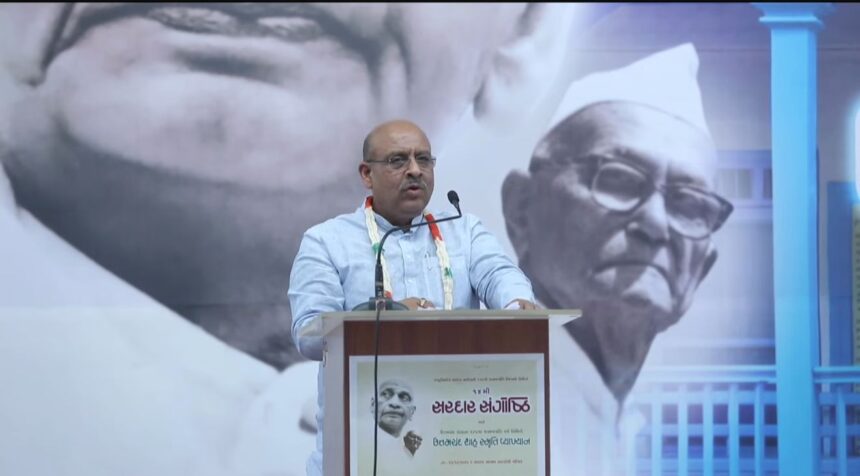
Delhi Assembly Speaker Vijender Gupta on Sunday underlined the historic and moral significance of Bardoli in India’s freedom struggle while addressing the 14th Sardar Seminar and Uttamchand Shah Memorial Lecture at Swaraj Ashram in Bardoli, Gujarat. The event was organised to commemorate the 150th birth anniversary of Sardar Vallabhbhai Patel and the 125th birth anniversary of Uttamchand Shah.

Speaking as the keynote speaker, Gupta said Bardoli was not merely a chapter in history but the moral conscience of India’s freedom movement, where the principles of non-violence, social reform and collective courage were tested together for the first time. He noted that Bardoli emerged as a centre of disciplined and principled mass resistance well before the famous Bardoli Satyagraha of 1928.
The programme was attended by several distinguished personalities, including Lokbharati Rural Innovation University Vice-Chancellor and noted author Vishal Bhadani, thinker, writer and senior administrator Vasant Gadvi, and spiritual leader Morari Bapu, whose presence and blessings added a spiritual dimension to the event. Delhi Assembly members Ashok Goyal, Gajendra Singh Yadav and Sandeep Sahrawat were also present, along with Swaraj Ashram Trust secretary Niranjanaben Kalarthi.
Paying tribute to Vithalbhai Patel, Gupta recalled Bardoli’s deep-rooted association with the national movement. He referred to January 29, 1922, when a historic public meeting was held in Bardoli in the presence of Mahatma Gandhi and under the chairmanship of Vithalbhai Patel. Thousands of people dressed in khadi participated in the gathering, which Gupta described as an early example of organised, ethical and disciplined resistance.

Gupta said the resolutions adopted in Bardoli in 1922 reflected extraordinary moral courage. He pointed out that the people voluntarily accepted the strict conditions laid down by Mahatma Gandhi, including the complete eradication of untouchability, equal access to public resources and unwavering commitment to non-violence. As a result, Bardoli evolved into a laboratory of social reform and political resistance.
He noted that although the Non-Cooperation Movement was suspended in February 1922 following the Chauri Chaura incident, Bardoli had already established itself as a centre of principled and non-violent mass mobilisation. This tradition reached its peak during the Bardoli Satyagraha of 1928, when farmers united against the unjust increase in land revenue imposed by the British administration.
Under the leadership of Vallabhbhai Patel, people of Bardoli rose above caste and class divisions and launched a peaceful yet determined movement. Gupta said the sustained struggle forced the British government to withdraw the revenue hike in August 1928. Following this historic victory, the people of Bardoli conferred the title “Sardar” on Vallabhbhai Patel, a moment that became a milestone in India’s freedom struggle.

Remembering Vithalbhai Patel, Gupta described him as a visionary nationalist and a pioneer of India’s parliamentary democratic tradition. He said Vithalbhai Patel played a crucial role in mobilising public opinion in Bardoli during the 1920s and later went on to become the first elected Indian Speaker of the Central Legislative Assembly in 1925, giving Indian leadership a distinct identity within colonial legislative institutions.
Gupta also referred to the All India Speakers’ Conference held at the Delhi Assembly in 2025 to mark the completion of 100 years since Vithalbhai Patel became the first elected Indian Speaker of the Central Legislative Assembly. He said the conference, attended by Speakers and Deputy Speakers from across the country, emerged as a significant milestone reflecting the strength and continuity of India’s parliamentary traditions.
During the event, Gupta shared details about a special coffee table book titled “Centenary Journey: Vithalbhai Patel”, published by the Delhi Assembly. He said the publication documents India’s parliamentary journey from 1925 to 2025 and serves as an important historical record, featuring rare archival photographs, documents and defining moments in the evolution of Indian democracy.

He added that the book also includes detailed documentation of the 2025 All India Speakers’ Conference, making it a valuable contribution to contemporary parliamentary history and a tribute to the enduring legacy of Vithalbhai Patel.
Concluding his address, Gupta said the legacy of Bardoli—rooted in non-violence, social equality, unity and sacrifice—continues to inspire India’s democratic institutions and national consciousness, remaining deeply relevant even in contemporary times.