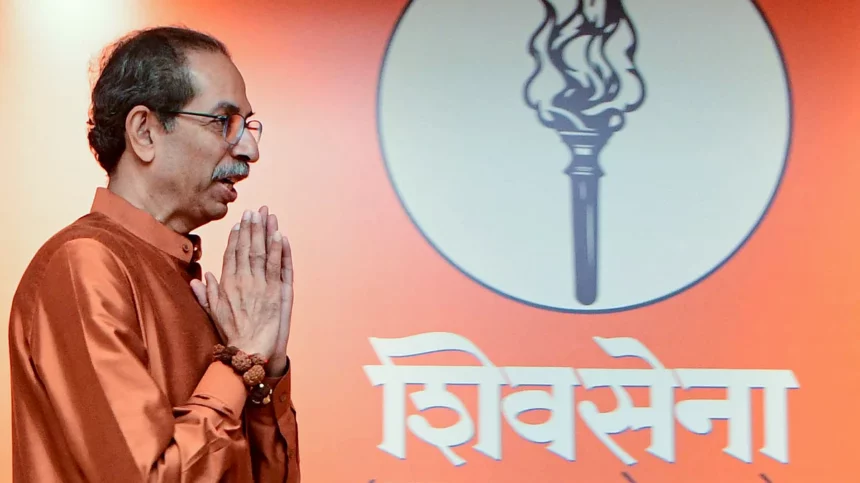
The suspense over who will become the next mayor of Mumbai has intensified following the results of the Brihanmumbai Municipal Corporation elections, with political equations remaining fluid despite clear numerical gaps. Shiv Sena (UBT) chief Uddhav Thackeray’s party has secured only 65 seats in the 227-member civic body, far short of the 114 seats required for a simple majority. Yet, Thackeray has publicly expressed confidence that the mayor’s post could still go to his party, a claim that rests on two politically significant scenarios that could reshape the final outcome. As parties await the mayoral reservation lottery scheduled for January 22 and backroom negotiations continue, the battle for control of India’s richest municipal corporation is far from settled.
Reservation Lottery Could Reshape the Mayor’s Contest
One of the most crucial factors that could alter the mayoral race is the reservation lottery for the post of mayor, which will be held on January 22 at the Council Chamber of the state ministry. The lottery will decide whether the mayor’s post is reserved for Scheduled Castes, Scheduled Tribes, women, Other Backward Classes, or remains in the open category, in line with Maharashtra’s rotational reservation policy for municipal corporations. Only after the reservation is announced can political parties formally project candidates for the coveted post.
If the mayor’s post in Mumbai is reserved for the Scheduled Tribe category, the balance of power could shift dramatically in favour of the Shiv Sena (UBT), despite its relatively modest tally. The Bharatiya Janata Party, which has emerged as the single largest party with 89 seats, and its ally Shiv Sena (Shinde), which has won 29 seats, do not have a single newly elected corporator belonging to the Scheduled Tribe category. In contrast, the Uddhav Thackeray-led Shiv Sena has two corporators from the ST category, Jitendra Walvi from ward number 53 and Priyadarshani Thakare from ward number 121.
Under reservation rules, if the mayor’s post is earmarked for a specific category such as ST or SC, only elected corporators from that category are eligible to contest, irrespective of the overall strength of their party in the House. This means that even without a numerical majority, the Thackeray faction could legitimately claim the mayor’s post if the reservation lottery favours the ST category. Such a scenario would automatically rule out the BJP and the Shinde-led Shiv Sena from staking a claim, as neither has eligible corporators under that reservation.
This possibility explains the intense focus on the reservation lottery, which has become a high-stakes political event in itself. For the Thackeray camp, an ST reservation would open a direct route to the mayor’s office, allowing the party to retain symbolic and administrative control over Mumbai despite being outnumbered. For the Mahayuti alliance, such an outcome would be a major setback, as it would deprive the alliance of the top civic post even after securing a combined strength of 118 seats.
However, this scenario is not without uncertainties. There is speculation that the rotational reservation cycle could be reset, potentially starting again from the open category. If that happens, the advantage that the Thackeray group hopes to gain from an ST reservation would evaporate instantly, bringing the contest back to sheer numbers and alliances. Adding another layer of complexity is the inclusion of nominated corporators. For the first time, 10 nominated members, increased from five earlier, will also be part of the House, a development that could subtly influence voting dynamics during the mayoral election.
The presence of nominated corporators introduces an element of unpredictability, especially if voting margins become tight or if strategic abstentions come into play. While nominated members traditionally align with the ruling party or alliance, their role becomes significant in a House where political arithmetic is delicately balanced. As a result, even the reservation-based route to the mayor’s post, while legally sound, is dependent on multiple moving parts that will only become clear once formal announcements are made.
Behind-the-Scenes Political Understanding Could Alter Majority Mathematics
The second scenario that could potentially help Uddhav Thackeray’s camp secure the Mumbai mayor’s post is rooted not in formal numbers or reservations, but in political strategy and tacit understandings between rival camps. The Mahayuti alliance, comprising the BJP and the Eknath Shinde-led Shiv Sena, together commands 118 seats, comfortably crossing the halfway mark of 114. On paper, this gives the alliance a clear advantage in staking claim to the mayor’s post. Yet, internal negotiations and competing ambitions within the alliance have complicated matters.
The BJP, with 89 seats, is the dominant partner in the Mahayuti, but it still needs the support of Shinde’s Shiv Sena to form a stable majority. Shinde, on his part, has made no secret of his desire to see his faction secure the mayor’s post, at least for a portion of the five-year term. He has argued that the post should go to his party, citing the significance of Bal Thackeray’s birth centenary year and the symbolic importance of Shiv Sena’s legacy in Mumbai’s civic politics. To strengthen his bargaining position, Shinde has reportedly kept his corporators together in a hotel and has taken the matter to Delhi for discussions with the BJP leadership.
Amid this tussle within the Mahayuti, political circles are abuzz with speculation about a possible behind-the-scenes understanding between the Thackeray-led Shiv Sena and the BJP. According to this line of thinking, if the BJP decides to go solo for the mayoral election, the Thackeray group could extend indirect support by staying away from the voting process. If Shiv Sena (UBT) corporators remain absent during the mayoral election, the effective strength of the House would come down significantly, lowering the majority mark from 114 to around 82.
In such a reduced House, the BJP, with its 89 corporators, would be in a position to elect a mayor on its own, without needing the formal support of either the Shinde faction or the Thackeray camp. This would allow the BJP to claim the mayor’s post while avoiding internal friction within the Mahayuti and sidelining Shinde’s demand for the top civic position. In return, there is speculation that the BJP could accommodate the Thackeray group’s interests in other ways, including backing a consensus candidate with roots in the undivided Shiv Sena.
There is also talk that under such an arrangement, an old Shiv Sainik associated with the broader Sena legacy could be considered for the mayor’s post, offering a face-saving formula for all sides involved. While no official confirmation of such an understanding exists, the very possibility highlights how political manoeuvring and strategic absences can alter outcomes even when numerical strength appears decisive.
For Uddhav Thackeray, this scenario offers a different kind of leverage. Even without winning the mayor’s post outright, his party’s ability to influence the outcome through tactical decisions underscores its continued relevance in Mumbai’s civic politics. It also places him in a position to negotiate from a place of strategic importance, despite trailing in seat count. For the BJP, the option of going solo with tacit support could help consolidate its image as the dominant force in Mumbai, while keeping alliance complications at bay.
As these scenarios play out, the race for the BMC mayor’s post has become a reflection of Maharashtra’s broader political landscape, where alliances are fluid, numbers are negotiable, and outcomes often depend as much on strategy as on electoral arithmetic. With the reservation lottery and potential political understandings both in play, the question of who will occupy Mumbai’s top civic office remains open, keeping the city and the state’s political observers on edge.