The gandhinagar outbreak reveals deep flaws in urban water governance, infrastructure oversight, and emergency public health response.
A severe waterborne epidemic unfolding across large parts of Gandhinagar has pushed public health systems into crisis mode and raised troubling questions about urban infrastructure, accountability, and governance. Over the past several days, contaminated drinking water supplied to multiple residential sectors has led to a surge in typhoid and other waterborne diseases, leaving more than a hundred children in critical condition. While authorities insist that water leaving the treatment plant is safe, mounting evidence suggests that sewage contamination within damaged pipelines is allowing polluted water to enter households, transforming a basic civic service into a widespread public health threat.
Contaminated water supply and breakdown in distribution infrastructure
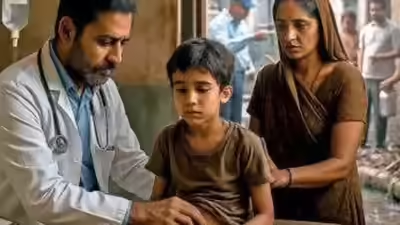
The outbreak has primarily affected residential areas spanning sectors 14 to 30 of gandhinagar, with sectors 24, 28, and adivada emerging as the worst-hit zones. Hospitals in the city, particularly the civil hospital, have reported an alarming influx of patients suffering from high-grade fever, vomiting, severe abdominal pain, and extreme weakness. Of particular concern is the impact on children. A total of 104 children between the ages of one and sixteen are currently admitted in critical condition, forcing hospital authorities to open additional emergency wards to cope with the patient load.
At the centre of the controversy is the Charedi Water Distribution Centre, which supplies nearly 65 million litres of water daily to the affected sectors. A ground investigation revealed a disturbing contradiction between official claims and on-ground realities. While officials maintain that the water purification process at the charedi facility is technologically advanced and meets safety standards, the sheer scale of illness points to systemic failure beyond the treatment plant.
Health officials and engineers now acknowledge that the contamination is most likely occurring during distribution rather than at the source. Experts explain that even fully treated water can become hazardous if pipelines are damaged, leaking, or running parallel to sewage lines with structural faults. In such scenarios, negative pressure in water pipelines can draw in sewage, particularly during low supply hours, leading to widespread contamination across residential networks.
The capital project department supplies water during fixed morning hours, while certain older sectors receive round-the-clock supply. This uneven distribution schedule is believed to have exacerbated the problem, as fluctuating pressure increases the risk of sewage ingress through cracks and leaks. Residents have alleged that sewage water has been mixing with drinking water for months, but repeated complaints failed to trigger timely corrective action.
Health crisis, administrative response, and rising public anger
The scale of the health emergency is reflected in hospital data. Over the last three days alone, more than 50 percent of widal tests conducted on admitted patients have returned positive, confirming typhoid infection. Medical authorities have also detected typhoid bacteria in blood culture reports, underscoring the seriousness of the outbreak. In december, 685 widal tests were conducted at the civil hospital, with 130 testing positive, but the sharp spike in recent days has alarmed doctors and epidemiologists.
Dr Mitaben Parikh, superintendent of gandhinagar civil hospital, confirmed a nearly 50 percent rise in positive cases within a matter of days. Adults have not been spared either, with several serious cases admitted through the medicine outpatient department. The concentration of cases in specific sectors has strengthened suspicions that the outbreak is directly linked to the municipal water supply rather than isolated hygiene issues.
In response, the health department has ordered enhanced chlorination at the charedi centre and intensified water sampling across the affected areas. Super chlorination is currently being carried out throughout the old sectors, and authorities claim that ten major and minor pipeline leakages have been identified and repaired. However, officials concede that unless the entire distribution network is thoroughly inspected and faulty pipelines replaced, containment efforts may only provide temporary relief.
To manage the outbreak, forty health teams comprising more than eighty personnel, including female health workers, multipurpose health workers, and asha workers, have been deployed. These teams have surveyed nearly 10,000 households, covering a population of over 38,000 people. Residents have been issued advisories to boil drinking water for at least twenty minutes, use boiled water for cooking and brushing teeth, avoid street food, and seek immediate medical attention if symptoms persist.
Despite these measures, public anger continues to mount. The Gandhinagar City Residents Federation has sharply criticised the administration, accusing it of negligence and failure to act on repeated warnings. Its president, Keshari Singh Bihola, said that local dispensaries and hospitals are overwhelmed, while claims of uninterrupted water supply under the smart city initiative stand exposed by the reality of unsafe drinking water.
Residents allege that crores of rupees were spent on laying new pipelines under urban renewal and smart city projects, yet the infrastructure has proven fragile, with lines breaking even during trial runs. According to them, substandard materials and poor workmanship by contractor agencies have compromised both water and sewer pipelines, creating conditions ripe for contamination. Written complaints submitted to senior authorities over time, including to the chief minister’s office, allegedly went unaddressed, deepening public frustration.
The crisis has drawn the attention of Amit Shah, who is also the member of parliament from gandhinagar. He reviewed the situation with state home minister Harsh Sanghavi, along with district and municipal officials. Shah directed authorities to act on a war footing, ensure expert medical treatment for all affected children and citizens, provide food facilities for patients and their families at the civil hospital, and immediately repair damaged pipelines to prevent further spread.
While emergency measures are now underway, experts warn that the gandhinagar outbreak reflects a deeper national challenge. According to data from sustainability and public health studies, nearly seventy percent of india’s drinking water is contaminated, and the country ranks near the bottom globally in water quality. Contaminated water is estimated to cause around 200,000 deaths annually, with millions more falling ill each year due to preventable waterborne diseases such as diarrhoea and typhoid.
The crisis has also revived debate on access to household water purification. Amid rising health risks, there are indications that the gst council may consider reducing the tax on water purifiers, recognising them as essential items. Recent tragedies elsewhere, including deaths linked to contaminated water in indore, have further underscored the urgency of strengthening urban water safety frameworks.
In gandhinagar, however, the immediate focus remains on saving lives and restoring safe water supply. Yet the outbreak has already left a lasting mark, exposing gaps in infrastructure oversight, accountability of contractors, and responsiveness of civic authorities. As residents warn of mass public agitation if responsible agencies are not punished, the episode stands as a stark reminder that access to clean drinking water is not merely a development promise, but a fundamental public health necessity that demands constant vigilance.