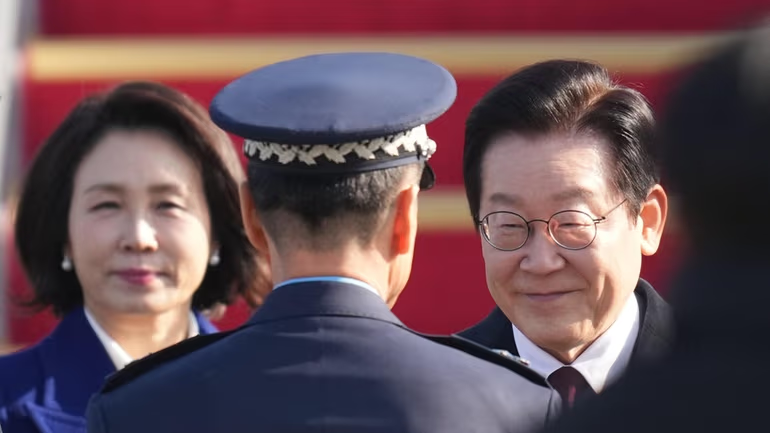
Lee jae myung’s beijing visit highlights south korea’s effort to rebalance diplomacy amid regional tensions and economic interdependence.
South korean president Lee Jae Myung is set to meet chinese leader Xi Jinping in a high-profile diplomatic engagement aimed at resetting ties between seoul and beijing after several years of strain. The meeting, scheduled for monday, comes at a delicate moment in east asian geopolitics, marked by heightened tensions over taiwan, frictions between china and japan, and the complex strategic positioning of us allies in the region. For lee, the visit represents both a symbolic and substantive attempt to stabilise relations with south korea’s largest trading partner while safeguarding national security interests and diplomatic autonomy.
Strategic timing and regional security calculations
Lee’s decision to visit beijing now is widely seen as a calculated move shaped by shifting regional dynamics. China and japan have recently been locked in a diplomatic row over beijing’s claims on self-governed taiwan, an issue that has ripple effects across the region. The situation became more charged after japanese prime minister Sanae Takaichi suggested in parliament that tokyo could consider deploying its self-defence forces in the event of a chinese attack on taiwan. Beijing responded with sharp rhetoric, further escalating tensions.
For south korea, which maintains a security alliance with the united states while relying heavily on china for trade, the situation presents a familiar but increasingly difficult balancing act. Seoul supports the us-led regional security framework and has expressed concern about stability in the taiwan strait, yet it also seeks to avoid antagonising beijing. Against this backdrop, lee’s beijing visit signals an attempt to keep diplomatic channels open and reduce the risk of south korea being drawn into escalating great-power rivalries.
Experts note that one of lee’s key objectives is to seek assurances that china will not weaponise economic ties in response to political disagreements. South korea’s economy is deeply intertwined with china’s, from manufacturing supply chains to exports of technology and consumer goods. Past episodes, including informal chinese restrictions on korean businesses and cultural exports, have underscored the vulnerability inherent in this dependence. Addressing these concerns directly with xi allows lee to test whether a more stable and predictable relationship is possible.
The meeting with xi will be lee’s second summit with the chinese leader since november, when xi visited south korea. This continuity suggests an effort on both sides to prevent further deterioration in ties. Lee is also expected to raise issues related to regional security architecture, including the korean peninsula and broader east asian stability, seeking to position south korea as a constructive but independent regional actor rather than a passive bystander.
Economic ties, cultural friction, and diplomatic balancing
Beyond security concerns, economic and cultural issues are central to the reset lee hopes to achieve. China remains south korea’s largest trading partner, and any sustained disruption in economic relations would have significant domestic consequences. In recent years, however, ties have been strained by political disagreements and what seoul sees as beijing’s use of informal economic pressure. One prominent example is china’s unofficial ban on korean pop culture, which has limited the presence of k-pop, korean dramas, and entertainment companies in the chinese market.
Lee’s visit aims to address these grievances as part of a broader normalisation effort. Speaking to korean residents in beijing, he described the trip as a “new starting point” to fill gaps in bilateral relations, restore them to normal, and upgrade them to a higher level. Such language reflects an aspiration not merely to repair damage but to redefine the relationship in a way that acknowledges mutual sensitivities and interdependence.
The symbolism of the visit is reinforced by its rarity. This is the first trip to china by a south korean leader since 2019, underscoring how far relations had cooled under lee’s predecessor, impeached former president yoon suk yeol, whose administration adopted a more openly critical stance toward beijing. Lee’s approach marks a shift toward pragmatic engagement, even as he maintains alignment with us strategic priorities.
During his stay, lee is expected to attend a banquet hosted by xi, followed by meetings with china’s premier Li Qiang and parliament chairman Zhao Leji. These engagements indicate a comprehensive diplomatic outreach that goes beyond a single bilateral meeting, allowing discussions across political, economic, and legislative dimensions of the chinese system. After beijing, lee is scheduled to travel to shanghai, where he will hold a memorial service for activists who fought for korea’s independence from japan, a gesture that resonates with china’s own historical narrative.
Analysts suggest that xi’s willingness to engage so readily with lee reflects china’s own strategic calculations. With relations strained with japan and competition intensifying with the united states, beijing has an interest in preventing south korea from drifting further into a firmly anti-china alignment. By invoking shared historical experiences, particularly resistance against japanese imperialism in the twentieth century, china seeks to frame the relationship in emotional as well as strategic terms.
At the same time, seoul appears determined not to choose sides in a zero-sum fashion. Lee is reportedly planning to visit japan later this month to meet prime minister takaichi, reinforcing the message that south korea intends to strengthen ties with both neighbours rather than pivot exclusively toward one. South korea’s national security director has also reiterated respect for the one china policy, a diplomatic acknowledgement that beijing is the sole legitimate government of china, even as seoul maintains unofficial relations with taiwan.
This dual-track diplomacy highlights the complexity of south korea’s position. As a middle power with global economic reach and significant security commitments, it must constantly navigate competing pressures. Lee’s beijing visit illustrates an attempt to recalibrate rather than realign, seeking stability with china without compromising ties with the united states or japan. Whether this delicate approach yields lasting results will depend on how far beijing is willing to accommodate seoul’s concerns and how regional tensions evolve in the months ahead.