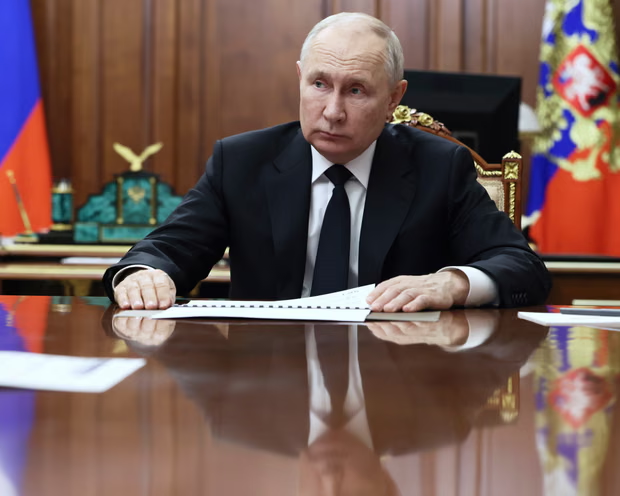
Vladimir Putin’s abrupt cancellation of the Russia-Arab world summit has sent a stark signal of waning Russian influence in the Middle East, exposing how the Ukraine war and shifting international dynamics have eroded Moscow’s role in regional diplomacy. Initially intended as a showcase of Russia’s enduring ties with Arab nations and a demonstration of the Kremlin’s ability to project power beyond its immediate sphere, the summit was quietly shelved after only a handful of confirmations, leaving Moscow notably absent from global attention at the concurrent Gaza peace summit in Egypt. This development highlights both the symbolic and practical decline of Russian clout, revealing the growing importance of US-led initiatives under former President Donald Trump and a reorientation of Middle Eastern leaders toward Washington amid frustration over Russia’s ongoing military engagement in Ukraine.
Vladimir Putin’s Middle East Ambitions and the Summit’s Collapse
When Vladimir Putin first announced the Russia-Arab world summit in April, the Kremlin envisioned a high-profile gathering of Arab leaders in Moscow to discuss energy, security, and regional stability, with the Russian president positioned at the center of diplomatic attention. Preparations had been underway for months, and the event was intended to affirm Russia’s continued influence in the Middle East, positioning Moscow as a counterweight to Western powers despite years of sanctions and international isolation. However, the reality proved less flattering. Only a few leaders, including Syrian President Ahmed al-Sharaa and Arab League chief Ahmed Aboul Gheit, confirmed attendance, prompting an embarrassing cancellation of the event.
The summit’s collapse coincided with the Gaza peace summit in Sharm el-Sheikh, Egypt, which drew leaders from across the Middle East and Europe to witness the signing of a long-awaited Gaza ceasefire agreement. Former US President Donald Trump and Egyptian President Abdel Fatah al-Sisi hosted the event, which symbolized Washington’s growing influence in regional diplomacy and emphasized Russia’s absence on the global stage. While Moscow had never been expected to play a central role in brokering the Gaza agreement, its exclusion from such a high-profile diplomatic initiative underscores a harsh reality: the war in Ukraine has significantly weakened Russia’s ability to project influence beyond its immediate strategic objectives.
Analysts have noted that Russia’s role in Middle Eastern affairs has steadily declined since the Ukraine invasion. Hanna Notte, a Berlin-based expert on Russian foreign policy, highlighted that key regional developments now largely bypass Moscow, with leaders increasingly focusing on the United States for diplomatic solutions. The Gaza summit also underscored a broader realignment, with many regional powers seeking closer ties to Trump and Washington, signaling a shift in the Middle East away from Russia’s once-prominent position as a power broker.
For nearly a decade, Vladimir Putin had cultivated influence in the region, leveraging Russia’s 2015 military intervention in Syria to preserve Bashar al-Assad’s regime and secure permanent naval and air bases along the Mediterranean. This military campaign enhanced Moscow’s reputation as a global power capable of projecting force far beyond its borders. Russia simultaneously engaged with Palestinian authorities and hosted Hamas delegations in Moscow, further cementing its regional presence. However, the Ukraine war forced a diversion of military, economic, and diplomatic resources, leaving Russia unable to sustain its prior level of influence. Assad’s regime, while still in power, has faced instability, and Russia’s other key ally, Iran, has suffered repeated attacks on its military and economic infrastructure by Israel.
Shifting Alliances and Russia’s Declining Role
The evolving geopolitical landscape has highlighted how Russia’s alliances are under strain. While Russia maintained ties with Iran and the Palestinians, it has seen relationships with other longstanding allies fray, including Israel, whose growing support for Ukraine underlines Moscow’s declining strategic leverage. The delivery of a Patriot missile system from Israel to Kyiv, as noted by Ukrainian President Volodymyr Zelenskyy, further underscores the shifting alignment of regional powers. Russian officials publicly acknowledged the US-led Gaza initiative, with Vladimir Putin framing the postponement of the Russia-Arab summit as a supportive gesture, yet privately frustration persists at being sidelined from key negotiations.
Senior Russian officials have expressed dissatisfaction with their exclusion from the peace process. Foreign Minister Sergei Lavrov asserted that Russia remained willing to participate if invited but would not impose itself. Dmitry Medvedev criticized Trump’s Gaza agreement as inadequate, arguing that without the creation of a fully recognized Palestinian state aligned with UN resolutions, the conflict would continue unabated. This divergence between public support and private discontent illustrates the Kremlin’s precarious position in a region where Russia once projected substantial influence.
The repercussions of Russia’s retreat extend beyond the Middle East. Across Central Asia and the Caucasus, countries historically aligned with Moscow—including Kazakhstan, Armenia, and Azerbaijan are reassessing their strategic calculations due to the risks posed by the Ukraine war. For instance, Trump recently mediated a peace deal between Armenia and Azerbaijan, granting Washington a key role in developing the so-called “Trump Route” for trade and infrastructure development. Both Armenian Prime Minister Nikol Pashinyan and Azerbaijani President Ilham Aliyev attended the Gaza summit in Egypt, further signaling the reorientation of regional powers toward US-led diplomacy rather than Russia.
Looking ahead, Moscow has indicated that the Russia-Arab summit may be rescheduled for November. While the summit could reinforce Russia’s message of remaining engaged with the Arab world, analysts caution that symbolic gestures alone cannot restore Moscow’s diminished influence. The Kremlin’s strategic options are constrained by ongoing military commitments in Ukraine, economic sanctions, and waning credibility among Middle Eastern leaders. The challenge for Russia is not merely to host a summit but to demonstrate that it remains a key actor capable of shaping regional outcomes amid shifting alliances and intensifying US engagement.
Vladimir Putin’s cancelled summit and absence from Egypt’s Gaza peace negotiations illuminate the erosion of Russian influence in the Middle East, reflecting broader geopolitical shifts caused by the Ukraine conflict and changing regional priorities. Once considered a formidable counterbalance to Western power, Russia now faces a reality where its ability to influence outcomes in both conflict resolution and strategic alliances is increasingly constrained, forcing the Kremlin to recalibrate its approach to the Middle East and beyond.