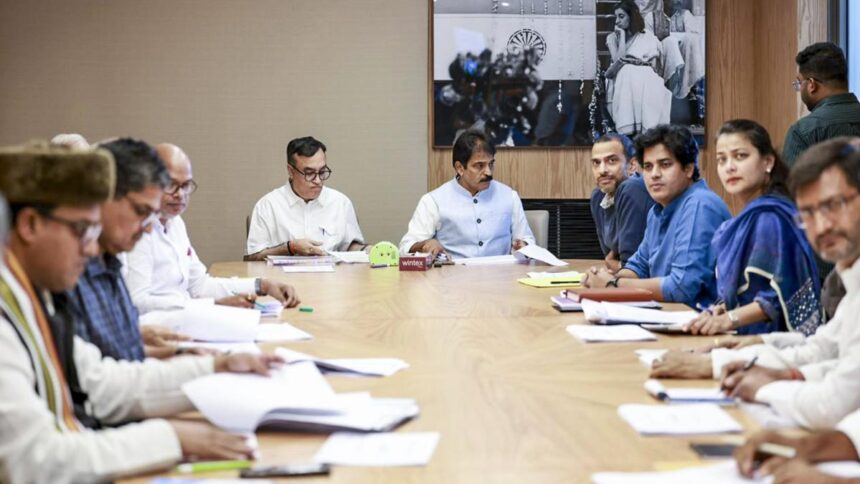
As the Bihar Assembly elections approach, the Congress has begun releasing names of key candidates while seat-sharing arrangements with allies remain unresolved, reflecting the party’s efforts to assert its presence in the state and manage internal dissent amid heightened political activity. Although the official list of candidates has not been formally announced, several aspirants received party tickets at private gatherings, signaling the urgency and complexity of the pre-election preparations. The party leadership is also navigating tensions with disgruntled members and coordinating with allies, attempting to balance competitive ambitions with strategic cooperation in a state where electoral dynamics are increasingly fluid. Congress appears to be drawing lessons from both allies and opponents who have distributed tickets ahead of formal announcements, showcasing an evolving approach to candidate selection and alliance management.
Congress Moves to Nominate Candidates Amid Internal Backlash
On Wednesday, the Congress witnessed a flurry of activity as its state leadership began distributing tickets to candidates for the Bihar Assembly elections. Several leaders, including the state president, received party tickets, while others engaged in protests or expressed discontent at the distribution process. Aspirants arrived at Patna airport in the evening to confront the state Congress president Rajesh Kumar and legislative party leader Shakil Ahmed Khan, alleging that tickets were being “put up for sale.” Such reactions highlight the internal pressures the party faces in managing ambitious candidates and maintaining cohesion within its ranks.
Initially, Rajesh Kumar and Khan had planned to distribute tickets at Sadaqat Ashram, the BPCC headquarters, but sensing the tense atmosphere and the potential for further agitation, they opted to convene candidates at the residence of one of the party leaders, where tickets were handed over along with the party symbol. The photographs of these candidates were later shared on the official X handle of Bihar Congress, signaling transparency to supporters and the public. Among the notable recipients were Rajesh Kumar himself, who aims to retain the reserved Kutumba seat, sitting MLAs Anand Shankar Singh from Aurangabad, Vijendra Chaudhary from Muzaffarpur, and Pratima Das from Raja Pakar.
The approach taken by the Congress seems influenced by the strategies of other political players in Bihar, including allies like the RJD and CPI(ML) Liberation, as well as the ruling JD(U) led by Chief Minister Nitish Kumar, all of which have been distributing tickets informally in anticipation of formal announcements. Many candidates have already filed their nomination papers, with deadlines set for the first phase of elections on Friday and continuing until October 20 for subsequent phases. By initiating early ticket distribution, the Congress seeks to establish its electoral readiness, while simultaneously attempting to manage dissatisfaction among aspirants who might feel marginalized by the allocation process.
Negotiations with Allies and Strategic Seat-Sharing Discussions
Late into the night, the Congress leadership, including Rajesh Kumar, Shakil Ahmed Khan, and AICC in-charge for Bihar Krishna Allavaru, visited the residence of RJD president Lalu Prasad. The meeting reportedly culminated in an “amicable deal” to resolve seat-sharing disputes, a crucial step in ensuring that electoral alliances remain cohesive and effective. While Congress has historically been perceived as a struggling force in Bihar politics, its recent Voter Adhikar Yatra led by Rahul Gandhi is believed to have revitalized party prospects, giving the leadership a basis to adopt a more assertive stance in negotiations with allies.
Reports suggest that the Congress may settle for contesting 61 seats in the state, nine fewer than it had contested in the 2020 elections, in which it had won only 19 seats. The RJD, which continues to dominate the alliance dynamics, is expected to contest the majority of seats, although it may field fewer candidates than the 144 it presented in the previous assembly elections, when 75 candidates secured victory. The remaining seats are likely to be distributed among Left allies including CPI(ML) Liberation, CPI(M), CPI, and former state minister Mukesh Sahani.
The ongoing seat-sharing discussions underscore the delicate balancing act Congress faces between maximizing its own representation and ensuring a collaborative strategy with allied parties. The process also reflects broader political dynamics in Bihar, where electoral negotiations involve not only strategic calculations about winnable constituencies but also the management of competing interests within a coalition. By addressing internal dissent and formalizing alliances, Congress is attempting to project an image of unity and preparedness, critical factors in a politically competitive state.
The decision to release candidate names prior to finalizing all seat-sharing arrangements indicates a proactive strategy by the Congress to maintain momentum and demonstrate decisiveness to voters. It also highlights the challenge of balancing transparency, political expediency, and internal party management in a high-stakes electoral environment. By carefully managing candidate announcements alongside negotiations with RJD and other partners, Congress is signaling its intention to remain a relevant and competitive force in Bihar politics, despite historical perceptions of diminished influence.
While Congress has not officially declared its full roster of candidates or finalized all alliance arrangements, the party’s actions in distributing tickets and engaging in negotiations with allies reflect a concerted effort to assert influence, manage internal tensions, and optimize its position ahead of the upcoming Bihar Assembly elections. These developments illustrate the complex interplay of electoral strategy, candidate management, and alliance politics that define Bihar’s dynamic political landscape, setting the stage for what promises to be a highly contested and strategically significant election cycle.