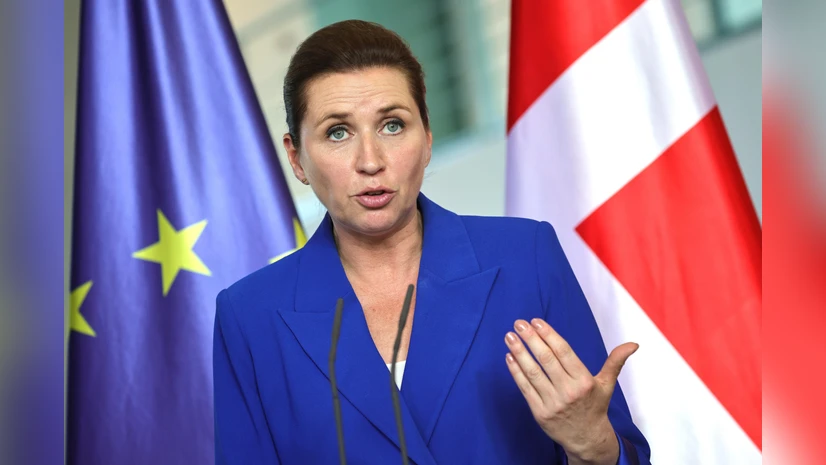
Denmark’s prime minister has issued one of the strongest warnings yet against renewed threats by the United States to take control of Greenland, declaring that any military attack by Washington on a Nato ally would mark the collapse of the alliance itself and the end of the post-second world war security framework. The comments come after former US president Donald Trump again claimed that the United States “needs” Greenland, reviving long-standing anxieties about American ambitions in the Arctic and prompting sharp reactions from Copenhagen, Nuuk, and across Europe. At a moment when global geopolitics is already strained by conflict, economic rivalry, and shifting alliances, the Greenland question has emerged as a flashpoint that tests the durability of Nato, the principle of territorial integrity, and the rules-based international order.
The warning was delivered by Danish prime minister Mette Frederiksen, who said that if the United States were ever to attack another Nato country, “everything would stop”, including Nato itself and the system of collective security that has underpinned peace in Europe since 1945. Her remarks followed Trump’s renewed rhetoric after a controversial US military operation in Venezuela, which has heightened fears that threats once dismissed as bluster could now carry real consequences.
greenland, strategic rivalry, and rising transatlantic tensions
Greenland occupies a unique position in global geopolitics. Though largely autonomous, it remains part of the Kingdom of Denmark, with foreign and security policy controlled from Copenhagen. Its vast Arctic territory lies between Europe and North America, making it strategically indispensable to the United States’ ballistic missile defence architecture and early warning systems. In addition, Greenland’s untapped reserves of rare earths and other critical minerals have drawn increasing attention as global powers seek to reduce dependence on Chinese supply chains.
It is this combination of strategic geography and resource potential that has repeatedly drawn Trump’s attention. During his presidency, he openly floated the idea of buying Greenland, a proposal that was rejected outright by Denmark and Greenlandic leaders. While the idea was initially treated with disbelief, Trump’s refusal to rule out military options in later remarks shifted the tone from eccentric to alarming. His latest comments, made after the US operation in Venezuela, have again suggested that Greenland is a national security priority for Washington, reinforcing fears that pressure could escalate beyond diplomacy.
Frederiksen responded with unusually blunt language. Speaking to Danish broadcasters, she described US pressure as “unacceptable” and warned that an attack on Greenland would not merely be a bilateral crisis but a systemic shock to global security. Her argument rests on the foundational principle of Nato: collective defence among allies. If the alliance’s most powerful member were to turn its military might against another ally, the very logic of Nato would collapse, along with the trust that sustains it.
Greenland’s own leadership has been equally direct. Prime minister Jens-Frederik Nielsen accused Trump of indulging in “fantasies about annexation” and condemned US rhetoric as “completely and utterly unacceptable”. In a forceful statement shared on social media, Nielsen said threats and pressure had no place between allies and declared: “Enough is enough.” He later sought to calm fears of an imminent takeover, stressing that Greenland is a democratic society and cannot be compared to countries where US military intervention has occurred.
Despite these reassurances, anxiety remains high. The US bombardment of Venezuela and the capture of its president Nicolás Maduro have transformed the context in which Trump’s Greenland remarks are received. Actions that once seemed implausible are now viewed through the lens of demonstrated willingness to use force, even against sovereign states. Trump’s comments aboard Air Force One, where he mocked Denmark’s defence capabilities and claimed Greenland was surrounded by Chinese and Russian ships, have only intensified concerns.
Denmark has sought to mobilise international support, framing the issue not as a bilateral dispute but as a test of core principles. Frederiksen has emphasised that Greenland has repeatedly stated it does not wish to become part of the United States and that its future must be decided by its own people. She has also made clear that Denmark will “do everything” to defend democratic values and the international community built after the second world war.
european response, nato credibility, and a shifting arctic order
The controversy has resonated widely across Europe, with leaders and institutions closing ranks around Denmark and Greenland. The European Union has reiterated its commitment to national sovereignty and territorial integrity, warning that it would not remain silent if the borders of a member state were threatened. EU foreign policy spokesperson Anitta Hipper said these principles were universal and non-negotiable, particularly when the territorial integrity of an EU member was at stake.
Nordic neighbours have been especially vocal. Sweden’s prime minister Ulf Kristersson declared unequivocal support for Denmark, stating that only Denmark and Greenland have the right to decide Greenland’s future. Norway and Finland have expressed similar solidarity, reflecting a shared regional concern about Arctic security and great-power competition.
From the UK, prime minister Keir Starmer underlined that Greenland’s destiny lies with its people and the Danish kingdom alone. Germany has also weighed in, with foreign minister Johann Wadephul suggesting Nato discussions on strengthening Greenland’s protection, signalling that the alliance must adapt to new pressures without undermining its foundational commitments.
At the heart of the issue lies Nato itself. The alliance was created to deter aggression and ensure that an attack on one member would be met with a collective response. Trump’s rhetoric challenges that premise in unprecedented ways. If a Nato member were to threaten another, it would raise profound questions about the alliance’s coherence, credibility, and future. Frederiksen’s warning that such an act would mean “the end of everything” reflects fears that Nato’s deterrent power depends as much on shared values as on military strength.
Within Greenland, the debate has also exposed internal divisions and long-term questions about independence. Aaja Chemnitz, a Greenlandic member of the Danish parliament, said that while she did not believe an invasion was imminent, Greenlanders should prepare for the worst. She described Trump’s latest remarks as the most serious yet and suggested they signalled the emergence of a “new world order” in which dialogue and collaboration are being replaced by coercion.
At the same time, opposition voices such as Pele Broberg, head of Greenland’s pro-independence Naleraq party, have played down the threat. Broberg argued that the US would ultimately protect Greenland as an independent nation if it chose that path and called for dialogue with Washington. His remarks highlight the complex interplay between Greenlandic aspirations for greater autonomy and the geopolitical realities of being courted by global powers.
The Greenland controversy also sits within a broader Arctic context. As climate change accelerates ice melt, the region is becoming increasingly accessible, intensifying competition among the US, China, and Russia for shipping routes, resources, and strategic footholds. Danish intelligence services have already warned of US economic pressure and military threats against allies, underscoring how Arctic rivalry is reshaping traditional alliances and assumptions.
For Denmark, the stakes are both national and global. Frederiksen faces domestic pressure ahead of a general election, with calls for clearer contingency planning should Greenland face direct threats. Yet she has so far prioritised diplomacy, alliance-building, and the reaffirmation of international norms. Her challenge is to deter aggression without escalating tensions, while ensuring that Denmark and Greenland are not left isolated in an increasingly unpredictable world.
As the rhetoric continues and global attention remains fixed on Washington’s next moves, Greenland has become more than a remote Arctic island. It is now a symbol of how fragile the postwar order may be when power politics collide with principles of sovereignty and alliance solidarity. The outcome of this standoff will not only shape the future of Greenland and Denmark but could redefine the meaning of Nato and collective security in the twenty-first century.