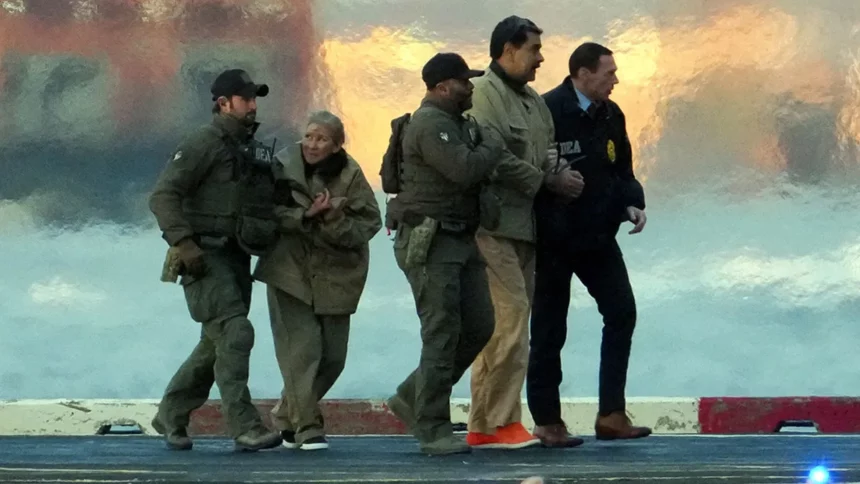
Claims that the wife of Venezuelan President Nicolás Maduro suffered significant injuries during a US-led operation have added a new and highly charged dimension to the international controversy surrounding Washington’s actions in Venezuela. According to legal representatives, Cilia Flores, a powerful political figure in her own right and Maduro’s long-time partner, was hurt during what has been described as a forcible operation by US authorities, an allegation that has sparked diplomatic outrage, legal debate, and renewed fears about the escalation of American interventionism in Latin America. As images and court appearances fuel public attention, the incident has become emblematic of a broader confrontation involving sovereignty, human rights, and the limits of foreign power in a deeply polarised global environment.
The episode unfolds against the backdrop of a dramatic US operation that reportedly resulted in the capture of Nicolás Maduro, a move that has already shaken international norms and prompted sharp reactions from governments across the world. Now, with allegations that Flores was physically harmed during the same sequence of events, the focus has widened from geopolitical strategy to questions of legality, accountability, and the treatment of detainees linked to a sitting head of state.
Allegations of injury, legal claims, and competing narratives
Cilia Flores, a former first lady who has held senior political roles in Venezuela, appeared in a New York court with visible bandages on her face, including one covering her eye and another on her forehead. Her lawyer claimed these injuries were sustained during her alleged kidnapping by US forces, describing the operation as violent and disproportionate. According to the defence, Flores was subjected to rough handling that resulted in physical harm, a claim that, if substantiated, could raise serious concerns under international law.
US authorities have yet to provide a detailed public account addressing the allegations of injury. Officials have framed the operation as a necessary and lawful action tied to long-standing accusations against the Venezuelan leadership, including corruption, drug trafficking, and abuses of power. From Washington’s perspective, the operation represents an extension of its broader strategy to hold Maduro’s inner circle accountable and disrupt what it views as an illegitimate regime.
The contrasting narratives reflect the deep mistrust that has defined US–Venezuela relations for years. While US officials emphasise enforcement and security imperatives, the Venezuelan side and its allies characterise the operation as an act of aggression that violates national sovereignty. Flores’s legal team has argued that her injuries underscore the human cost of such actions, transforming what might otherwise be framed as a political manoeuvre into a potential human rights issue.
The courtroom appearance itself has become a focal point. Observers noted Flores’s frail condition and the symbolism of a senior political figure appearing injured before a US court. Supporters of the Venezuelan government have seized on these images to reinforce claims that Washington’s actions are reckless and abusive, while critics argue that the legal process should determine responsibility rather than political rhetoric.
international reaction, human rights concerns, and regional consequences
The allegations surrounding Flores’s injuries have reverberated far beyond the courtroom, prompting reactions from Latin American governments, international organisations, and human rights advocates. For many in the region, the incident revives painful memories of past US interventions and reinforces fears that hard-won norms of sovereignty are once again under threat. Critics argue that even if allegations against the Venezuelan leadership are serious, the means employed to pursue accountability must adhere to international standards.
Human rights groups have called for an independent inquiry into the circumstances of Flores’s injuries, stressing that all detainees, regardless of political affiliation, are entitled to humane treatment. They warn that failure to transparently address such claims risks undermining the credibility of any legal proceedings and could set a dangerous precedent for future cross-border operations.
Within Venezuela, the incident has further polarised public opinion. Government supporters view the alleged injuries as proof of US hostility and disregard for Venezuelan lives, while opposition voices remain focused on the broader accusations against Maduro’s administration. The fate of Flores has thus become intertwined with Venezuela’s internal political struggle, amplifying tensions at a moment of extreme uncertainty.
The regional implications are significant. Latin America has long sought to reduce external interference, emphasising dialogue and multilateral solutions to political crises. The reported injury to Flores has strengthened calls for regional bodies to assert a more active role in mediating disputes and safeguarding human rights. Some governments have warned that unilateral actions by powerful states risk destabilising the entire region, particularly if they provoke retaliatory measures or embolden other actors to bypass international mechanisms.
Globally, the case has added to concerns about a shifting international order in which force and coercion appear increasingly normalised. Coming on the heels of other high-profile operations and confrontations, the Venezuela episode feeds into a narrative of growing instability and eroding consensus on the rules governing state behaviour. Allies of the United States have been notably cautious in their responses, balancing strategic partnerships with unease about the implications of such actions.
For Washington, the challenge lies in reconciling its stated commitment to democracy and human rights with the perception that its methods contradict those principles. How US authorities respond to claims about Flores’s injuries, both legally and diplomatically, will shape international perceptions and potentially influence future cooperation or resistance.
As legal proceedings continue and more details emerge, the story of Cilia Flores’s alleged injuries remains a powerful symbol of the human dimension of geopolitical conflict. It underscores how decisions taken in the realm of high politics can have immediate and personal consequences, and how those consequences can, in turn, reshape the broader debate about power, accountability, and justice in the international system.