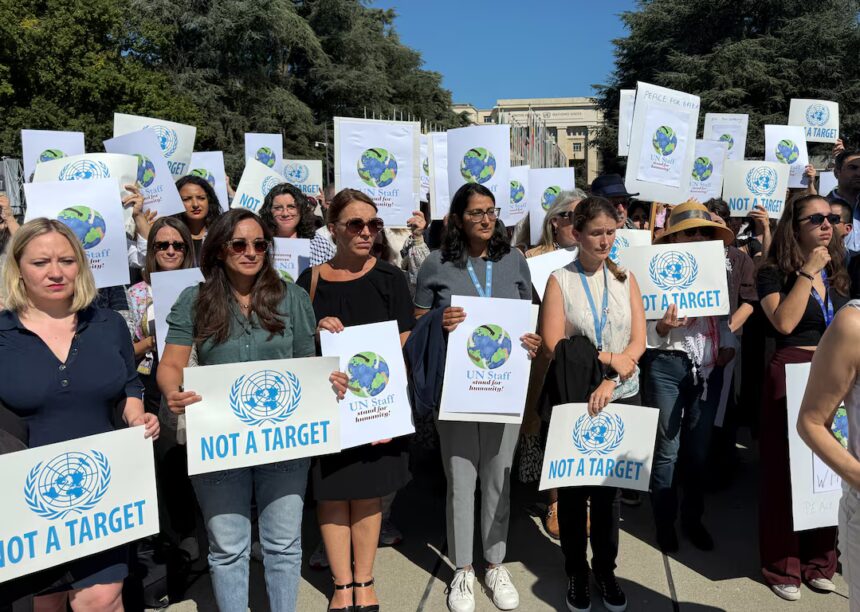
Tensions between the United Nations and its major donors, the United States and Israel, have escalated as UN staff protested the ongoing Gaza conflict while the two countries criticized the organization’s impartiality. Hundreds of UN employees gathered outside the European headquarters in Geneva to honor colleagues killed in the nearly two-year-long war in Gaza and to express their frustration at what they describe as a lack of adequate protection and accountability. The protest, which included laying 370 white roses next to a memorial plaque for each aid worker killed, came amid complaint letters from the U.S. and Israel accusing UN staff of violating neutrality and showing bias against Israel. The protest reflects the growing frustration within the UN workforce over unprecedented losses and the perceived tension between humanitarian duties and the expectations of member states.
Protests Highlight Unprecedented Losses and Staff Outcry
The Geneva demonstration brought together several hundred UN employees who carried placards reading “Peace for Gaza” and “Not a Target,” emphasizing the urgency of safeguarding humanitarian workers and holding parties accountable for ongoing violence. Nathalie Meynet, president of the UN refugee agency staff council, told Reuters, “Today, the UN staff are coming together to say that enough is enough, to say that we cannot kill our colleagues in Gaza with such impunity and to say stop to all these murders.” The protestors highlighted the risks faced by UN aid workers in conflict zones, where operations continue under extremely dangerous circumstances. Since the outbreak of the Israel-Hamas conflict on October 7, 2023, UN data indicates that approximately 543 aid workers, including 373 UN staff members and team affiliates, have been killed in Gaza. This scale of loss is unprecedented in the organization’s 80-year history, drawing attention to the humanitarian and operational crisis faced by international staff.
The protest also involved a minute of silence under the bright Geneva sun, demonstrating solidarity and remembrance for fallen colleagues. Earlier in the week, about a thousand UN employees participated in an online briefing with Francesca Albanese, a UN independent expert whose criticism of Israel has previously prompted U.S. sanctions. The meeting aimed to provide information and guidance on operational safety, humanitarian advocacy, and international law, although it became the focus of complaints from both Israel and the United States. Both Israel’s diplomat Meron and U.S. Charge d’Affaires Tressa Finerty sent emails to UN officials, including UN Under-Secretary-General Valovaya, arguing that such meetings compromise the organization’s neutrality.
The letters from Israel and the United States described the participation of UN staff in online sessions during official work hours, using UN computers and email accounts, as a “grave violation of the UN’s principle of neutrality on multiple levels.” Finerty emphasized that the perception of systemic bias against Israel could emerge if UN employees engage in these discussions under organizational auspices. This conflict underscores the tension between the expectations of donor states and the advocacy roles that UN staff sometimes undertake to fulfill humanitarian responsibilities. UN representatives and staff unions have clarified that these meetings are part of essential work, aimed at promoting safety, coordination, and operational guidance in conflict zones, rather than political activism.
Institutional Tensions and Calls for Impartiality
The criticisms from the U.S. and Israel come as the UN struggles to balance operational effectiveness with neutrality in a highly polarized conflict environment. The UN staff council has highlighted the psychological and operational toll of the conflict, noting that losses among aid workers have caused “immense suffering” and raised concerns about the sustainability of missions in high-risk areas. In a letter dated September 17, Catherine Pollard, Under-Secretary-General for Management Strategy, Policy, and Compliance, acknowledged the tragedy of losing colleagues but reiterated that staff associations must avoid organizing or promoting activities that could be perceived as political. The letter underscored the delicate position of the UN, needing to protect staff, maintain humanitarian objectives, and navigate pressures from influential member states.
Yousra Ahmed, a UN staff worker present at the protest, stressed the moral and humanitarian imperative guiding staff actions: “It’s not a question of neutrality. I’m just outraged that the rules of the United Nations and humanitarian law are not being applied.” Ahmed’s statement reflects a broader sentiment among UN staff who feel caught between donor expectations and the operational realities on the ground, where the protection of human life often demands vocal advocacy and visibility. The protest illustrated the increasing urgency for mechanisms that address staff safety, support bereaved families, and ensure that the humanitarian mission remains central even amid political disagreements.
The controversy also comes against the backdrop of the United States’ prior disengagement from the UN Human Rights Council, which Washington criticized for alleged anti-Israel bias. The ongoing complaints and letters to top UN officials underscore how political disagreements and perceptions of bias can complicate the organization’s operational mandate. While management has asked staff to remain impartial regarding the Gaza conflict, employees insist that calling attention to violations and dangers faced by aid workers is an essential part of fulfilling their professional and ethical duties.
The UN’s unique position as both a humanitarian actor and a multilateral institution means that staff advocacy and protests often carry international visibility. While a parallel vigil at the UN headquarters in New York was denied permission by management, the Geneva protest was carried out peacefully and symbolically, using white roses to honor each staff member lost. This act of remembrance and advocacy exemplifies how employees navigate the tension between official guidelines, operational requirements, and moral responsibility to protect human lives.
The unprecedented scale of UN staff losses in Gaza has triggered a broader reflection on institutional policies, international law, and humanitarian ethics. Staff stress that impartiality should not prevent the organization from publicly mourning fallen colleagues or calling attention to violations of humanitarian norms. The protest in Geneva represents a convergence of grief, operational concern, and moral accountability, demonstrating the challenges faced by international organizations operating in conflict zones where the line between advocacy and politics is often blurred.
As the United States and Israel exert pressure on UN leadership, staff continue to navigate the complexity of fulfilling their humanitarian mandates under scrutiny. The letters sent by the two nations, along with warnings from management, reveal a growing divide between operational staff on the ground and the diplomatic expectations of member states. Despite these tensions, UN employees insist on highlighting the human cost of the Gaza conflict, advocating for measures that protect aid workers, and maintaining transparency regarding casualties.
By organizing protests, laying memorials, and engaging in virtual briefings, UN staff have sought to strike a balance between adherence to institutional rules and the moral imperative to bear witness to violence against humanitarian workers. Their actions underscore the challenges of maintaining neutrality in the face of overwhelming human suffering and operational risks. The Geneva protest, in particular, symbolized collective grief and solidarity while sending a clear message to member states about the stakes involved in conflict zones.
In conclusion, the protests and letters reveal the complex interplay between political pressures, staff advocacy, and operational ethics in the UN system. The extraordinary losses among humanitarian staff have created a situation in which impartiality, safety, and ethical responsibilities intersect, producing friction with member states that influence UN operations financially and politically. Staff insistence on honoring colleagues and raising awareness of operational risks highlights the ongoing challenge of maintaining both neutrality and moral responsibility in humanitarian crises.
The Geneva protest, coupled with the letters from the U.S. and Israel, underscores the difficult environment in which UN staff operate. These developments demonstrate the increasing expectations placed on humanitarian workers and the need for international institutions to reconcile operational necessity with political pressures. The events highlight the delicate balance between staff advocacy, ethical duties, and compliance with the principles of neutrality mandated by the UN. The protests serve as a testament to the dedication, bravery, and moral courage of UN staff confronting unprecedented losses while navigating intense scrutiny from powerful member states.
The ongoing controversy surrounding Gaza and UN staff actions illustrates the complex dynamics of international diplomacy, humanitarian responsibility, and institutional governance. Staff protests, memorials, and online briefings underscore the moral and operational imperatives guiding humanitarian actors, while complaint letters from the U.S. and Israel highlight the political sensitivity inherent in conflict zones. As the UN continues to mediate between operational realities and political expectations, staff advocacy remains a critical aspect of addressing the human cost of war and ensuring accountability for the protection of aid workers in Gaza.
The incidents in Geneva also shed light on the evolving role of UN staff in conflicts, where advocacy, remembrance, and operational oversight intersect. Their actions illustrate the importance of moral responsibility alongside strict adherence to institutional rules. As the organization faces pressure from major funders, staff continue to highlight the unprecedented humanitarian toll, advocating for stronger safety protocols and international attention.
The United Nations’ efforts to navigate these challenges underscore the ongoing tension between donor expectations, political neutrality, and humanitarian action. Geneva’s protest demonstrates that staff morale, ethical responsibility, and operational effectiveness are deeply interconnected in crisis environments. By raising awareness, honoring fallen colleagues, and engaging in structured advocacy, UN staff aim to maintain the integrity of the organization while confronting unprecedented operational and human losses.
Through memorials, protests, and advocacy, UN employees continue to balance neutrality with moral responsibility, challenging both member states and institutional frameworks to prioritize human life and operational safety. The events surrounding the Gaza war illustrate how humanitarian ethics, staff agency, and political pressures converge in the UN system, highlighting the ongoing struggle to protect those risking their lives in one of the world’s most dangerous conflict zones.
The Geneva protest ultimately represents a collective assertion by UN staff that honoring the fallen, advocating for safety, and maintaining operational integrity are inseparable from the organization’s mission, even in the face of political pressures and unprecedented challenges.