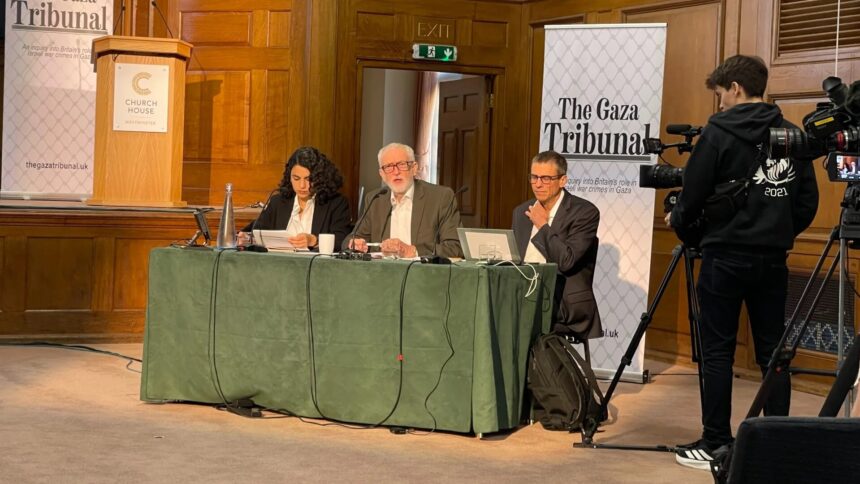
The United Kingdom has faced serious allegations of complicity in Israel’s military actions in Gaza, with witnesses at an independent Gaza tribunal in London asserting that the British government repeatedly ignored its legal obligation to prevent genocide. The two-day tribunal, independent of both government and parliamentary oversight, aimed to document Britain’s failures in holding Israel accountable for what organizers consider war crimes amounting to genocide. Chaired by former Labour leader Jeremy Corbyn, the tribunal heard from 29 witnesses, many experts on Middle Eastern affairs and human rights, who collectively painted a picture of a government that prioritized shielding itself from scrutiny over taking meaningful action to prevent civilian casualties or ensure accountability. The tribunal’s proceedings revealed alleged systematic collaboration with Israeli forces, opaque handling of civilian deaths, and a broader reluctance to enforce international law in response to the ongoing conflict. Corbyn emphasized that the testimonies had “paved the way for truth” and announced plans to compile a report with two legal experts, which he intends to present to the UK Foreign Secretary.
Allegations of Complicity and Government Inaction
Testimony during the tribunal highlighted repeated instances in which the UK government allegedly failed to take adequate measures to prevent or respond to atrocities in Gaza. One of the most significant claims involved the Royal Air Force’s Akrotiri base in Cyprus, from where RAF pilots reportedly shared real-time intelligence with the Israel Defense Forces. This collaboration, according to witnesses, occurred without coordination with the International Criminal Court, raising concerns about Britain’s direct involvement in facilitating operations that may have targeted civilian areas. Witnesses further contended that the government actively sought to minimize accountability by restricting parliamentary oversight and avoiding judicial scrutiny, effectively shielding ministers from political or legal consequences.
The tribunal also examined the UK’s handling of individual cases, including the killing of British aid worker James Henderson, affiliated with the World Central Kitchen, by the IDF on April 1, 2024. Henderson’s lawyers alleged that No. 10 Downing Street failed to provide requested support, leaving the family dependent on an internal Israeli investigation. The coroner’s inquiry into the incident remains pending, with a projected duration of up to two years. Witnesses argued that the lack of proactive intervention and support exemplified a broader pattern of negligence, where Britain did not exercise its influence to ensure accountability for international law violations or protect its own citizens working in conflict zones.
Further claims focused on the UK’s approach to international legal obligations. According to witnesses, Britain did not adequately support the ICC prosecutor, Karim Khan, after US-imposed sanctions led to the closure of his bank account, effectively weakening the court’s capacity to investigate alleged war crimes. In addition, the UK trade department reportedly continued to allow imports from Israeli-occupied territories even after the International Court of Justice issued an advisory opinion declaring the occupation unlawful. Witnesses highlighted that such decisions collectively emboldened parties accused of war crimes while undermining mechanisms designed to enforce accountability.
Forz Khan, representing the Henderson family, emphasized that the aid worker’s death appeared deliberate despite the IDF’s internal investigation claiming it was a mistake. He criticized the UK government for failing to ensure that the family’s lawyers were present when a meeting with ministers finally took place, framing it as part of a systemic failure to advocate effectively for British citizens affected by military operations. Witnesses noted that the Israeli government’s official stance—that civilians are not deliberately targeted—clashed with evidence presented at the tribunal, particularly regarding airstrikes on marked vehicles and densely populated civilian areas.
Charlotte Andrews-Briscoe, representing Palestinian rights group Al-Haq, provided some of the tribunal’s most damning testimony. She outlined how allegations of war crimes were routinely passed from the UK Foreign Office to Israeli authorities, effectively creating a circular process in which perpetrators could avoid scrutiny. According to Andrews-Briscoe, by September 2024, the conflict had resulted in the deaths of 40,000 Palestinians and 10,000 airstrikes, yet the UK government had examined only 413 cases, finding no confirmed violations of international law beyond the case involving Henderson. This testimony suggested a systematic reluctance by the UK to investigate or intervene in situations that might implicate Israel in war crimes, fostering an environment of impunity and eroding confidence in Britain’s commitment to international legal standards.
Challenges in Arms Control and Internal Diplomacy
The tribunal also explored the broader structural and bureaucratic issues underpinning the UK’s approach to the conflict. Mark Smith, a former diplomat who resigned over Britain’s refusal to halt arms sales to Israel in August 2024, described how civil servants attempting to challenge the IDF’s methods were routinely pressured to soften their findings. Smith highlighted that thousands of internal conversations concerning controversial arms sales policies remained inaccessible to the public and were unlikely to ever be presented in court due to the informal nature of the discussions. This testimony emphasized systemic issues within the Foreign Office, where diplomatic and bureaucratic considerations appeared to take precedence over accountability and adherence to humanitarian obligations.
In addition to intelligence sharing and arms policy, witnesses addressed the lack of support provided to international investigative bodies and human rights organizations. Witnesses stressed that effective monitoring and oversight were undermined by deliberate policy choices that limited information sharing, delayed investigations, and curtailed engagement with independent accountability mechanisms. For instance, British authorities reportedly provided no substantive assistance to Karim Khan, the ICC prosecutor, despite the critical need for international cooperation to investigate alleged war crimes in Gaza.
The tribunal highlighted that these patterns of inaction and self-protection extended to the broader legislative and judicial framework. Members of parliament and legal authorities faced significant barriers in accessing information or intervening effectively, raising questions about institutional accountability and the government’s willingness to uphold its obligations under international law. According to witnesses, these systemic shortcomings not only allowed ongoing violations in Gaza to persist but also sent a signal to state and non-state actors that British oversight and enforcement of humanitarian law were limited.
Testimonies also underscored the human cost of inaction. Beyond the figures of 40,000 killed and 10,000 airstrikes, witnesses described the profound psychological and societal impacts on Palestinians living under continuous military operations. Civilian casualties, destruction of infrastructure, and the disruption of essential services compounded the humanitarian crisis. By failing to enforce accountability, witnesses argued, Britain contributed indirectly to these ongoing harms, undermining its credibility as a defender of human rights and international law.
The tribunal further explored the legal and ethical implications of the UK’s arms exports. Testimonies suggested that the Foreign Office often prioritized strategic partnerships and political expediency over rigorous compliance with international norms. Evidence presented indicated that arms and military support were provided despite credible reports of human rights violations, reinforcing allegations of complicity. Experts described a pattern in which legal obligations were subordinated to geopolitical considerations, illustrating the tension between foreign policy objectives and the moral and legal responsibilities of the state.
Witnesses also highlighted the role of public perception and transparency. Many described how the UK government’s limited disclosure of internal communications and decision-making processes prevented effective public debate and accountability. By restricting access to critical information regarding arms sales, intelligence sharing, and diplomatic interventions, the government maintained a degree of opacity that further hindered independent scrutiny and contributed to perceptions of complicity.
In addition, witnesses drew attention to the challenges faced by humanitarian organizations operating in Gaza. Cases such as the death of James Henderson highlighted the vulnerabilities of aid workers and underscored the need for robust government protection and advocacy. Witnesses emphasized that the lack of timely and effective intervention by the UK government not only compromised individual safety but also undermined the broader effectiveness of humanitarian efforts, limiting the ability of aid organizations to operate in conflict zones.
The tribunal’s proceedings illustrated the complex interplay between diplomacy, law, and human rights in the context of the Gaza conflict. Witnesses repeatedly pointed to systemic deficiencies in the UK’s approach, including insufficient enforcement of international law, failure to support accountability mechanisms, and prioritization of self-protection over humanitarian imperatives. These factors collectively framed the UK as not merely passive but actively complicit in perpetuating conditions that allowed civilian harm to continue.
Jeremy Corbyn emphasized the significance of the testimonies, noting that they offered a foundation for truth and accountability. He committed to compiling the evidence with legal experts and presenting the findings to the UK Foreign Secretary, signaling an effort to push the government toward acknowledging its responsibilities. Corbyn underscored that the tribunal’s goal was not only to document alleged failures but also to stimulate public and parliamentary scrutiny of policies that have direct implications for human rights and international law compliance.
Throughout the tribunal, the convergence of diplomatic, military, and legal testimony painted a picture of a government navigating a fraught geopolitical landscape while often neglecting moral and legal responsibilities. Witnesses argued that repeated decisions to prioritize political expediency, minimize scrutiny, and maintain strategic partnerships had direct consequences for the civilian population in Gaza. By failing to hold Israel accountable for alleged violations and by providing continued support in various forms, the UK was portrayed as complicit in perpetuating ongoing harm.
Experts attending the tribunal also highlighted the broader implications of these actions for international law and human rights enforcement. They noted that when a prominent state such as the UK fails to act in accordance with legal obligations, it sets a concerning precedent for global accountability mechanisms. Witnesses stressed that this could embolden other states to disregard humanitarian law, undermining international norms designed to protect civilians in conflict zones.
The tribunal concluded with a reaffirmation of the need for independent oversight, robust enforcement of international law, and enhanced transparency in government decision-making. By documenting the testimonies of 29 witnesses, the proceedings aimed to provide a comprehensive record of alleged complicity, systemic inaction, and failures to prevent civilian harm. The findings are intended to contribute to ongoing debates about Britain’s role in the Gaza conflict, its responsibilities under international law, and the broader ethical and legal considerations of foreign policy.
The independent Gaza tribunal in London provided a forum for witnesses to present detailed evidence of Britain’s alleged failures in addressing war crimes in Gaza. The testimonies revealed patterns of intelligence sharing with Israeli forces, limited support for accountability mechanisms, delayed interventions, and insufficient protection for civilians and aid workers. Experts highlighted systemic deficiencies in arms export controls, diplomatic transparency, and governmental oversight, suggesting a government more focused on shielding itself from scrutiny than preventing civilian harm. The tribunal’s work underscores the ongoing tension between geopolitical priorities and the moral and legal obligations of states, raising critical questions about accountability, complicity, and the enforcement of international law in contemporary conflicts.