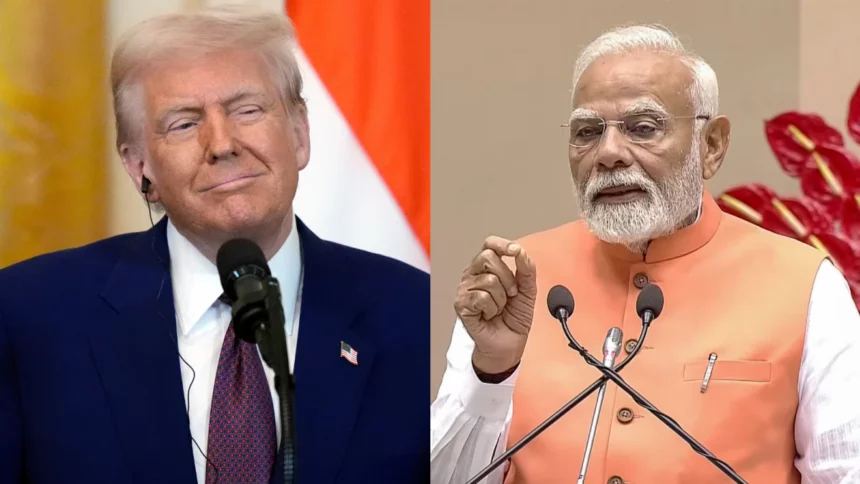
In a sharp diplomatic exchange, US President Donald Trump accused India of benefiting from Russian oil sales while turning a blind eye to the human cost of the war in Ukraine. The Indian government swiftly responded with a pointed rebuttal, highlighting the continued trade relations Western nations, including the US and EU, maintain with Russia. As accusations and counterclaims fly, the focus returns to a key question: what is the actual scope of India’s energy trade with Russia, and how does it compare to others?
On Monday, Trump alleged that India is not just purchasing large volumes of discounted Russian oil, but also reselling it in global markets for significant profit. He said India was ignoring the ongoing devastation in Ukraine and announced intentions to substantially raise tariffs on Indian goods, potentially exceeding previous hikes of 25%.
India Pushes Back
India responded firmly through its Ministry of External Affairs, labelling the proposed tariff hike as “unjustified and unreasonable.” In its statement, India called out what it described as double standards in the West’s policy towards Russia, pointing out that:
The US and EU continue to import goods and energy products from Russia.
The US still imports uranium hexafluoride from Russia for its nuclear industry.
The EU’s 2024 trade with Russia totaled over €84 billion, dwarfing India’s trade volume.
India emphasized that it operates within a transparent and rules-based global trading system and would take all necessary steps to protect its economic and strategic interests.
Trump, when questioned by reporters about India’s response and specific details like US purchases of Russian uranium and fertilisers, admitted he was unaware and said he would look into the matter.
Understanding the Trade Landscape
Russian oil is not banned outright; rather, it is subject to a price cap mechanism set by the G7 and EU to limit Moscow’s revenue while keeping oil flowing in global markets. India complies with this framework by buying Russian crude below the price ceiling and using Western-regulated channels for shipping and insurance.
While India has increased its Russian oil imports in recent years, it is not the only major buyer. From December 2022 to July 2025, China purchased 47% of Russia’s crude oil exports, India accounted for 38%, and the EU and Turkey bought about 6% each. These figures challenge the notion that India alone is sustaining Russia’s oil economy.
India has not been buying Russian natural gas in significant quantities, while the European Union remains the largest importer. In June 2025 alone, the EU paid over €1.2 billion for Russian gas, with major consumers including France, Hungary, Slovakia, and the Netherlands.
India also does not purchase refined petroleum products from Russia, unlike Turkey, China, and Brazil. Turkey, a NATO member, bought 26% of Russia’s refined fuel in the same period.
Compliance with International Norms
India’s oil purchases from Russia are legal, priced within the G7-mandated limits, and carried out through international commodity traders using Western-compliant mechanisms. These transactions are both transparent and compliant with all applicable global trade regulations.
Energy analysts warn that if India were to halt its Russian oil imports, it could cause global oil prices to skyrocket, potentially exceeding $200 per barrel. India’s presence in the global oil market has played a stabilizing role, helping prevent a worldwide supply shock, especially in developing economies that cannot absorb sudden price hikes.
Acknowledgement of India’s Role by US Officials
Despite Trump’s recent remarks, several US officials have publicly acknowledged India’s constructive role in maintaining energy stability. As far back as 2022, the US Treasury Secretary had said that the Biden administration was comfortable with India continuing to purchase Russian oil. In 2024, Biden’s energy adviser also praised India for its contributions to stabilizing the market. Most recently, in May 2024, US Ambassador to India Eric Garcetti stated that India had effectively helped prevent a surge in global oil prices.
Western Trade Continues Quietly
While India’s trade with Russia remains visible and openly debated, many Western countries continue trading with Moscow under less scrutiny. The EU, for example, imports Russian crude oil through pipelines to Hungary, Slovakia, and the Czech Republic. Japan has a special exemption allowing Russian oil imports until 2026. Even in the EU’s latest sanctions package, countries like the UK, Canada, Norway, and Switzerland received carve-outs for specific Russian imports.
Given these realities, India’s actions are not anomalous but part of a broader pattern of nations balancing economic needs with geopolitical positioning. Its trade with Russia, particularly in the energy sector, remains legal, transparent, and compliant with international frameworks — the same ones designed by the countries now questioning its decisions.
The recent exchange between Trump and India highlights the complexities of global trade in times of conflict, where political narratives can often overshadow economic facts. What stands out is India’s consistency in defending its national interest while remaining within the boundaries of global norms, even as others pursue similar trade practices behind closed doors.