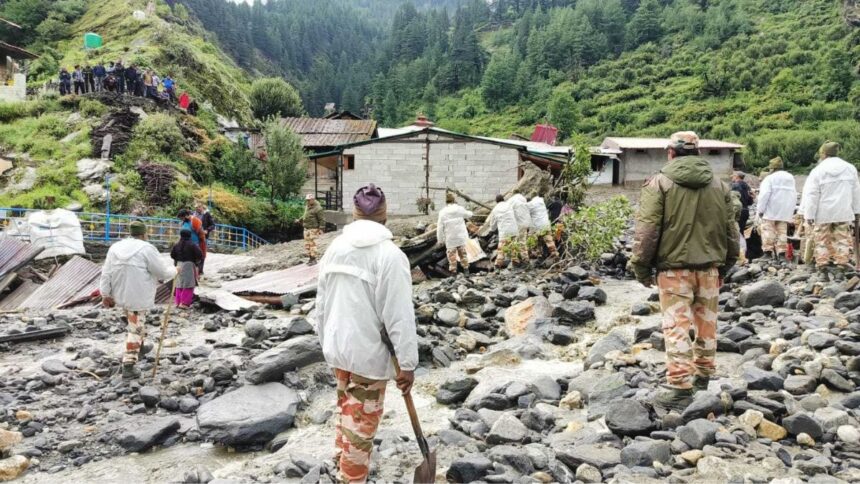
Prime Minister Narendra Modi has extended strong central support to Uttarakhand Chief Minister Pushkar Singh Dhami in the wake of the devastating cloudburst and flash floods in the Dharali region of Uttarkashi. The natural calamity, which has already claimed four lives and caused widespread destruction, prompted an immediate response from the central and state governments. As rescue and relief operations intensified, PM Modi personally reached out to CM Dhami, assuring full assistance from the Centre and expressing deep concern over the ongoing crisis. His call underlined the urgency of coordinated efforts to bring relief to affected communities and restore essential infrastructure in the rain-ravaged hill district.
The flash floods, triggered by two consecutive cloudbursts in Dharali and Sukhi Top, wreaked havoc across Uttarkashi on Tuesday. Torrential rains led to landslides, swollen rivers, and washed-out roads, trapping many locals and tourists in remote locations. The disaster damaged homes, shops, and public utilities, with visuals from the ground showing uprooted trees, debris-strewn pathways, and submerged settlements. As the rains continued to lash the region, the task of rescue teams became increasingly difficult.
In this challenging scenario, PM Modi has taken a hands-on approach. On Wednesday morning, he spoke with CM Dhami for the second time in 24 hours to take stock of the situation and assess rescue operations. According to the Uttarakhand Chief Minister, the Prime Minister was given a detailed update about the overnight rescue efforts, the evacuation of affected individuals to safer locations, and the deployment of resources to meet the immediate needs of the people.
PM Modi Reviews Rescue Efforts, CM Dhami Heads to Ground Zero
Chief Minister Dhami informed the Prime Minister that the state government had mobilized all concerned departments and is actively engaged in round-the-clock rescue and relief operations. He also conveyed the challenges posed by continuous heavy rainfall, which is obstructing rescue routes and delaying logistical movements. Despite these hurdles, agencies including the Indian Army, Indo-Tibetan Border Police (ITBP), National Disaster Response Force (NDRF), and State Disaster Response Force (SDRF) have been deployed and are operating in close coordination.
Sharing his update via social media, CM Dhami said he was heading personally to Dharali to oversee rescue work and ensure swift action. “Honourable Prime Minister Shri Narendra Modi ji spoke on the phone this morning to inquire about the ongoing relief and rescue operations in Dharali,” Dhami posted, adding that he briefed Modi on rescue efforts, safe evacuations, and availability of essential services like food, shelter, and medical care.
PM Modi’s continued engagement and prompt assurance of central support highlighted the importance being placed on mitigating the crisis and reaching affected families at the earliest. Union Home Minister Amit Shah had also earlier spoken with CM Dhami and pledged the Centre’s unwavering support.
Army, Air Force, NDRF Lead Multi-Agency Rescue Mission in Uttarkashi
The Indian Army has taken a lead role in the rescue operations with 150 personnel deployed under the leadership of Colonel Harshvardhan, Commanding Officer of the 14 Rajputana Rifles (RAJRIF). Tracker dogs, drones, and heavy-duty earthmoving equipment are being utilized to navigate debris-filled zones, trace missing persons, and provide relief supplies to stranded individuals.
Air and ground support has been mobilized extensively. Helicopters from the Army and Air Force are delivering essential supplies such as food, clean water, and medicines to inaccessible regions. With road links cut off due to landslides, airlift operations are proving vital to maintain lifelines in severely affected zones.
So far, over 130 individuals have been rescued and shifted to safer locations, as confirmed by the state emergency control room. The District Magistrate and Superintendent of Police remain in constant communication with the State Emergency Operation Centre (SEOC) to coordinate ongoing efforts. Relief camps have been set up, and temporary shelters are being arranged for displaced families.
Meanwhile, the situation in Sukhi Top, the other cloudburst-hit area, remains equally grave. Teams have been dispatched to assess damage and assist those in distress. Given the remote and hilly terrain of Uttarkashi, access continues to be a major obstacle for rescue teams, but the coordinated efforts of multiple agencies are gradually bringing order to the chaos.
Back in Dharali, the presence of top-level leadership—from both the Centre and state—has helped accelerate decisions, ensure rapid mobilization of aid, and strengthen morale on the ground. The coming days remain critical as weather forecasts predict further rainfall, but the combined resolve of civil, military, and administrative machinery is aimed squarely at minimizing loss and maximizing recovery.
As the rescue and relief mission continues at full pace, both local residents and government authorities are hoping that quick response, along with sustained coordination between state and central agencies, will help Uttarkashi recover from this calamity and rebuild its affected communities with resilience.