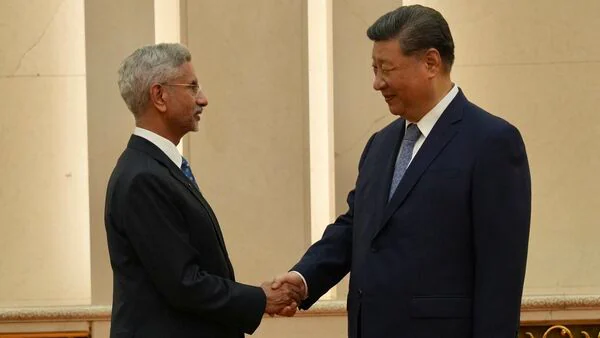
In a significant step towards stabilising ties between Asia’s two largest neighbours, External Affairs Minister S Jaishankar met Chinese President Xi Jinping in Beijing, marking his first visit to China since relations deteriorated following the Galwan Valley clashes in 2020. During the meeting, S Jaishankar conveyed greetings from President Droupadi Murmu and Prime Minister Narendra Modi, discussed the evolving dynamics of the India-China bilateral relationship, and emphasised the importance of continued dialogue to sustain the positive momentum initiated during last year’s Kazan meeting between the two leaders.
A Diplomatic Reset After Years of Strain
S Jaishankar’s visit comes as a crucial development in the thawing of relations between India and China, which had seen a sharp decline after the deadly clashes along the Line of Actual Control in 2020. The meeting with Xi Jinping follows India and China’s announcement last year to disengage troops in Depsang and Demchok in Ladakh, a move seen as a foundational step towards reducing tensions along the contested border areas.
On social media, S Jaishankar shared a picture from his meeting with Xi, stating, “Apprised President Xi of the recent development of our bilateral ties. Value the guidance of our leaders in that regard.” His words highlighted the efforts to build upon the progress made since Prime Minister Modi and President Xi’s interaction on the sidelines of the summit in Kazan in October 2024, which had initiated a constructive trajectory in India-China relations.
Before meeting Xi Jinping, S Jaishankar held discussions with Chinese Vice President Han Zheng, where he emphasised the significance of open dialogue between India and China as neighbouring nations and major economies in Asia. He expressed his expectation for candid discussions during this visit to facilitate a clearer understanding between the two sides.
Looking Ahead to Strengthen Engagement
S Jaishankar’s Beijing visit is part of his two-nation diplomatic outreach, following his recent engagements in Singapore, and includes bilateral discussions with his Chinese counterpart Wang Yi. His visit reflects India’s approach to engage with China on multiple levels to manage differences while exploring areas of cooperation.
The External Affairs Minister’s visit underlines New Delhi’s recognition that open communication channels and leadership-level guidance remain critical in navigating the complex relationship between the two countries. By reaffirming the importance of maintaining dialogue, the visit aims to reduce friction along the LAC while advancing mutual interests in trade, regional stability, and multilateral cooperation under platforms such as the SCO.
S Jaishankar’s visit also signals a careful recalibration of India-China ties, with a focus on maintaining stability along the borders and addressing the issues that have overshadowed bilateral ties over the past five years. While the memories of the 2020 Galwan clashes continue to shape strategic thinking on both sides, there is an evident willingness to move towards pragmatic engagement that prioritises peace and predictability.
The Indian foreign minister’s engagement in Beijing demonstrates the evolving contours of India’s foreign policy, where strategic caution is balanced with the need to engage constructively with China to prevent disputes from escalating into crises. The dialogue held during this visit, along with planned bilateral meetings with Wang Yi, is expected to focus on ensuring that both nations can continue on the positive trajectory charted since their leadership-level talks last year while managing the sensitivities linked to their unresolved border issues.