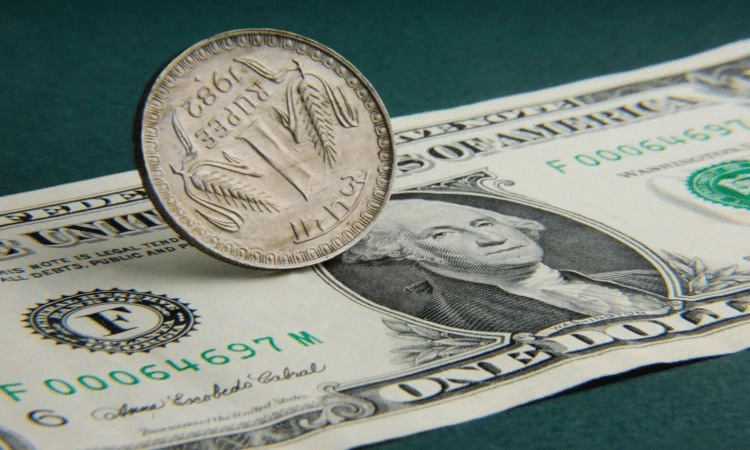
The Indian rupee weakened further on Monday, sliding to an unprecedented low of ₹90.74 against the US dollar, as persistent uncertainty over a potential India–United States trade agreement and continued outflows of foreign institutional investment (FII) exerted pressure on the domestic currency. This record depreciation came despite some favourable macroeconomic indicators, underscoring how external factors and market sentiment have dominated rupee performance through the trading session.
Traders reported that the rupee opened the day at around ₹90.53 and faced renewed selling pressure as importers’ demand for US dollars remained strong and investors stayed cautious amid broader risk-off sentiment. The currency even slipped to as weak as ₹90.80 in intra-day trade before closing at the fresh lifetime low of ₹90.74, down around 25 paise from its previous closing level. Analysts noted that persistent capital outflows and lacklustre support from foreign investors have been the primary drags on the currency, leaving it vulnerable even when economic fundamentals show improvement.
Market participants described the rupee as one of the weakest-performing currencies in Asia over recent sessions, hurt by a combination of strong dollar demand, uncertainty around trade negotiations and risk-averse positioning by global funds. Some experts explained that the imbalance between dollar supply and demand, driven by elevated import requirements and weaker foreign inflows, has created additional downward pressure. Technical analysts pointed to a bullish bias for the USD-INR exchange pair in the near term, with traders watching key resistance and support levels closely as volatility remains elevated.
Commerce Secretary Rajesh Agrawal, when asked about the protracted trade negotiations with the United States, said India and the US are “very close” to finalising a framework agreement, although he declined to provide a specific timeline for its completion. India and the US have been conducting parallel discussions on a framework arrangement to address tariff irritants as well as broader talks on a comprehensive bilateral trade agreement. Exporters and industry bodies have closely monitored these developments, since high import duties have been cited as a key impediment to expanding Indian shipments to the US.
On the macroeconomic front, data showed a better-than-expected trade balance for India, but the rupee failed to derive sustained support from this improvement. Currency strategists emphasised that positive trade numbers alone may not be sufficient to counteract the strong external headwinds facing emerging market currencies, especially when investor confidence is waning. Meanwhile, the US dollar index—which gauges the greenback’s strength against a basket of major currencies—was slightly lower on the day, but still reflective of a generally firm dollar that renders emerging market currencies vulnerable.
Commodity price movements offered a mixed backdrop: Brent crude futures rose modestly, adding to import cost pressures for India, which is a major crude importer. Higher energy costs typically translate into greater demand for dollars in the energy import settlement process, further weighing on the rupee.
Equity markets also reflected the risk-off mood, with benchmark indices closing marginally lower. The Sensex slipped modestly from its highs, while the Nifty similarly edged down, even as some sectors showed resilience. Foreign institutional investors continued to reduce their exposure to Indian equities, registering significant net outflows in recent trade sessions—a trend that has aggravated downward pressure on the domestic currency and financial markets more broadly.
On the external buffers side, India’s foreign exchange reserves provided a measure of comfort, showing an uptick in the week ending early December. The reserves rose by over a billion dollars, offering some cushion against volatility in global currency markets, though they do not fully insulate the rupee from near-term sentiment shifts.
The rupee’s slide to a new all-time low reflects a confluence of factors: ongoing trade negotiation uncertainty with a key partner, persistent FII outflows, strong dollar demand from domestic importers, and broader risk-off tendencies among global investors. Until clarity emerges on trade talks and foreign investment flows stabilise, the currency is likely to remain under pressure, with market participants closely monitoring developments that could influence direction in the coming weeks.