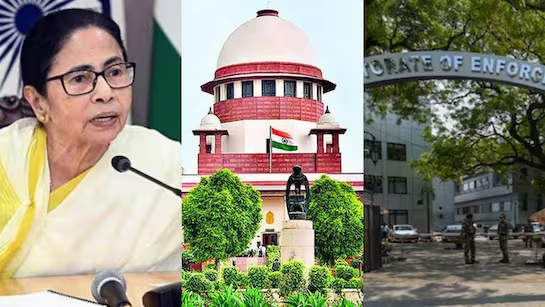
The Supreme Court is set to hear on February 10 the plea filed by the Enforcement Directorate (ED) alleging obstruction and interference by West Bengal Chief Minister Mamata Banerjee during recent search operations at I-PAC’s office and co-founder Pratik Jain’s residence in Kolkata. The case has drawn attention due to its political sensitivity ahead of the 2026 West Bengal Assembly elections.
ED Seeks FIRs Against Mamata Banerjee and State Police Officials
The Enforcement Directorate approached the Supreme Court claiming that the West Bengal government, led by Chief Minister Mamata Banerjee, interfered with its lawful duties during simultaneous searches conducted at the Indian Political Action Committee (I-PAC) office in Bidhannagar and the residence of its co-founder Pratik Jain at Loudon Street. According to the petition, ED officials faced obstruction while carrying out searches related to an ongoing investigation under the Prevention of Money Laundering Act (PMLA). The plea seeks directions for registering First Information Reports (FIRs) against Chief Minister Banerjee, the state Director General of Police (DGP), and the Kolkata Police Commissioner for allegedly interfering with federal agency operations.
The case had been listed for hearing earlier but was deferred after Solicitor General Tushar Mehta, representing the ED, requested additional time to file a detailed response to the counter affidavit submitted by the West Bengal government. The Supreme Court’s cause list now shows the matter is scheduled before a bench of Justices Prashant Kumar Mishra and Sandeep Mehta, highlighting the judiciary’s willingness to address high-profile allegations involving political leadership and central investigative agencies.
The ED’s petition alleges that the interference by the Chief Minister and state police officials disrupted the course of the search operations and that this obstruction was deliberate. The plea claims that the simultaneous searches targeted sensitive documents and devices at I-PAC’s office and at Pratik Jain’s residence, which the ED argues were critical for ongoing investigations. It underscores that the agency’s role is mandated under federal law, and any obstruction constitutes a violation of statutory responsibilities. The petition emphasizes that such interference not only hampers lawful investigative processes but also sets a concerning precedent for the autonomy of central enforcement agencies in politically sensitive cases.
Chief Minister Mamata Banerjee’s Counter Affidavit Denies Interference
In response, Chief Minister Mamata Banerjee has submitted a detailed counter affidavit categorically denying all allegations of interference. According to her affidavit, her visit to I-PAC’s office and Pratik Jain’s residence on January 8, 2026, was solely to retrieve confidential political data belonging to her party, the All India Trinamool Congress (AITC). She maintained that the presence of sensitive documents, including party strategy details and proposed candidate lists for the upcoming legislative assembly elections, necessitated her involvement to safeguard the information.
The affidavit states that Banerjee requested permission from the ED officials to access certain devices and physical files containing the party’s proprietary data. She asserts that the Enforcement Directorate officers did not object to her request and allowed her to retrieve the required material. After securing the data, she reportedly left the premises to avoid any inconvenience to the agency officials. The counter affidavit emphasizes that the ED’s own records, including panchnamas, confirm that the searches continued peacefully and were conducted in an orderly manner after her departure.
Banerjee’s affidavit further argues that neither the AITC nor its officials are implicated in the coal scam under investigation and, therefore, the ED had no legal authority to claim possession of party-specific information. She has also raised concerns about the timing of the searches, suggesting that they were conducted strategically in the lead-up to the 2026 West Bengal Assembly elections, coinciding with I-PAC’s possession of critical political documents. The counter affidavit alleges mala fide intent on the part of the ED, asserting that the agency’s actions could potentially compromise the confidentiality of election-related strategies and sensitive internal party documents.
Additionally, the affidavit highlights procedural irregularities, claiming that the ED failed to maintain audio or video documentation of the searches, a standard safeguard under the Prevention of Money Laundering Act. According to the affidavit, this omission raises a “strong presumption” that the operations were executed in a manner aimed at accessing confidential political data rather than strictly following investigative norms. Banerjee’s legal team contends that the absence of such documentation undermines the credibility of the ED’s operations and raises questions regarding the timing and purpose of the raids.
The counter affidavit further questions the ED’s prolonged delay in initiating investigations, noting that searches were conducted after an extended period of inaction. It alleges that the sudden execution of search operations appears politically motivated, designed to target the party and its affiliates ahead of critical elections. By highlighting these aspects, Banerjee’s affidavit seeks to contextualize her presence at the premises as an effort to safeguard her party’s proprietary and confidential data, rather than an act of obstruction or interference.
The Supreme Court had earlier intervened on January 15, 2026, by staying FIRs registered by the West Bengal Police against ED officials in connection with these searches. The apex court also directed the preservation of CCTV footage and other digital storage devices containing recordings of the searched premises and surrounding areas. This intervention was intended to ensure transparency and to safeguard evidence amid the competing claims of obstruction and lawful investigation. The ongoing hearing in the Supreme Court is now expected to examine the validity of the ED’s allegations alongside the Chief Minister’s defense, making it a high-stakes case involving legal, political, and procedural questions.