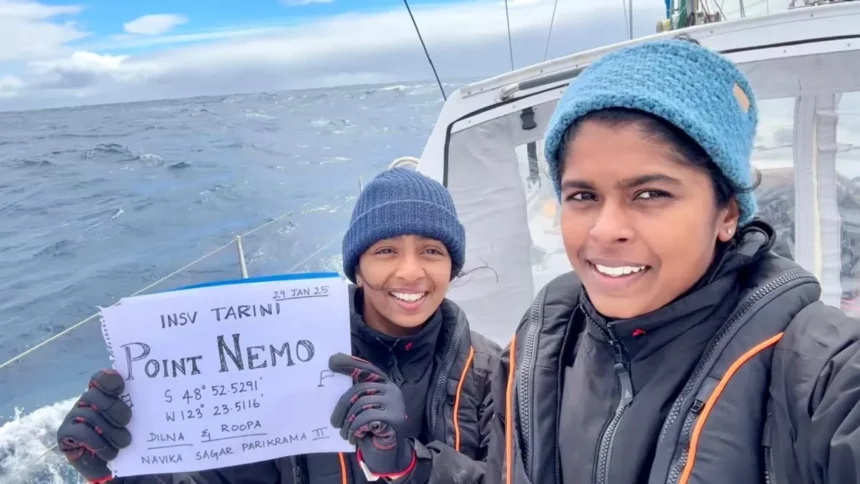
Two female officers of the Indian Navy, Lieutenant Commander Dilna K and Lieutenant Commander Roopa A, achieved a historic feat as they crossed Point Nemo, the most remote location on Earth, during their circumnavigation voyage aboard the Indian Naval Sailing Vessel (INSV) Tarini. The officers passed through the Oceanic Pole of Inaccessibility at 12:30 am IST on Thursday while navigating the third leg of their journey from Lyttelton, New Zealand, to Port Stanley, Falkland Islands. This milestone marks a significant achievement in the Navika Sagar Parikrama II, India’s ambitious naval expedition to circumnavigate the globe.
Point Nemo, located in the South Pacific Ocean, is the farthest point from any landmass, approximately 2,688 kilometers away from the nearest inhabited location. The extreme isolation of this point makes it one of the most challenging navigation zones, with vast stretches of open ocean and no immediate access to land-based assistance. The Indian Navy, in a statement, described the crossing as a testament to the officers’ resilience, courage, and spirit of adventure. The achievement was highlighted on social media, where the Indian Navy posted, “#INSVTarini charts through the world’s most isolated waters! Lt Cdr Dilna K & Lt Cdr Roopa A cross Point Nemo – the Oceanic Pole of Inaccessibility. A testament to resilience, courage & the spirit of adventure.”
The officers embarked on their expedition on October 2, 2024, setting sail from Goa aboard INSV Tarini with the aim of completing a global circumnavigation. As part of their journey, they reached Lyttelton Port in New Zealand on December 22, successfully completing the second leg of the mission. They then commenced the third and longest stretch of their voyage earlier this month, covering a distance of approximately 5,600 nautical miles from New Zealand to the Falkland Islands. The completion of this phase will bring them one step closer to achieving their goal of circumnavigating the world under sail.
The journey through Point Nemo was accomplished entirely using wind power, underscoring the challenges of navigating one of the world’s most isolated maritime regions. The feat highlights the expertise and endurance required for long-distance sailing, particularly in remote oceanic conditions where extreme weather, strong currents, and the vast expanse of water pose formidable obstacles. This segment of the expedition further cements India’s growing presence in global maritime exploration and scientific research.
Point Nemo is known not only for its remoteness but also for its unique role in space exploration. Given its extreme isolation, it serves as a designated “spacecraft cemetery,” where space agencies worldwide guide decommissioned satellites and space stations for controlled re-entry into Earth’s atmosphere to avoid harming populated areas. The region has been used for this purpose by multiple space organizations, including NASA, Roscosmos, and other international agencies.
During their passage through Point Nemo, the officers conducted scientific research by collecting water samples, which will be analyzed by the National Institute of Oceanography. These samples are expected to provide crucial data on marine biodiversity, oceanic chemical composition, and environmental conditions, contributing to ongoing studies on ocean health and climate change. The scientific aspect of the mission underscores the significance of naval expeditions in advancing oceanographic research and understanding global marine ecosystems.
As the officers continue their mission, their next destination, Port Stanley in the Falkland Islands, remains a critical waypoint in their journey. Their success in navigating some of the world’s most challenging waters not only brings pride to the Indian Navy but also reinforces India’s commitment to fostering maritime excellence, scientific exploration, and gender inclusivity in naval operations. The Navika Sagar Parikrama II mission stands as a powerful symbol of perseverance, adventure, and India’s growing prominence in global sailing expeditions.