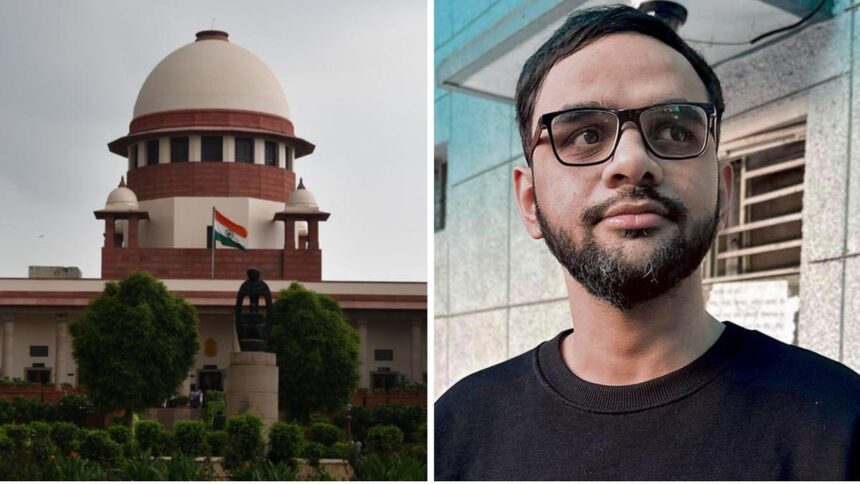
The supreme court’s verdict on delhi riots bail pleas may redefine free speech, conspiracy, and anti-terror law interpretation.
The supreme court is set to pronounce its long-awaited verdict on the bail pleas of activists umar khalid, sharjeel imam, and several others accused in the 2020 delhi riots case, a decision that carries profound legal, political, and constitutional implications. The case, which has remained at the centre of national debate for more than five years, raises fundamental questions about the boundaries of dissent, the interpretation of anti-terror legislation, and the balance between national security and individual liberty. As the apex court prepares to deliver its ruling, attention has once again turned to the events of early 2020, the subsequent investigation, and the prolonged incarceration of the accused without trial.
The delhi riots case and the legal battle over bail
The 2020 violence in north-east delhi erupted during widespread protests against the citizenship amendment act and the proposed national register of citizens, leaving 53 people dead and more than 700 injured. The clashes, which unfolded over several days, represented one of the most serious episodes of communal violence in the capital in recent decades. In the aftermath, the delhi police registered multiple cases and later invoked stringent provisions of the unlawful activities prevention act, alleging a larger conspiracy behind the unrest.
Activists including Umar Khalid and Sharjeel Imam were arrested and accused of being “masterminds” of the violence. The prosecution’s case has rested largely on speeches, protest planning meetings, and alleged calls for actions such as road blockades, which investigators claim were designed to disrupt essential supplies and destabilise the city. According to the police, these acts went beyond protest and amounted to a coordinated conspiracy that attracted the definition of a terrorist act under section 15 of the uapa.
The accused have consistently denied these allegations, maintaining that their involvement was limited to constitutionally protected protest and speech. Their legal teams have argued that there is no direct evidence linking them to acts of violence, and that the prosecution’s reliance on speeches and political mobilisation criminalises dissent. They have also highlighted the prolonged period of incarceration without trial, arguing that continued detention violates the fundamental right to personal liberty.
The delhi high court, in a september 2 order, denied bail to the accused, describing the allegations as grave and indicative of a premeditated conspiracy. That decision was subsequently challenged in the supreme court, where detailed arguments were heard before a bench comprising Aravind Kumar and N. V. Anjaria. After extensive hearings, the bench reserved its judgment on december 10, setting the stage for today’s pronouncement.
During the proceedings, the delhi police, represented by additional solicitor general S. V. Raju, argued that calls for “chakka jams” were not mere political slogans but deliberate instructions intended to choke essential supplies and paralyse the city. Such actions, the police contended, threatened economic security and therefore met the statutory threshold of terrorism under the uapa. The prosecution maintained that granting bail at this stage would undermine the seriousness of the charges and could potentially affect public order.
On the other hand, defence counsel strongly contested this interpretation, asserting that speeches, however provocative or unpopular, cannot by themselves constitute a terrorist act. Senior advocates argued that the prosecution had failed to establish the necessary intent or direct linkage between the accused and the actual violence. They cautioned that an expansive reading of anti-terror laws risks eroding democratic freedoms and setting a dangerous precedent where political dissent could be equated with terrorism.
Broader implications for civil liberties and anti-terror law
The supreme court’s verdict is being closely watched not only for its immediate impact on the accused but also for its broader implications for civil liberties in india. At the heart of the case lies the question of how far the state can go in using anti-terror legislation to address situations of mass protest and civil unrest. The uapa, with its stringent bail provisions, has long been criticised for making pre-trial release exceptionally difficult, effectively allowing prolonged incarceration even before guilt is established.
Supporters of the accused argue that the delhi riots case exemplifies the dangers of such a framework. Umar khalid, in particular, has spent years in custody without trial, save for brief interim bail granted to attend personal family events. His continued detention has drawn international attention, including expressions of concern from foreign lawmakers and human rights groups, who have urged india to ensure fair trial standards and adherence to international legal norms.
The prosecution, however, maintains that the scale of the violence and the alleged planning behind it justify the invocation of stringent laws. From this perspective, the use of uapa reflects the state’s obligation to prevent organised violence and protect public order. The case thus highlights a persistent tension in democratic societies: how to safeguard national security without undermining the freedoms that define a constitutional democracy.
The verdict will also shape jurisprudence on the interpretation of section 15 of the uapa, particularly regarding what constitutes a terrorist act. If the court accepts the argument that disruption of essential supplies through protest amounts to terrorism, it could significantly widen the scope of the law. Conversely, a narrower interpretation could reaffirm the distinction between violent extremism and political mobilisation, reinforcing constitutional protections for speech and assembly.
Beyond the legal domain, the outcome carries political resonance. The 2020 protests against the citizenship amendment act were among the most significant mass mobilisations in recent years, drawing participation from students, civil society groups, and ordinary citizens. The subsequent arrests and prosecutions have been viewed by supporters of the movement as an attempt to delegitimise dissent, while critics argue they were necessary to restore order. The supreme court’s ruling will inevitably be read through these competing narratives.
Institutionally, the case underscores the judiciary’s role as the final arbiter in disputes involving fundamental rights and state power. By examining the evidentiary threshold required to deny bail under anti-terror laws, the court has an opportunity to clarify legal standards that will influence future cases. Its reasoning, regardless of the outcome, is likely to be cited extensively in subsequent litigation involving protest movements and national security laws.
As the bench assembles to pronounce the verdict, the immediate focus remains on whether umar khalid, sharjeel imam, and the other accused will be granted bail or continue to remain in custody. Yet the significance of the decision extends far beyond individual liberty. It touches on how india negotiates dissent, interprets security threats, and upholds constitutional values in moments of political and social strain. The ruling is expected to mark an important moment in the evolving relationship between protest, policing, and the law in contemporary india.