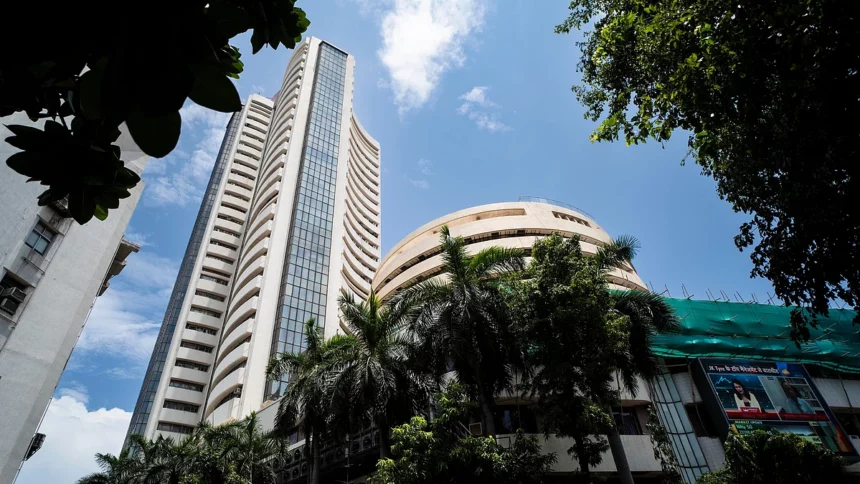
Indian equity markets extended strong gains on Monday, driven by renewed investor optimism after reports of progress in an interim trade framework between India and the United States. The announcement of the trade agreement, which includes a reduction of reciprocal tariffs to 18 percent on a number of Indian goods, provided a major boost to market sentiment. Benchmark indices opened higher, and throughout the trading session, investor enthusiasm persisted, with broad-based buying across sectors, particularly in banking, pharmaceuticals, metals, real estate, and consumer durables. The Sensex closed at 84,065.75, up 485 points, while the Nifty finished at 25,867.30, marking a gain of 173 points. Midcap and smallcap indices outperformed, reflecting increased risk appetite and the perception that the trade development could positively impact corporate earnings and export-driven sectors. Analysts and market participants viewed the trading session as a demonstration of the underlying strength in Indian equities, buoyed by macroeconomic stability, strong corporate performance, and external trade developments.
The session began on a positive footing, with the Nifty opening around 25,900 and touching an intraday high of 25,922.25 before profit-taking led to modest corrections. Despite intermittent selling, the indices maintained gains comfortably above critical support levels, signaling sustained market confidence. Investors responded positively to individual stock performance, with top gainers including State Bank of India, Shriram Finance, Titan, Dr. Reddy’s Laboratories, and Grasim Industries. Conversely, Max Healthcare, Power Grid Corporation, ITC, ONGC, and NTPC lagged, reflecting sector-specific pressures and profit-booking tendencies. Analysts noted that the gains were not isolated to large-cap stocks alone; midcap and smallcap segments saw significant inflows, suggesting that domestic liquidity and investor optimism were widespread. Market breadth favored buyers, with nearly all sectoral indices closing in positive territory, and gains were led by media, consumer durables, realty, PSU banks, pharmaceuticals, healthcare, and metals, rising between one and three percent.
Trade Deal Catalyzes Sectoral Performance and Boosts Investor Confidence
Investor sentiment across the equity markets was significantly influenced by the ongoing India-US trade discussions. Reports of a trade framework that included tariff reductions and enhanced economic cooperation removed a key source of uncertainty that had been weighing on investor confidence in export-driven and manufacturing sectors. Market participants saw the trade development as a catalyst for potential revenue growth for companies engaged in exports, particularly in diamonds, gemstones, pharmaceuticals, and specialty foods. For instance, companies in the diamond and gemstone industry witnessed sharp gains after the announcement that tariffs on exports to the United States would be reduced, leading to improved profitability and competitiveness. Similarly, companies like Apex Frozen Foods and Avanti Feeds experienced share price increases ranging from seven to nine percent, reflecting anticipated benefits from increased access to the U.S. market.
Banking stocks also led gains on the Nifty, with the State Bank of India registering a 7.5 percent rise following the announcement of a 24 percent increase in its Q3 profit. Strong financial performance in conjunction with favorable macroeconomic cues reinforced confidence in the sector. Additionally, corporate actions influenced market dynamics, with AXISCADES Technologies seeing a 5 percent gain after securing an order from HAL, while Force Motors rose 4.3 percent on acquiring complete equity in Veera Tanneries. Patanjali Foods recorded modest gains following block deals involving 53.60 lakh shares, and BEML surged 9 percent after board approval for a Rs 1,500 crore greenfield rail manufacturing facility. These developments underscore the role of both macroeconomic factors and company-specific events in shaping investor behavior.
Sectoral indices were broadly positive, demonstrating that the buying momentum was not limited to a handful of blue-chip companies. Realty, metals, and pharmaceuticals led the gains, reflecting investor confidence in structural growth, policy support, and export-driven earnings. Analysts highlighted that midcap and smallcap segments outperformed large-cap indices, indicating a willingness among investors to take on slightly higher risk in anticipation of stronger returns, particularly in sectors poised to benefit directly from policy and trade developments. Market momentum was further supported by global cues, as Asian indices and mixed international trends reinforced optimism about global economic recovery and bilateral trade agreements.
Technical Trends and Market Outlook Suggest Continued Positive Momentum
Technical analysts noted that the Nifty maintained an overall positive trajectory throughout Monday’s trading session, consolidating above the critical 25,800 level. The index’s movement reflected a combination of a bullish breakout and the continuation of a broader uptrend that began in early February. According to market experts, the formation of bullish “runaway gaps” on the daily charts, which typically appear mid-uptrend, suggests that the market is likely to continue testing higher levels. In the near term, analysts are closely watching the 26,000–26,350 range as potential upside targets, while immediate support for Nifty remains at 25,700, providing a cushion against short-term volatility.
The Sensex mirrored this trend, with gains led by sectors benefiting directly from trade facilitation and strong corporate earnings. Analysts emphasized that investor positioning should focus on selective stock picking, taking into account sectoral strength, company fundamentals, and macroeconomic indicators. While IT stocks participated in the rally, performance was rotational, underscoring the need for disciplined investment strategies. Technical research highlighted that sustained buying pressure, combined with strategic trade developments, created a favorable risk-reward environment for investors seeking both growth and stability.
The broader market dynamics were further reinforced by improvements in corporate earnings and continued optimism around structural reforms. Indian companies have been strategically leveraging government incentives, trade facilitation measures, and favorable macroeconomic conditions to improve profitability. For example, HBL Engineering shares fell marginally despite reporting a three-fold increase in consolidated Q3 profits, indicating that sector-specific factors, market positioning, and investor expectations continue to influence trading patterns. Similarly, Force Motors’ strategic acquisition of Veera Tanneries and BEML’s greenfield investment announcement reflect ongoing corporate initiatives to expand production, optimize costs, and capture market opportunities.
Global cues also played a critical role in bolstering domestic investor sentiment. As international markets responded to developments in trade agreements, geopolitical stability, and commodity prices, Indian equities benefited from positive spillovers, particularly in sectors tied to exports, metals, and consumer demand. Mixed global trends were absorbed by domestic optimism, reflecting confidence in the resilience of the Indian economy and the capacity of corporate India to capitalize on policy and trade opportunities. Analysts highlighted that while global volatility remains a factor, the underlying fundamentals in India, including strong corporate earnings, policy support, and investor confidence, are likely to maintain the upward momentum.
From a macroeconomic perspective, the India-US trade framework is viewed as a strategic enabler of growth, reducing barriers to exports, enhancing corporate competitiveness, and stimulating investor confidence across sectors. The reduction of reciprocal tariffs is expected to particularly benefit sectors like agriculture, pharmaceuticals, engineering goods, and processed foods. Market participants anticipate that these developments, combined with supportive fiscal and monetary policy measures, will create a conducive environment for sustainable growth, encouraging continued inflows into both large-cap and midcap stocks.
While market volatility is always a consideration, Monday’s trading session demonstrated the ability of Indian equities to respond positively to both macroeconomic and microeconomic catalysts. The Sensex and Nifty indices posted robust gains, driven by strong domestic demand, company-specific corporate actions, and the optimism generated by a prospective India-US trade agreement. Midcap and smallcap segments outperformed, reflecting broad-based buying, while sectoral strength was evident in realty, metals, and pharmaceuticals. Technical analysis suggests the Nifty is poised to test higher levels, while immediate support zones provide a buffer against downside risks. With sustained domestic consumption, supportive policy measures, strong corporate earnings, and ongoing trade developments, the market’s underlying trend appears favorable, setting the stage for potential further gains in the coming weeks.