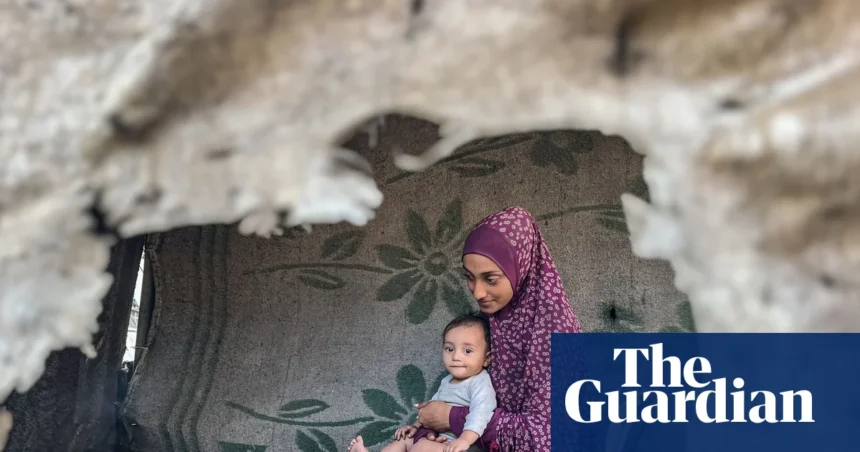
Fundraisers and mutual aid organisers working directly with displaced Palestinian families in Gaza have warned of a severe and “catastrophic” fall in donations since the October ceasefire, saying that public perception has shifted dramatically and many people mistakenly believe the suffering has ended. Despite the continuing destruction, extreme hunger, lack of shelter, collapsing healthcare, and a harsh winter approaching, the flow of small donations that had kept thousands alive for two years has dropped to its lowest point, threatening the survival of countless families.
Sharp decline in individual and grassroots donations leaves families vulnerable amid destroyed homes, hunger and approaching winter
Fundraisers supporting Palestinian civilians through mutual aid networks say that since the ceasefire was announced, donations have fallen so drastically that many families who were previously surviving on weekly or monthly support now receive almost nothing. Megan Hall, an organiser based in Australia who manages ninety-five individual aid funds for families in Gaza, said the decline began slowly in September but accelerated sharply after 10 October. Throughout the war, Hall regularly raised around five thousand dollars per week to distribute among families struggling with malnutrition, illness and displacement. But in October, all her campaigns combined barely reached two thousand dollars, a fraction of what was required for basic food, medicine and shelter.
Hall said the global public seemed to assume that a ceasefire meant the crisis had eased. In reality, she explained, the destruction of homes, infrastructure, farmland, livestock, hospitals and water systems means that people have less than ever before. She described how repeated displacements over two years have left families without cooking utensils, bedding, warm clothes or even a permanent roof. As winter approaches, many families, especially those with infants, elderly members or chronic illnesses, face life-threatening conditions.
Several other mutual aid organisers echoed this concern, confirming that donations across dozens of campaigns had fallen dramatically in the past four weeks. Unlike large humanitarian organisations that receive state funding or corporate support, these grassroots networks rely entirely on small contributions from individuals. Their visibility depends on social media outreach, which is increasingly difficult as access to electricity and the internet inside Gaza remains intermittent due to infrastructure damage.
Organisers point out that Palestinians themselves have been trying to raise awareness online whenever they manage to connect to the internet, often posting from bombed-out areas, crowded shelters and makeshift tents. But fundraising efforts cannot compete with the overall decline in global attention, which has led to the widespread belief that the ceasefire has resolved most problems.
Mainstream aid organisations have also witnessed declining support. Gaza Soup Kitchen, which raised more than five million dollars since early 2024 and provides ten thousand meals each day in the enclave, saw a fifty-one percent drop in donations between September and October. Its co-founder, Hani Almadhoun, said the organisation’s operations have not yet been disrupted, but long-term sustainability is now a pressing concern. He stressed that despite a temporary plateau in violence, the humanitarian need remains immense and unrelenting.
The World Health Organization referenced an assessment by SARI Global indicating that nearly seventy percent of Gaza’s population—about 1.9 million people—is living in areas exposed to harsh weather, coastal flooding and strong winds without any functional infrastructure. Most fields have been destroyed, livestock decimated, and a huge portion of the healthcare system has collapsed entirely. Families who have been uprooted over and over have depleted every coping mechanism they once had.
A spokesperson from the United Nations Office for the Coordination of Humanitarian Affairs said the ceasefire merely stopped constant airstrikes but did not improve living conditions. Entire neighborhoods remain uninhabitable. The spokesperson noted that “quiet skies do not equal restored lives,” explaining that survival remains a daily battle for many.
Save the Children UK reported that donations from its social media campaigns have fallen by one-third. The organisation’s spokesperson explained that lower media coverage leads to lower engagement on fundraising appeals, creating a cycle in which aid becomes more difficult to mobilise even as needs increase.
Although some aid trucks have entered Gaza through three of the seven border crossings, the UN said this remains insufficient. Around two thousand tonnes of food assistance are required daily, but only sixty percent of this is currently reaching the territory. Limited access to northern Gaza, destroyed roads and restrictions on aid distribution have further compounded the crisis.
One of the many families affected is that of Ahmed al-Deeb, twenty-eight, from Gaza City. For six months he has relied entirely on a mutual aid fund began by Hall. The fund has raised around six thousand five hundred dollars since its creation, gradually increasing until September, when donations nearly reached three thousand dollars. But in October, the total fell to just three hundred dollars, and in November barely one hundred and fifty dollars.
After the ground invasion in September, al-Deeb and his extended family of fourteen people—including a two-year-old niece suffering from illness—were forced to flee to Deir al-Balah. There, he rented a patch of land among ten other families and lived in a tent for three hundred dollars per month. When donations collapsed, he could pay the October rent only by borrowing money.
Terrified of facing winter in a tent, he returned to Gaza City in search of a damaged apartment. He found one, but must pay four hundred dollars a month, an amount he cannot afford. He said that if he cannot pay, his family will be evicted and have no option but to sleep in the streets. He believes his situation reflects the broader reality of thousands of families, many of whom live in shattered buildings where windows, walls and roofs are missing.
Markets are slowly beginning to show more food items, but prices remain high and supplies inconsistent. Al-Deeb’s family mostly survives on lentils and pasta. He has not received formal humanitarian assistance for eight months due to severe shortages and distribution challenges.
Other Palestinians across Gaza described similar hardship. Some reported that even families living in ruined buildings are still being charged rent by landlords, and those unable to pay face eviction. Children play amid rubble, parents struggle to keep tents from collapsing during rainstorms, and pregnant women fear giving birth without access to medical care or sufficient food.
Fundraisers attribute the sudden drop in donations not only to the ceasefire but also to donor fatigue, financial strain in Western nations and algorithmic bias on large social media platforms. Many long-time donors have exhausted their savings after two years of constant contributions. Some organisers said they have sold household furniture to continue sending assistance.
Meanwhile, financial hardships in donor countries have worsened. Public sector workers in the United States faced delays due to the government shutdown. Households in the United Kingdom and Europe are struggling under the rising cost of living. These economic pressures have naturally reduced the disposable income people can give to international causes.
In addition, social media algorithms appear to suppress pro-Palestinian content, making it harder for fundraisers to reach audiences outside activist circles. Paul Biggar, CEO of Tech for Palestine, said that biased visibility has severely limited outreach, resulting in declining donations even among newly interested supporters.
For Gaza’s population of around two million people, another unsafe and uncertain winter has begun. Families continue to face the threat of eviction, hunger and exposure to cold weather with no guaranteed access to water, fuel, heat or medicine. Many still live in skeletal remains of buildings, tents that flood during rainstorms, or crowded shelters with inadequate sanitation.
Al-Deeb, awaiting the next rent deadline with fear, said that if his family is forced out again, they will have nowhere to go. His final message expressed the sentiment of thousands enduring similar conditions: this is not the time for the world to look away.