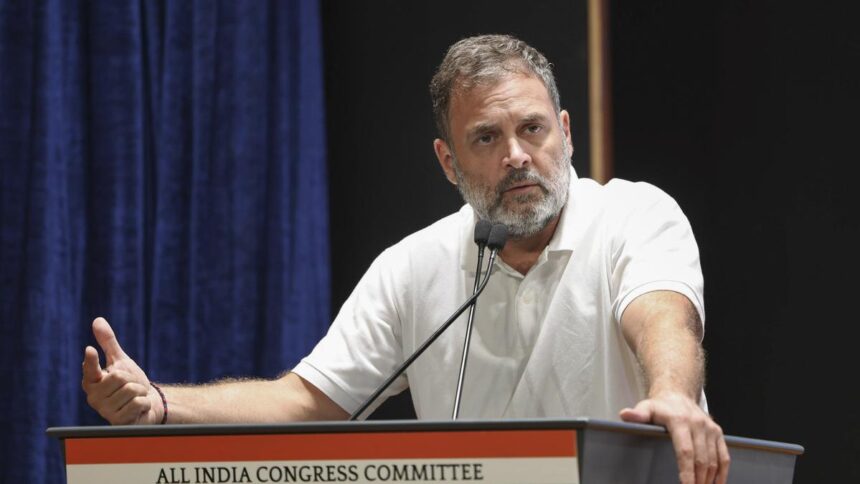
In a tense and highly charged political atmosphere, Congress leader Rahul Gandhi visited the family of Hari Om Valmiki, a Dalit man lynched in Rae Bareli, seeking to express solidarity and offer support while facing alleged administrative obstacles. The incident has not only triggered outrage across political and social spheres but also highlighted systemic issues concerning the safety, rights, and dignity of Dalits in Uttar Pradesh. Rahul Gandhi’s visit, which took place in Fatehpur along with Amethi MP Kishori Lal Sharma, became a focal point of debate, underscoring the interplay between politics, caste-based violence, and government accountability in the state. While the family had earlier released a statement suggesting they did not wish to meet opposition leaders, Gandhi spent considerable time listening to their grievances, reflecting his party’s stance on Dalit protection and social justice.
Rahul Gandhi’s Visit and Political Reactions
Rahul Gandhi arrived in Fatehpur amidst a backdrop of controversy surrounding the lynching of Hari Om Valmiki on October 2 in the Unchahar area of Rae Bareli. Valmiki, a Dalit native of Fatehpur district, was beaten to death by a mob on suspicion of theft, highlighting the persistent issue of caste-based violence in India. Police have so far arrested twelve accused in connection with the incident, yet the circumstances surrounding the lynching and the alleged inaction or delays in administrative response have sparked widespread outrage. The political significance of the case was amplified when news surfaced about alleged attempts by the Uttar Pradesh administration to intimidate the victim’s family and block Rahul Gandhi’s visit, raising questions about state accountability and the influence of political pressure in sensitive criminal cases.
Upon arrival, Rahul Gandhi spent nearly thirty minutes with the family in the Turab Ali ka Tola locality, listening attentively to their experiences and grievances. He stated that the government had threatened the family against meeting him, emphasizing that the core issue is not about political meetings but about ensuring that the victims and their families are not further criminalized or ostracized. Rahul Gandhi remarked that “these people are not criminals. They have committed no mistake,” reinforcing the Congress Party’s stance on protecting marginalized communities and advocating for justice in cases of caste-based violence.
Ajay Rai, the Uttar Pradesh Congress President, strongly criticized the Yogi Adityanath government for its handling of the incident, claiming that the state administration has engaged in systemic oppression and injustice against Dalits. Rai alleged that the Chief Minister only “came to his senses” after the Congress raised the issue publicly, implying a delay in accountability and action at the highest levels of state governance. Rai’s comments underscored the political dimension of the lynching, where parties are seeking to position themselves as defenders of marginalized communities, highlighting the sensitive balance between social justice, media attention, and political mobilization.
The situation was further complicated when, earlier on the day of Rahul Gandhi’s visit, the family of Hari Om Valmiki released a video statement declaring that they did not wish to meet him or any other opposition leader. The family expressed satisfaction with the action taken by the Yogi Adityanath government, urging political leaders not to “cash in on the tragedy.” This statement surfaced just hours before Rahul Gandhi was scheduled to arrive, creating a complex dynamic where the Congress leader’s intentions of offering support intersected with the family’s desire to avoid political exploitation. The family’s position highlights the delicate nature of engagement between political figures and victims’ families, emphasizing respect, consent, and the autonomy of those directly affected by violence.
During the visit, Rahul Gandhi reiterated Congress’s commitment to providing all possible help to the family and ensuring that justice is served. He stated that wherever atrocities against Dalits occur, the Congress Party will actively intervene and advocate for the victims. This declaration served not only as a reassurance to the Valmiki family but also as a broader political statement, positioning the party as a champion of Dalit rights and social justice, while simultaneously critiquing the current state administration for its perceived lapses in governance and protection of vulnerable communities.
Caste-Based Violence and Administrative Accountability in Uttar Pradesh
The lynching of Hari Om Valmiki has sparked renewed discourse on caste-based violence in Uttar Pradesh, where Dalits continue to face threats, discrimination, and systemic marginalization. Incidents such as these serve as stark reminders of the entrenched social hierarchies that perpetuate violence and discrimination, and the challenges faced by law enforcement and state machinery in ensuring timely justice. The case has triggered intense scrutiny of administrative mechanisms, with civil society groups and political observers demanding transparency, impartial investigations, and protective measures for victims’ families.
Experts argue that incidents of mob violence often reveal broader structural issues, including inadequate policing, delayed judicial processes, and political interference that undermine the rule of law. The administrative response in Rae Bareli has come under criticism, particularly in light of claims that the family faced intimidation when approached by political leaders. Such allegations raise serious questions about the role of the state in safeguarding not just individual victims but also the integrity of the justice system itself.
Beyond immediate administrative accountability, the case has ignited debates about the broader social and political responsibilities of leaders in India. Rahul Gandhi’s visit, while intended to demonstrate solidarity and offer support, became a focal point for discussions on how political interventions intersect with social justice, community trust, and public perception. Analysts note that in high-profile cases involving caste-based violence, political visibility can both amplify advocacy and risk overshadowing the victims’ voices, making sensitive navigation and respect for the affected families essential.
The political narrative around the incident also reflects the instrumentalization of social tragedies for electoral and party strategies. While opposition parties, including Congress, emphasize protection, justice, and activism, the ruling government is faced with defending its administrative actions and demonstrating commitment to law and order. The convergence of political positioning, media coverage, and grassroots mobilization creates a complex environment where every public statement, visit, and action is scrutinized for both its social impact and political resonance.
The role of media in such cases is equally significant, shaping public understanding and influencing accountability. Coverage of Rahul Gandhi’s visit, the family’s video statement, and subsequent political commentary has amplified awareness of the issues faced by Dalits, while also raising broader questions about how incidents of caste-based violence are reported, politicized, and addressed in India’s public discourse. Media scrutiny has the potential to encourage more prompt administrative action but also necessitates ethical reporting that centers the experiences and dignity of the victims and their families.
The larger implications of this case extend beyond Rae Bareli, highlighting persistent challenges in protecting vulnerable communities across India. Analysts emphasize that lynching and mob violence are symptomatic of deeper societal issues, including caste-based prejudices, social inequities, and failures in preventive governance. Comprehensive solutions require coordination between political authorities, law enforcement agencies, civil society, and community leaders to create an environment where such atrocities are not only investigated but also actively prevented.
Rahul Gandhi’s engagement with the family serves as a microcosm of broader debates on social justice, political responsibility, and ethical leadership. By publicly committing to support victims of caste-based violence, Rahul Gandhi aligns with a political narrative that seeks to emphasize the protection of marginalized groups, accountability of authorities, and the necessity of legislative and societal interventions to ensure justice. The visit also reflects the ongoing tension between political advocacy and the autonomy of families affected by violence, a balance that requires sensitivity, respect, and genuine commitment to social reform.
As the Rae Bareli case continues to draw attention, it has prompted multiple stakeholders—including political parties, media, and civil society—to reflect on the mechanisms necessary to prevent similar tragedies in the future. Experts advocate for robust policies addressing hate crimes, stronger legal safeguards, and systemic reforms in policing and judiciary processes. Moreover, educational and awareness campaigns are recommended to challenge caste-based discrimination and promote social cohesion, demonstrating that prevention and justice must operate hand-in-hand.
The political and social ramifications of the lynching incident are further magnified by Uttar Pradesh’s status as a politically significant state with diverse caste demographics. Events such as these influence electoral discourse, mobilize communities, and shape perceptions of governance effectiveness. Political leaders’ responses, administrative transparency, and media coverage collectively contribute to shaping narratives around justice, equality, and governance, reflecting the complex interplay between social realities and political accountability in India today.
The intersection of caste-based violence, media coverage, and political intervention underscores the critical importance of protecting democratic rights, ensuring freedom of expression, and upholding equality before the law. Rahul Gandhi’s visit, despite the family’s video statement expressing satisfaction with government action, demonstrates a continued effort by political actors to highlight social injustices and advocate for vulnerable communities. The incident serves as a reminder of the ongoing struggles faced by marginalized populations and the responsibilities of leaders, institutions, and citizens in safeguarding human rights, dignity, and justice.
Ultimately, the episode in Rae Bareli is emblematic of the broader challenges facing India in confronting caste-based violence, enforcing legal accountability, and balancing political activism with the autonomy and wishes of affected families. Rahul Gandhi’s visit, the responses from the administration, and the media coverage collectively illustrate the delicate negotiation between advocacy, governance, and ethical responsibility, providing a lens through which to examine the complexities of social justice, political engagement, and democratic principles in contemporary India.