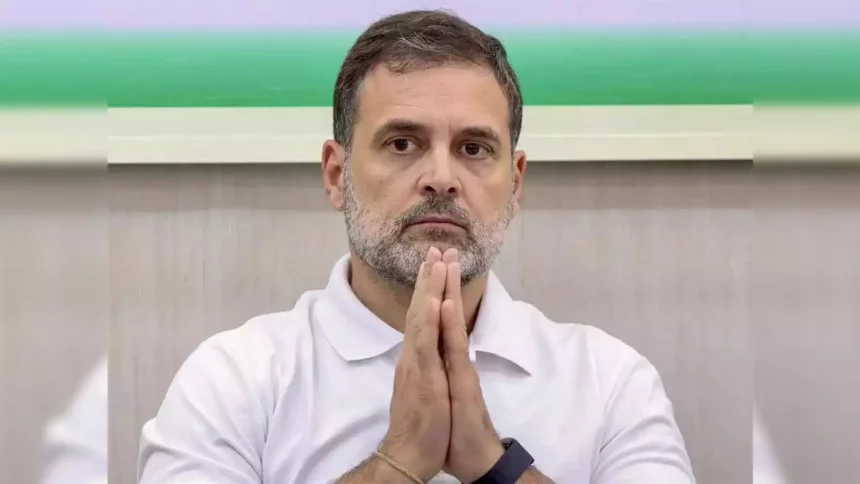
Congress leader Rahul Gandhi launched a scathing attack on both Prime Minister Narendra Modi and Delhi’s Chief Minister Arvind Kejriwal during his first public meeting for the Delhi assembly elections, emphasizing that there is little distinction between the two leaders. He accused them of serving the interests of powerful elites rather than prioritizing the welfare of the backward, Dalit, tribal, and minority communities.
Addressing a crowd at his rally, Rahul Gandhi made it clear that Arvind Kejriwal was following what he called “Narendra Modi’s strategy of propaganda and false promises” despite the persistent issues of pollution, corruption, and rising inflation in Delhi. He criticized Arvind Kejriwal for failing to deliver on his promises to clean up Delhi, remove corruption, and improve the national capital, calling out the AAP leader for making promises that were never realized. Rahul Gandhi stated that under Arvind Kejriwal’s leadership, Delhi had not seen the improvements he had once promised, particularly regarding pollution and inflation, both of which had worsened in recent years.
Rahul Gandhi also announced that if the Congress were to form the government in Delhi, they would conduct a caste survey in the city, a move he argued would help address the longstanding issues of inequality. He defended the Congress party’s past achievements under Sheila Dikshit’s leadership, asserting that neither Arvind Kejriwal nor the Bharatiya Janata Party (BJP) could match the track record of the Congress in terms of governance and development in Delhi.
Rahul Gandhi, a vocal critic of the current government’s policies, specifically targeted Arvind Kejriwal over the issue of caste census and reservations. He called on Arvind Kejriwal to make his stance clear on the demand for a nationwide caste census and the removal of the 50 percent cap on reservations. Rahul Gandhi promised that if the Congress formed the government at the Centre, it would push for a nationwide caste census and work to remove the reservation cap through legislation in both the Lok Sabha and the Rajya Sabha. He further added that the Congress was determined to create an India where equality prevailed, where the poorest, whether from any religion or caste, could dream big and realize their potential.
In his speech, Rahul Gandhi also highlighted the problem of inequality in India, pointing to the fact that the country’s top companies were predominantly led by individuals from privileged communities, and none were headed by members of backward, Dalit, tribal, or minority communities. He criticized both Narendra Modi and Arvind Kejriwal for not speaking up on the issue, claiming that they were reluctant to address the real problems facing marginalized communities.
Rahul Gandhi remarked that the Congress party had a clear vision for the country, one that was based on equality, justice, and opportunity for all. He vowed that the Congress would fight against the influence of billionaires like Adani and Ambani, who he claimed controlled large sectors of India’s economy while the poor continued to suffer. Rahul Gandhi insisted that the Congress was committed to protecting the interests of the common people, and would not allow the country to be run by a handful of wealthy individuals. He rhetorically asked whether Arvind Kejriwal and Narendra Modi had ever spoken out against these business magnates.
The Congress leader also reflected on the party’s past achievements, including the implementation of the Right to Information (RTI), land acquisition reforms, the Right to Food, and the Mahatma Gandhi National Rural Employment Guarantee Scheme (MGNREGS). He promised that the Congress would continue to prioritize the needs of the common people, as it had done in the past under Sheila Dikshit’s leadership, which he claimed was the golden era of governance in Delhi. Rahul Gandhi asserted that Arvind Kejriwal and the BJP could never replicate the achievements made by the Congress.
As he spoke about the political situation in the country, Rahul Gandhi expressed his unwavering commitment to protecting the Indian Constitution, stating that it belongs to everyone and not just to a small group of elites. He strongly condemned the ideology of the BJP and the Rashtriya Swayamsevak Sangh (RSS), accusing them of spreading hatred and division in the country. He pointed out that during the Bharat Jodo Yatra, he had walked thousands of kilometers to protect the Constitution and the values it enshrines.
Rahul Gandhi’s speech also included a direct appeal to the people of India to support Congress in its fight against what he described as the divisive politics of the BJP and the RSS. He stressed that the Congress party would continue to oppose the BJP-RSS ideology and would work towards an India where everyone, irrespective of caste or religion, had equal opportunities.
At the rally, Rahul Gandhi emphasized the importance of unity in India, saying that the Congress would strive to ensure that the country remained a place where everyone could dream big, irrespective of their background. He reiterated his commitment to protect every Indian, regardless of their caste, religion, or community, and vowed to continue the fight for equality, justice, and social harmony.
The upcoming Delhi assembly elections will be crucial for both Congress and AAP, who are now contesting separately despite being part of the opposition alliance, INDIA. With Congress aiming to regain its relevance in Delhi, Rahul Gandhi’s speech was aimed at appealing to the masses and asserting that only the Congress party could deliver the promises that Arvind Kejriwal and Narendra Modi had failed to keep.
As the political battle intensifies in Delhi, it remains to be seen whether Gandhi’s clarion call will resonate with the voters, especially given AAP’s growing influence in the region. However, with the Delhi assembly elections on the horizon, one thing is clear: the political dynamics in the capital are set for a fierce contest between Congress, AAP, and the BJP.