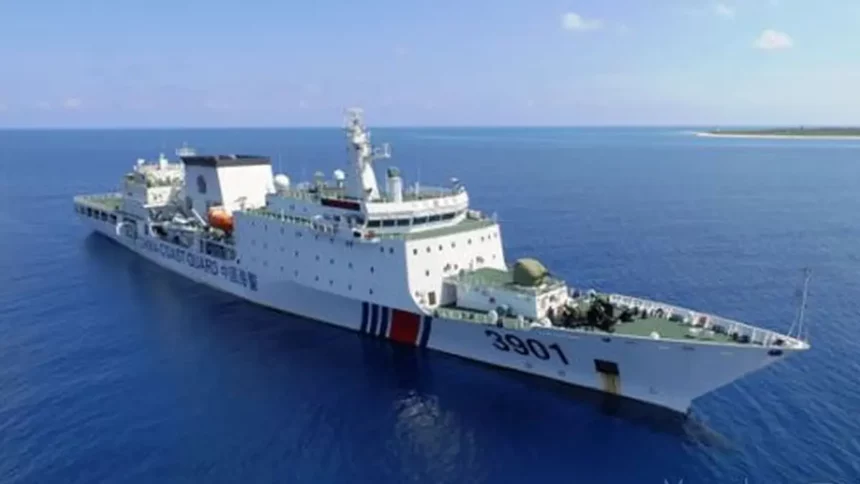
The Philippines has formally raised concerns regarding the recent deployment of China’s largest coastguard vessel inside its exclusive economic zone (EEZ), located within the contested waters of the South China Sea. The Philippine government has voiced alarm over the presence of the 165-meter long Chinese coastguard ship, identified as vessel 5901, which was found operating 77 nautical miles off the coast of Zambales province. The Philippines National Security Council spokesperson Jonathan Malaya condemned the intrusion, describing it as a provocative act meant to intimidate Filipino fishermen working in the disputed waters around a shoal that has been a source of long-standing contention between China and the Philippines.
In response to the presence of the Chinese vessel, the Philippine government lodged a formal protest against the Chinese action, demanding that the ship immediately withdraw from Philippine waters. Malaya emphasized that such deployments threaten the safety and livelihood of local fishermen, as well as breach Philippine territorial rights. China, however, defended the actions of its coastguard, asserting that its patrols and law enforcement activities in the area were within their rights and fully legal. Chinese Ministry of Foreign Affairs spokesperson Guo Jiakun described the operations as “reasonable, lawful, and beyond reproach,” further reinforcing China’s stance that it has sovereignty over most of the South China Sea.
The tensions between China and the Philippines have been mounting over the past two years due to their conflicting claims in the South China Sea. In addition to the deployment of the massive coastguard vessel, the Philippine National Maritime Council also condemned the activities of other Chinese maritime forces in the region, including Chinese naval helicopters that hovered over a Philippine coastguard vessel. The Council decried the “illegal presence and operations” of the Chinese ships and personnel in the Philippine EEZ, which has been a subject of international dispute for years. The Philippines claims sovereignty over parts of the waters, while China asserts almost total control over the area, despite a ruling from an international tribunal in 2016 which declared China’s expansive claims in the South China Sea to be without legal basis. Beijing has consistently rejected the ruling and has continued to pursue its territorial claims in the region.
The South China Sea is a critical maritime region, as it serves as a strategic shipping route through which approximately $3 trillion worth of global trade passes each year. The waterway is also rich in natural resources, further intensifying the territorial disputes between China, the Philippines, and other Southeast Asian nations such as Brunei, Malaysia, and Vietnam. The Philippines, along with other nations with claims in the South China Sea, has called for a peaceful resolution to the conflict, but tensions have escalated in recent years, particularly with China’s aggressive maritime activities.
The Philippine government continues to assert its rights over its territorial waters, in accordance with international law, and has vowed to take all necessary steps to safeguard its sovereignty and protect its citizens from any forms of intimidation or aggression in the region. As the situation continues to unfold, the international community is watching closely to see whether diplomatic efforts will be able to resolve the longstanding disputes or whether tensions will continue to escalate in this strategically important and highly contested area of the South China Sea.