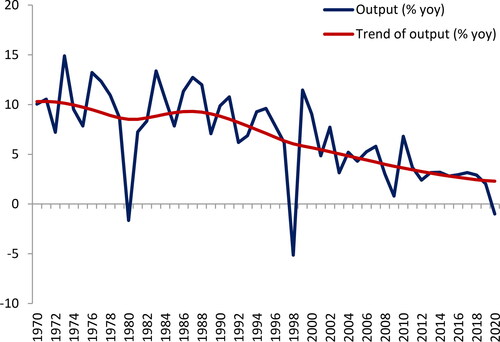
South Korea’s fourth-quarter GDP growth for 2024 came in below expectations, marking a six-quarter low. The country’s economy grew by just 1.2% compared to the same period a year earlier, missing the 1.4% expansion that economists had forecast. This result marks a significant slowdown from the 1.5% growth seen in the previous quarter. On a quarter-on-quarter basis, the economy grew only 0.1%, well below the 0.2% growth expected in a Reuters poll. While the full-year GDP growth for 2024 was reported at 2%, compared to 1.4% in 2023, the data highlights a concerning trend of weaker-than-anticipated growth, particularly driven by the slowdown in consumption and construction sectors.
The fourth-quarter economic performance was impacted by sustained weakness in both private consumption and the construction industry. Despite the overall decline, certain sectors experienced positive growth. For instance, government consumption, facility investment, and exports saw improvements during the period. However, the Bank of Korea (BOK) noted that the construction industry continued to face challenges, contributing to the overall slowdown. The services sector also saw a reduction in growth, while the manufacturing industry fared better, showing a faster rate of growth compared to the previous year.
The slowdown in domestic demand has emerged as a critical factor dragging down the country’s economic performance. Consumer spending, which had grown at a rate of 0.5% in the third quarter, decelerated to just 0.2% in the final quarter of the year. Economists, including Shivaan Tandon of Capital Economics, expressed concerns that the ongoing political instability and a bleak outlook for the construction sector might lead to continued weakness in the economy in the short term. Tandon revised his growth forecast for 2025 to just 1.1%, significantly lower than the Bank of Korea’s most recent projection of 1.6% to 1.7% growth.
This economic slowdown has also impacted investor sentiment, with the South Korean won weakening by 0.13% to 1,436.4 against the U.S. dollar. The country’s benchmark stock index, Kospi, fell by 0.47% following the release of the GDP data.
The Bank of Korea has faced challenges in managing the economic outlook. After cutting interest rates by 25 basis points in late November, the central bank opted to hold rates steady in its January meeting. The BOK’s policy rate currently stands at 3%. The central bank has warned that downside risks to economic growth have intensified due to the political instability and heightened exchange rate volatility. Additionally, export growth is expected to slow, and domestic demand recovery is anticipated to occur at a slower pace than previously forecasted.
The decline in consumer sentiment also signals broader concerns within the economy. In December 2024, the consumer sentiment index plummeted to its lowest level since November 2022, reaching a reading of 88.4. This sharp drop came after a brief period of political turmoil, which included the controversial declaration of martial law by impeached President Yoon Suk Yeol. The index did show a slight recovery in January, rising to 91.2, but it remained below the threshold of 100, indicating that consumer pessimism about the economy still prevails.
South Korea’s GDP for the full year 2024 showed growth compared to 2023, the country’s economic performance in the fourth quarter highlighted the growing challenges posed by weak domestic demand, particularly in consumption and construction. The political landscape, along with global economic uncertainties, continues to cast a shadow over the nation’s economic outlook. With experts predicting slower recovery in 2025, South Korea’s economy faces a tough road ahead as it navigates these uncertainties.