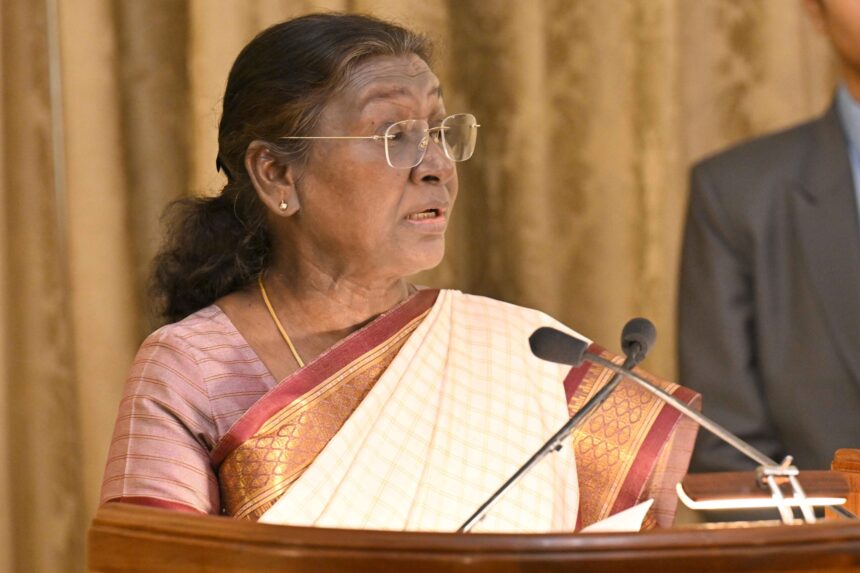
Droupadi Murmu has begun a four-day official visit to Goa, Karnataka and Jharkhand, a tour that brings together key national priorities such as defence preparedness, higher education, linguistic heritage and the celebration of tribal culture. The visit reflects the constitutional role of the President as a unifying figure who engages with diverse regions, institutions and communities, while also underscoring the importance of India’s cultural plurality and strategic strength.
The President is scheduled to depart for Goa this evening, marking the first leg of her multi-State itinerary. Over the next four days, she will participate in programmes that span naval operations, academic ceremonies and cultural gatherings, each highlighting a different facet of the nation’s identity. From maritime security on the western coast to the preservation of indigenous scripts and traditions in eastern India, the visit is designed to showcase continuity between India’s past, present and future.
Defence engagement and maritime significance in Goa and Karnataka
The opening phase of President Murmu’s tour begins in Goa, a State that occupies a strategic position along India’s western coastline. While the stay in Goa is brief, it sets the tone for the defence-related engagements that follow. Goa’s proximity to major naval installations and its role in maritime surveillance make it an important location in the broader context of national security.
On the second day of her visit, the President will travel to Karnataka, where she is scheduled to undertake a sea sortie in a submarine from Karwar Harbour. Karwar is one of India’s most significant naval bases and serves as a hub for advanced maritime operations. The submarine sortie is expected to underline the critical role of the Indian Navy in safeguarding the country’s extensive coastline and sea lanes, which are vital for trade, energy security and regional stability.
The engagement is widely seen as a symbolic affirmation of India’s defence preparedness and technological capabilities. A President undertaking such a sortie sends a strong message of confidence in the armed forces and highlights the importance accorded to maritime security at the highest constitutional level. It also reflects India’s growing emphasis on strengthening its naval presence in the Indian Ocean region, amid evolving geopolitical dynamics.
The visit to Karwar is not only about showcasing military hardware or operational readiness but also about recognising the dedication of naval personnel who operate in demanding and often unseen conditions. By directly engaging with defence establishments, the President reinforces the link between civilian leadership and the armed forces, an essential element of a robust democratic system.
Celebrating language, education and tribal culture in Jharkhand
The latter part of President Murmu’s four-day tour takes her to Jharkhand, a State with deep tribal roots and rich cultural traditions. On December 29, she will visit Jamshedpur to grace the centenary celebrations of Ol Chiki Lipi. The Ol Chiki script was created in 1925 by Raghunath Murmu for the Santali language and holds immense cultural and linguistic significance for the Santhal tribal community.
Ol Chiki is more than a writing system; it is a symbol of identity, self-expression and cultural continuity. For decades, it has played a crucial role in preserving Santali literature, folklore and oral traditions, giving them a written form that could be passed down through generations. The centenary celebrations are expected to highlight the enduring relevance of the script in promoting indigenous knowledge systems and reinforcing the cultural confidence of tribal communities.
President Murmu’s participation in the event carries particular resonance, given her consistent emphasis on inclusivity and respect for tribal heritage. Her presence underscores the Union government’s focus on recognising and honouring India’s diverse linguistic traditions, especially those rooted in indigenous communities that have historically been underrepresented in mainstream discourse.
Later the same day, the President will address the 15th convocation ceremony of the National Institute of Technology Jamshedpur. The convocation marks an important milestone for graduating students who are poised to enter professional fields across engineering, technology and research. In her address, the President is expected to speak about the role of higher education in nation-building, the importance of innovation and the responsibility of young professionals in shaping India’s future.
The interaction with students and faculty highlights the President’s engagement with academic institutions and her emphasis on education as a driver of social and economic progress. Institutions like NIT Jamshedpur play a critical role in producing skilled professionals and fostering research, making such engagements significant beyond ceremonial value.
On December 30, President Murmu will travel to Gumla, where she will attend and address the Antarrajyiy Jansanskritik Samagam Samaroh–Kartik Jatra. This inter-State cultural gathering celebrates folk traditions, art forms and community participation, bringing together diverse cultural expressions on a single मंच. The event is expected to emphasise cultural unity, social harmony and the preservation of traditional practices in a rapidly modernising society.
By addressing this gathering, the President highlights the importance of cultural dialogue and mutual respect among communities. Such events serve as reminders that development and modernisation need not come at the cost of cultural erosion, and that traditional knowledge and practices continue to have relevance in contemporary India.
Across Goa, Karnataka and Jharkhand, President Droupadi Murmu’s four-day tour reflects a broad engagement with the nation’s strategic, educational and cultural dimensions. From reinforcing maritime security to celebrating linguistic heritage and academic achievement, the visit brings together multiple strands of India’s national narrative under the unifying framework of constitutional values and inclusive development.