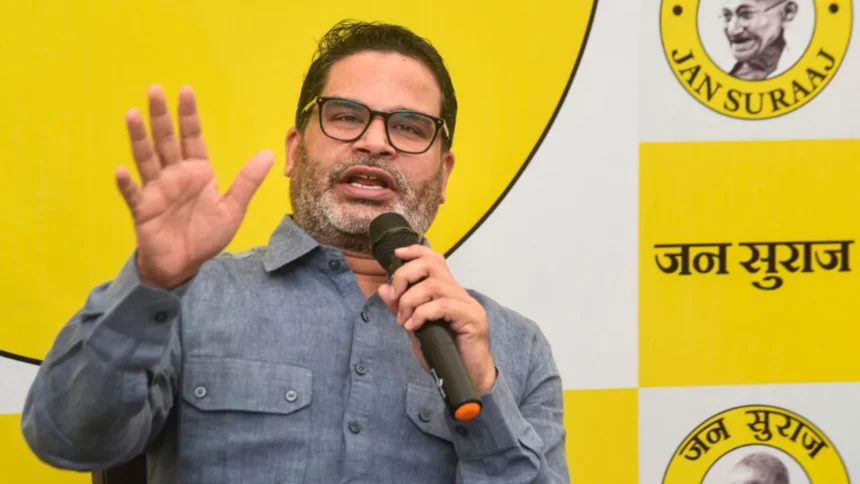
In a major declaration aimed at reshaping the political landscape of Bihar, Jan Suraaj Party founder and former poll strategist Prashant Kishor announced that he will contribute 90 percent of his income for his party’s campaign over the next five years, along with donating almost all the assets he has accumulated over the past two decades. Speaking to reporters after completing a day-long silent fast at the Gandhi Ashram in West Champaran, Kishor highlighted that this step symbolizes his commitment to building a clean, people-driven political alternative in the state.
Kishor’s financial pledge, public appeal, and roadmap for strengthening Jan Suraaj
Prashant Kishor’s decision to part with a large portion of his income is not simply a symbolic gesture; it represents a larger ideological and strategic shift in his movement. He said he will donate everything he has earned during the past twenty years, except for his Delhi house, to strengthen the work of the Jan Suraaj Party. According to him, this financial sacrifice is essential to build a political platform that is transparent, accountable and free from the influence of corporate or vested interests.
He urged the people of Bihar to contribute a nominal amount of ₹1,000 every year to the party. Kishor made it clear that he would refuse to meet anyone who does not support the movement with this minimum contribution. He emphasized that political change is a shared responsibility, and if the people desire transformation in governance, they must be prepared to support that transformation materially.
Kishor said that the Jan Suraaj movement has always been rooted in the belief that politics should serve society, not exploit it. By asking citizens to contribute directly, he aims to establish a participatory political model in which common people become stakeholders rather than passive observers. He stated that a people-funded political movement ensures independence from big donors and allows a party to remain committed to its mission without pressure from external interest groups.
Responding to questions about the timing of his announcement, Kishor noted that Bihar is at a critical juncture. The state has long been affected by corruption, unemployment, lack of development, and political instability. He believes that without an organised and ethical movement, meaningful change will remain out of reach. His personal financial contribution, he said, is a way of reinforcing his own accountability to the people.
He further added that the Jan Suraaj Party will work to ensure that the much-publicised promise made by the NDA during the elections—of transferring ₹2 lakh to women in Bihar—actually reaches those women. Kishor alleged that the NDA had already transferred ₹10,000 to the bank accounts of over one crore women before the elections to influence voting. He stated that such tactics undermine democratic integrity and reflect the growing distance between political power and public welfare.
Kishor challenged the government to take legal action against him if they believe he has made any false claims. He expressed confidence in his assessment and said that political leaders must have the courage to speak the truth, even if it threatens their own position.
He reiterated that strengthening the organisational structure of the Jan Suraaj Party will be a priority in the months ahead. He said that the party is preparing to build a more systematic, decentralised structure across urban and rural Bihar. According to him, a strong organisation is essential for inspiring public trust and carrying forward a long-term mission for the state. His focus, he said, is not on short-term political gains but on preparing the foundation for a more equitable political culture.
Bihar Navnirman Sankalp Yatra and the plan to reach every household in the state
Along with his financial pledge, Kishor unveiled the next major phase of his political strategy: the Bihar Navnirman Sankalp Yatra. Under this campaign, he and his party workers will visit every household in Bihar over the next fifteen to eighteen months. Kishor described this yatra as a massive outreach programme aimed at educating people about the failures and misgovernance of the current administration.
He explained that the yatra is not merely a political tour but a social movement that invites ordinary people to participate in the rebuilding of Bihar. He said that the state’s problems cannot be solved only through speeches or electoral campaigns; they require meaningful interaction with citizens, honest listening and consistent engagement with their struggles.
The yatra will include door-to-door interactions, community meetings, dialogues with farmers, youth groups, women’s associations, workers, teachers and others. Kishor believes that this direct contact will help the party create a database of local issues, develop region-specific solutions and build trust among communities that feel ignored by mainstream politics.
He added that thousands of volunteers have already joined the Jan Suraaj movement. These volunteers will have a key role in the yatra, helping to organise meetings, mobilise people and document grievances. Kishor expects the number of volunteers to grow substantially in the coming months as more people realise the need for a new direction in Bihar’s politics.
He said that the purpose of the yatra is not just to expose shortcomings of the government but also to offer an alternative vision rooted in accountability, transparency and effective public service. Kishor believes that if people are genuinely heard and respected, they will naturally support a political movement that prioritises their welfare.
The Jan Suraaj Party contested 238 of the 243 seats in the recently concluded Bihar Assembly elections but did not win any seat. Despite gathering significant public support during campaigns and roadshows, the support did not translate into electoral success. Kishor acknowledged the setback but said that building a new political culture takes time, and the recent elections were only the beginning of a much longer movement.
The NDA, meanwhile, secured a historic victory by winning 202 out of 243 seats, while the opposition Mahagathbandhan was reduced to only 35 seats. Kishor said that these results show the need for a stronger, more grounded alternative movement that does not rely on traditional political formulas. He believes that the Jan Suraaj movement will evolve with time and eventually emerge as a credible force if it stays committed to its core values.