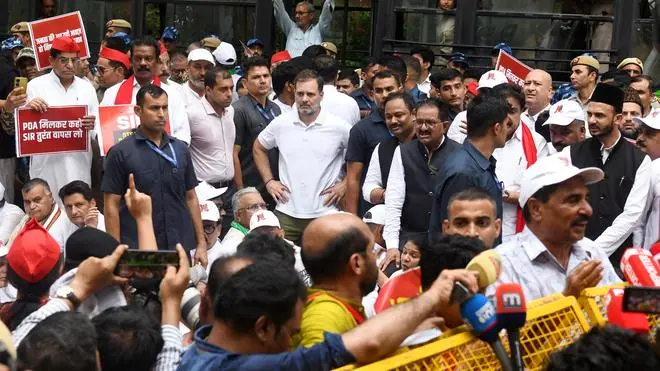
The opposition parties are preparing to raise strong objections against the ongoing special intensive revision of electoral rolls and the broader issue of alleged vote theft during the upcoming winter session of Parliament. Although united in their criticism of the Election Commission of India, the parties plan to approach the matter using diverse strategies shaped by their individual political contexts, recent electoral experiences and regional challenges.
Opposition outlines separate strategies to criticise ECI, highlight regional concerns and question electoral transparency
As Parliament’s winter session, scheduled from December 1 to 19, approaches, opposition parties are preparing to confront the government and the Election Commission over what they describe as unfair practices in electoral management. The Union government has convened an all-party meeting on November 30 to discuss key issues, but opposition leaders indicate that electoral integrity will be the central point of contention.
Congress leaders have already confirmed that their focus will revolve around the Bihar election results and their ongoing nationwide campaign seeking 50 million signatures against what they describe as vote theft. With the party winning only six seats in the Bihar assembly elections, Congress plans to organise a major rally in Delhi early next month to culminate its signature drive. Party spokesperson Pawan Khera clarified that the event will be a Congress-specific rally rather than one under the wider INDIA alliance banner. He said that Congress intends to raise public awareness about what it views as systemic flaws in the electoral process, including the special intensive revision and the broader issue of voters being unfairly removed or manipulated.
Khera recalled that the Supreme Court has passed multiple orders concerning the special intensive revision, which, according to him, exposed the Election Commission’s shortcomings. He said the party’s signature campaign reflects a nationwide effort to protect citizens’ voting rights. He emphasised that any attempt to deprive voters of their franchise must be resisted collectively, portraying this as not merely a political dispute but a democratic necessity.
The Trinamool Congress is preparing its own line of attack based on concerns raised by West Bengal chief minister Mamata Banerjee in her letter to the chief election commissioner. The letter demanded an immediate halt to the special intensive revision, describing the ongoing exercise as unplanned and coercive. Banerjee warned that continuing the process under its current structure could jeopardise both the safety of those involved and the legitimacy of the electoral rolls.
Trinamool Congress leader Derek O’Brien stated that his party’s strategy for the winter session will focus substantially on the functioning of the Election Commission. He confirmed that the party will seek a full debate in Parliament on the role, responsibilities and recent actions of the Commission. He also pointed to nine instances in the past when the functioning of the Election Commission had been discussed in Parliament, citing examples from 1965, 1981 and 1982 to illustrate parliamentary precedent. O’Brien criticised what he believes is the Centre’s attempt to shorten the winter session to avoid a thorough debate on the special intensive revision.
Meanwhile, the Dravida Munnetra Kazhagam is expected to centre its interventions on the Tamil Nadu government’s ongoing challenge against the special intensive revision in the Supreme Court. Tamil Nadu has argued that the revision could lead to errors, mismanagement and potential disenfranchisement in the state. For the DMK, the issue ties directly into a broader narrative of federalism, state autonomy and institutional accountability.
According to opposition leaders, the Aam Aadmi Party may not follow the Congress approach but could align its parliamentary interventions with the Trinamool Congress or the Samajwadi Party. The
opposition bloc is thus not entirely unified in its strategy, though several parties share the broad objective of questioning the transparency and fairness of the electoral roll revision.
The special intensive revision began in West Bengal on November 4 ahead of the state’s assembly elections next year. Mamata Banerjee’s letter highlighted concerns that the revision drive may disrupt public order and cause administrative difficulties. The Trinamool Congress maintains that the timing, pace and method of the revision process require urgent reconsideration.
According to individuals familiar with the matter, several opposition parties believe that the Election Commission’s recent conduct reflects larger concerns about institutional imbalance and diminishing public trust. They argue that any revision of electoral rolls must be transparent, carefully monitored and free of coercive practices to ensure that no citizen is unfairly removed.
Apart from electoral matters, the winter session is expected to include debates on a range of issues, but leaders across the opposition spectrum privately admit that elections and voter rights will dominate their agenda. For them, the legitimacy of the electoral system is foundational, and any perceived threat to it must be taken seriously.
International climate negotiations intensify as Lula pushes for a roadmap to phase out fossil fuels at COP30
As domestic political tensions escalate, global climate negotiations at COP30 are simultaneously witnessing heightened urgency and deepening divisions. In Belem, Brazil, President Luiz Inácio Lula da Silva engaged in extensive meetings to accelerate agreements on contentious issues such as climate finance, fossil fuel phase-outs and equitable transitions. Despite efforts by the COP30 presidency to finalise the Belem package texts by Wednesday evening, the documents were still under negotiation late into the night.
More than 80 countries have publicly endorsed the idea of a global roadmap to gradually phase out fossil fuels. Lula, upon arriving at the COP venue, held extensive discussions with ministers from China, India, Indonesia and Latin American countries. According to observers, the draft text under consideration calls on nations to develop equitable transition roadmaps, reduce dependency on fossil fuels and work toward reversing deforestation.
Groups representing like-minded developing countries expressed frustration that several developed nations are not on track to meet their greenhouse gas reduction targets for 2030, as required under the Paris Agreement. They warned that the burden of climate mitigation must not be shifted disproportionately onto the developing world.
India’s environment minister Bhupender Yadav reiterated that developed countries must reach net-zero emissions far earlier than currently planned and fulfil their financial commitments under Article 9.1 of the Paris Agreement. He emphasised the importance of adequate, affordable and accessible climate finance free from restrictive intellectual property barriers. Yadav said this COP should be remembered for turning commitments into meaningful action, calling it a conference of implementation and delivery.
Several developed countries indicated interest in the fossil fuel roadmap proposal. However, climate advocates criticised these nations for expanding fossil fuel projects in their own regions while expecting developing countries to curb their reliance. The European commissioner for climate action, Wopke Hoekstra, said that Europe supports the roadmap concept even though it uses different terminology. He outlined Europe’s goal to reach 90 percent emission reductions by 2040 as part of its broader transition plans.
Later in the evening, Lula addressed the media, stressing the need for consensus. He said each country must act within its capacities but acknowledged that reducing greenhouse gas emissions is essential and that dependency on fossil fuels must be addressed. Negotiators expect new draft texts to be released on Thursday as Lula continues efforts to build agreement.
Climate justice advocates raised concerns that the current draft text appears to weaken commitments and protect wealthy nations while burdening developing countries. They argued that the process has often marginalised vulnerable communities and disregarded Indigenous concerns. One environmental activist warned that the climate regime risks being diluted in a way that allows developed countries to avoid accountability while pushing mitigation responsibilities onto the global south.
The activist urged Brazil to ensure that final decisions reflect principles of equity and justice and prevent COP30 from becoming a symbolic failure. Observers noted that the negotiations reflect deep struggles between climate ambition, economic interests and geopolitical realities.