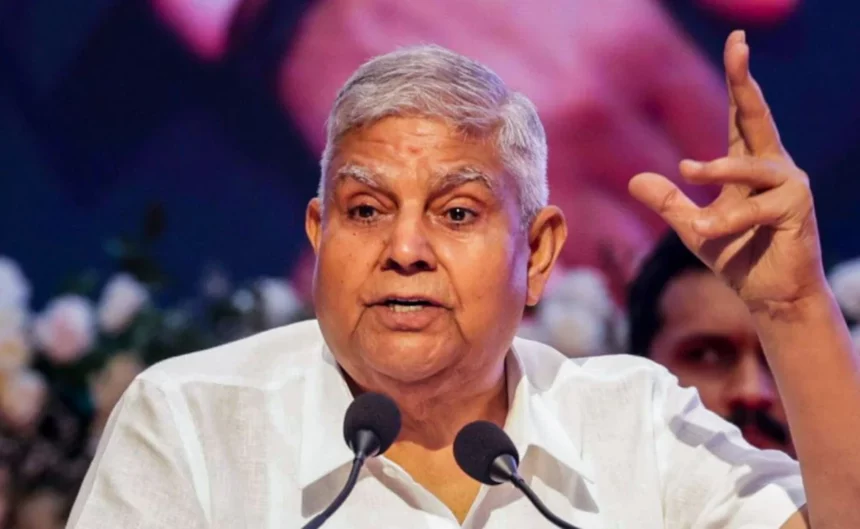
In his first major public appearance since stepping down as India’s vice president four months ago, Jagdeep Dhankhar addressed a gathering in Bhopal during the launch of senior RSS functionary Manmohan Vaidya’s new book. His remarks explored themes of duty, national narratives, disruptive technologies, and India’s civilizational strength at a time of global contestation.
Dhankhar Reflects on Duty, Public Life and His “Recent Past”
Jagdeep Dhankhar’s unexpected resignation earlier this year created ripples across political and public discourse. Citing health reasons, he stepped down from the second-highest constitutional office in July, expressing gratitude to President Droupadi Murmu for what he described as a harmonious and respectful working relationship during his tenure. His successor, former Maharashtra governor C. P. Radhakrishnan, took office in September after securing victory in the vice-presidential election.
Appearing in Bhopal for the release of Manmohan Vaidya’s book Hum Aur Yeh Vishwa, Dhankhar delivered an address that combined philosophical observations, personal reflections and political undertones. He opened his speech by acknowledging the significance of the occasion and expressing appreciation for the book’s message, which he said encourages India to look inward and draw upon its deepest historical and cultural narratives.
At one point during his address, an attendee approached him discreetly to remind him of his scheduled flight to Delhi. Dhankhar responded humorously but meaningfully, telling the audience that he could not abandon his duty simply to catch a flight. Adding a layer of intrigue, he remarked, “my recent past is proof of it,” hinting at his decision to place responsibility over personal convenience during his years in public office.
The comment drew attention not only because of its timing but also because it subtly referred to his sudden resignation, which many interpreted as a difficult personal decision made under challenging circumstances. Dhankhar did not elaborate on the remark, maintaining a stance of restraint while allowing listeners to interpret his words within the broader context of political responsibility and constitutional duty.
He continued his address by cautioning against the risk of getting trapped in prevailing narratives—what he called a “chakravyuh.” Without claiming to reference his own situation, he spoke about the difficulty individuals face once they become entangled in ideological, political or media-driven storylines. He emphasized the importance of moral clarity and intellectual independence at a time when information warfare is shaping public perception across the world.
Dhankhar also expressed concern that, in contemporary society, some people appear to be drifting away from moral, spiritual and intellectual anchors. He urged individuals and institutions to re-center themselves in principles that have historically guided India’s civilizational ethos.
India’s Deep Civilizational Inheritance Amid Disruptive Technologies
A significant portion of Dhankhar’s speech focused on the rapid rise of disruptive technologies such as artificial intelligence, blockchain, internet of things and machine learning. He noted that these technologies, while offering immense opportunities, also carry risks in the form of misinformation, manipulation, privacy breaches and amplified geopolitical tensions.
He described this era as one of “civilizational contestation,” where nations compete not just economically or militarily but through narratives, values and cultural influence. In this context, he argued that India must rely on its enduring civilizational wisdom.
According to Dhankhar, the book Hum Aur Yeh Vishwa reinforces this argument by providing insight into India’s position in an evolving global environment. He explained that the work illustrates how India can face challenges through reliance on its spiritual and cultural inheritance, which he described as the country’s “North Star” or “lighthouse” amid turbulent times.
Dhankhar highlighted that technological revolutions have historically tested societies, often overwhelming those that lack moral, cultural or philosophical grounding. For India, he said, the answer lies not in rejection of innovation but in harmonizing technological progress with long-standing value systems.
He noted that modern information warfare aims to distort reality, weaken social fabric and create internal conflict. As a result, nations with deep cultural frameworks are better prepared to withstand external and internal pressures. Dhankhar argued that India’s resilience owes much to its philosophical traditions of inquiry, tolerance and responsibility.
During his remarks, he also addressed perceptions surrounding the Rashtriya Swayamsevak Sangh (RSS). Referring to the book’s analysis, Dhankhar said it exposes propaganda that portrays the RSS as an ultra-right organization. He added that allegations linking the organization to Mahatma Gandhi’s assassination are baseless and historically incorrect, pointing out that such narratives often serve political or ideological agendas rather than truth.
As he praised the book, Dhankhar positioned it as a tool that challenges long-standing distortions and encourages rational engagement with India’s social and cultural realities. He emphasized that correcting misinformation is essential not just for institutional credibility but for national coherence.
Throughout his speech, Dhankhar underscored the idea that India’s future success will depend on its ability to combine innovation with moral grounding. He encouraged greater public awareness of disruptive technologies and warned that the nation must remain vigilant against the destabilizing effects of manipulated information and algorithm-driven narratives.
Taking a reflective tone, he suggested that the modern world is witnessing a shift in power dynamics where information, perception and digital influence often outweigh traditional forms of strength. He argued that India can navigate this transformation by relying on its internal strengths—ethical traditions, philosophical depth and the spirit of collective resilience.
Dhankhar concluded by reiterating the need for moral and intellectual clarity during disruptive times. He said that while challenges may appear overwhelming, India’s civilizational wealth offers a path forward grounded in wisdom, balance and duty. His appearance marked not only his first public speech since resigning but also a reminder of his continued engagement with national thought and discourse.