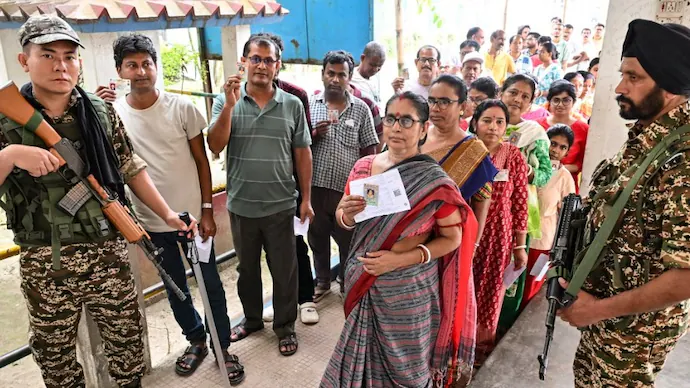
India witnessed a crucial electoral moment as polling began in two politically significant states, with West Bengal entering the first phase of its Assembly elections and Tamil Nadu conducting a single-day voting exercise. The elections have drawn national attention, with key political forces including All India Trinamool Congress, Bharatiya Janata Party, Dravida Munnetra Kazhagam, All India Anna Dravida Munnetra Kazhagam, and Vijay’s emerging political outfit Tamilaga Vettri Kazhagam competing for dominance.
Polling across 152 constituencies in West Bengal and all 234 seats in Tamil Nadu marks a decisive phase in the 2026 electoral cycle. With over 3.6 crore voters in Bengal and approximately 5.67 crore voters in Tamil Nadu, the scale and stakes of the elections underline their importance in shaping the political landscape of India.
High-Stakes Contest Between TMC and BJP in West Bengal
The electoral battle in West Bengal is largely seen as a direct confrontation between the ruling All India Trinamool Congress led by Mamata Banerjee and the opposition Bharatiya Janata Party. The campaign has been marked by high-intensity rhetoric, strategic alliances, and aggressive outreach efforts targeting various voter segments.
The BJP’s campaign has focused on issues such as governance, corruption allegations, and concerns over illegal infiltration. Senior leaders including Narendra Modi and Amit Shah spearheaded the party’s outreach, emphasizing nationalism and development.
On the other hand, the TMC has countered with a strong focus on regional identity, welfare schemes, and social support initiatives. Programs like Lakshmir Bhandar have been central to its campaign, appealing particularly to women voters. The party has positioned itself as a defender of Bengal’s cultural identity, creating a narrative that resonates with local sentiments.
The contest has also been influenced by the controversial Special Intensive Revision of electoral rolls, which saw the deletion of a significant number of voter names. The issue has added a layer of complexity to the election, with both parties engaging in legal and political battles over its implications.
Women Voters and Welfare Politics Shape Campaign
One of the defining aspects of the West Bengal elections is the increasing influence of women voters. With over 3.76 crore women voters, political parties have tailored their campaigns to address their needs and concerns.
The BJP has promised a monthly stipend of ₹3,000 for women, while the TMC has highlighted its existing welfare schemes, including financial assistance programs. This direct appeal to women voters reflects a broader trend in Indian politics, where gender-focused policies are becoming a key electoral strategy.
The emphasis on welfare politics underscores the importance of economic security and social support in influencing voter behavior. Both parties have sought to position themselves as champions of women’s empowerment, making this a central theme of the election.
Left Front Attempts Revival in Key Regions
Amid the intense competition between TMC and BJP, the Left Front is attempting a comeback. Contesting a significant number of seats, the Left is focusing on regions such as North Bengal and Jungle Mahal, where it aims to regain lost ground.
The alliance is targeting tea garden workers and younger voters, emphasizing issues related to employment, education, and social justice. While its influence has declined in recent years, the Left Front’s presence adds another dimension to the electoral contest.
Key constituencies such as Nandigram, Berhampore, and Mathabhanga are being closely watched, as they hold symbolic and strategic importance for various parties. These battles are expected to play a crucial role in determining the overall outcome of the election.
Tamil Nadu Witnesses Complex Three-Cornered Fight
In contrast to West Bengal’s direct contest, Tamil Nadu presents a more complex electoral scenario with a three-way battle. The ruling Dravida Munnetra Kazhagam, led by M. K. Stalin, faces challenges from the All India Anna Dravida Munnetra Kazhagam-BJP alliance and the newly formed Tamilaga Vettri Kazhagam.
The DMK has framed the election as a referendum on its governance, highlighting achievements in welfare, infrastructure, and state rights. The party has emphasized its commitment to social justice and federalism, seeking to consolidate its support base.
The AIADMK, under Edappadi K. Palaniswami, is attempting a political comeback. The party has recalibrated its strategy, focusing on rebuilding its organization and strengthening its alliance with the BJP.
The entry of actor Vijay into politics has added a new dimension to the contest. His party, Tamilaga Vettri Kazhagam, has attracted significant attention, particularly among younger and urban voters. The emergence of a third force has made the election more competitive and unpredictable.
Key Constituencies and Political Stakes
Several constituencies in both states are being closely monitored due to their political significance. In West Bengal, Nandigram remains a high-profile seat, symbolizing the intense rivalry between major political leaders.
In Tamil Nadu, constituencies such as Kolathur and Chepauk-Thiruvallikeni are crucial for the DMK, while Edappadi and Bodinayakkanur are key battlegrounds for the AIADMK and its allies. Vijay’s decision to contest from multiple seats has further heightened interest in the election.
These constituencies not only reflect local dynamics but also serve as indicators of broader political trends. The outcomes in these regions are likely to influence the overall narrative of the elections.
Voter Turnout and Early Trends
Initial reports indicate a steady voter turnout in both states, with long queues observed at polling stations. West Bengal recorded a turnout of 18.76 percent by 9 am, while Tamil Nadu reported 17.69 percent during the same period.
The participation of voters, particularly in the early hours, reflects the high level of engagement and interest in the elections. Factors such as campaign intensity, voter awareness, and local issues are expected to influence turnout as the day progresses.
Election authorities have implemented measures to ensure smooth polling, including security arrangements and logistical support. The focus remains on conducting free and fair elections.
Broader Political Implications
The elections in West Bengal and Tamil Nadu hold significant implications for national politics. The outcomes are expected to influence the balance of power among regional and national parties, shaping future alliances and strategies.
For the BJP, a strong performance in West Bengal would reinforce its position as a major political force in the state. For the TMC, retaining power would validate its governance model and strengthen its regional dominance.
In Tamil Nadu, the results will determine whether the DMK can maintain its hold or if the opposition can stage a comeback. The performance of Vijay’s party will also be closely watched, as it could signal the emergence of a new political force.
These elections serve as a reflection of changing voter preferences and evolving political narratives in India.
The ongoing elections in West Bengal and Tamil Nadu represent a critical moment in India’s democratic process. With high stakes, intense competition, and diverse political dynamics, the results are expected to have far-reaching consequences.
As voters exercise their franchise, the focus remains on the outcomes that will shape governance, policy direction, and political alignments in the coming years.