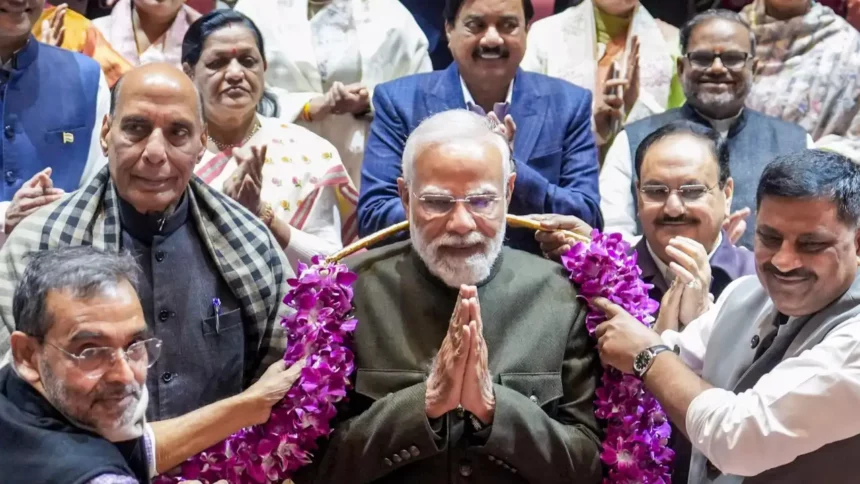
Prime Minister Narendra Modi’s special dinner for National Democratic Alliance (NDA) MPs at his official residence on Thursday is set to become one of the most significant political gatherings of the current parliamentary session. Planned originally for the previous session but postponed due to the Punjab floods, the event brings together lawmakers from across the alliance following their historic Bihar Assembly victory. With nearly 54 tables arranged to encourage region-wise coordination, guided interactions, and strategic dialogue, the dinner is expected to serve as an informal yet impactful platform for discussing legislative priorities, political strategies, and the NDA’s broader roadmap for the coming months.
Dinner Meeting Aims to Reinforce Alliance Cohesion and Shape Parliamentary Agenda
The dinner carries weight far beyond ceremonial hospitality. It comes at a time when the NDA is seeking to consolidate its growing political footprint and strengthen collaborative functioning among its member parties. All MPs from the alliance—including those from regional allies—are expected to attend, marking a rare occasion where leaders from different political backgrounds engage in open and direct conversation with the Prime Minister in a structured yet informal setting.
Senior Union ministers have been assigned responsibility for coordinating with MPs from different states and regions to ensure full attendance and smooth arrangements. Union Minister Dharmendra Pradhan and BJP MP Sukanta Majumdar are overseeing coordination for MPs from Odisha and West Bengal, while Kiren Rijiju is responsible for MPs from the Northeastern states. These arrangements highlight the purposeful, region-oriented approach adopted for the interaction.
According to officials involved in the planning, each of the 54 tables will accommodate eight MPs, representing a diverse mix of alliance partners and BJP members. A Union Minister will be seated at every table to encourage informal consultations and ensure direct feedback reaches the leadership in real time. Prime Minister Modi is expected to move from table to table during the evening, spending time with MPs, listening to their concerns, and gathering inputs on both governance challenges and regional political dynamics.
The format mirrors past interactions in which the Prime Minister has used similar settings to foster a collaborative environment, reduce hierarchical barriers and strengthen his direct engagement with elected representatives. With the ongoing parliamentary session entering critical phases of legislative activity, the dinner is expected to provide an opportunity to reinforce the government’s priorities and prepare MPs for coordinated action within both Houses.
Sources indicated that the Prime Minister will speak about the government’s legislative agenda for the remainder of the session, emphasising bills linked to public welfare, economic reforms, employment generation, and state-centric projects. He is also likely to address the need for greater discipline, constructive debate, and cohesive representation of alliance viewpoints in Parliament.
Earlier in the week, NDA MPs were briefed on governance priorities, with the Prime Minister outlining the roadmap for ongoing and upcoming initiatives. Thursday’s dinner is expected to build on that briefing, offering more granular clarity on political messaging, outreach, and implementation strategies.
The timing of the event is especially significant given that several important bills are set to be tabled in Parliament in the coming days. The government hopes to ensure smooth passage of the proposed legislations by maintaining unity within the alliance and minimising procedural disruptions. The dinner is therefore seen as an opportunity to energise MPs, reinforce their roles in parliamentary engagement, and sharpen the alliance’s collective strategy for the remainder of the session.
Focus on Upcoming Elections and Long-Term Alliance Strategy Likely to Shape Key Discussions
While the primary purpose of the dinner is to strengthen coordination for the ongoing parliamentary session, the meeting is also expected to serve as a strategic discussion platform for upcoming state elections. Preliminary conversations around West Bengal, Tamil Nadu, and Assam have already begun within various levels of the alliance, and Thursday’s gathering will offer the Prime Minister an opportunity to delve deeper into political assessments and outline early expectations for campaign preparedness.
The NDA’s strong performance in Bihar—where the alliance secured a historic victory—has provided momentum ahead of the 2025 electoral calendar. The leadership aims to replicate this model of coordination, message discipline, and grassroots outreach in other states. The dinner, therefore, functions as both a symbolic gesture of unity and a practical moment for realigning organisational focus.
For West Bengal, where the BJP has been expanding its base over recent years, discussions are likely to centre around strengthening organisational capacity, fine-tuning candidate selection processes, and building alliances with local parties that align with the NDA’s national policy framework. With political winds shifting rapidly in the state, the leadership will aim to harness recent gains and translate them into a consolidated electoral strategy.
In Tamil Nadu, where the BJP and its regional partners are working to expand their influence, the dinner provides an opportunity to review current political challenges, fine-tune messaging, and plan effective outreach campaigns across urban and rural constituencies. The Prime Minister’s inputs are expected to guide alliance partners in balancing regional sensitivities with national-level priorities.
Assam, already governed by the NDA, remains a crucial state for sustaining the alliance’s political stability in the Northeast. Kiren Rijiju’s coordination role for northeastern MPs underscores the importance the government places on regional unity, particularly ahead of the state’s political season. Discussions may include developmental priorities, welfare programs, and strategies to counter emerging opposition narratives.
Beyond state-specific concerns, the Prime Minister is expected to focus on broader alliance dynamics. With more than two dozen parties currently part of the NDA, periodic interactions such as this dinner help ensure that smaller allies feel included, valued, and aligned with the coalition’s objectives. Political analysts note that NDA’s electoral strength has often been linked to its ability to maintain harmony and visibility among its partners, a model Thursday’s gathering aims to reinforce.
Economically, the dinner may also provide an opportunity for MPs to raise issues relevant to their constituencies, from infrastructure projects and cooperative federalism to welfare schemes and investment priorities. Given the recent emphasis on employment, MSMEs, rural connectivity, and social welfare, many MPs are expected to share region-specific concerns. The presence of senior Union ministers at every table ensures that such inputs receive serious attention and can be channelled into ongoing policy planning.
The Prime Minister is also expected to encourage MPs to enhance their engagement with constituents, particularly in the context of digitised governance platforms, rural outreach programmes, and community engagement models that the government has been promoting. Strengthening on-ground communication and ensuring accurate information about welfare schemes remains a key priority for the government, and Thursday’s dinner is likely to reinforce this message.
Viewed in a broader political context, the dinner serves as a reminder of how the NDA seeks to evolve its functioning—shifting from a purely electoral coalition to a more integrated and consultative political platform. As the alliance prepares for multiple state elections and a packed parliamentary calendar, the emphasis on coordination, communication, and shared strategy reflects a long-term shift in its operational culture.