Bangladesh plunged into a tense atmosphere of grief and uncertainty following the death of Sharif Osman Hadi, a rising radical right-wing student leader, who passed away in a hospital in Singapore after sustaining gunshot injuries earlier this month. News of his demise spread rapidly across the country, triggering mass gatherings, emotional demonstrations, and violent incidents in parts of the capital Dhaka, as authorities moved swiftly to contain unrest and announced a day of national mourning.
The death of Hadi, who had emerged as a prominent and polarising figure among sections of Bangladesh’s youth, has added a new layer of volatility to an already fragile political and social environment. While many supporters mourned him as a symbol of resistance and sacrifice, others expressed concern over the unrest and rhetoric that followed, underscoring deep ideological divides within the country. The interim government, led by Chief Adviser Mohammed Yunus, sought to project calm while acknowledging the intensity of public emotions surrounding the incident.
Death in Singapore and nationwide mourning amid rising tensions
Sharif Osman Hadi was shot in the head by unidentified assailants on December 12, an attack that immediately sent shockwaves through political and student circles in Bangladesh. As his condition deteriorated, he was transferred to Singapore earlier this week for advanced medical treatment. Despite intensive care, he succumbed to his injuries on December 18, prompting an outpouring of grief among his followers and supporters back home.
The interim government announced that Bangladesh would observe a day of national mourning on Saturday, December 20, 2025, as a mark of respect for the deceased leader. In addition, special prayers were scheduled at mosques, temples, churches, and other places of worship across the country on Friday, December 19. The decision reflected the government’s attempt to channel public emotion into collective mourning rather than uncontrolled protest, while also recognising the influence Hadi commanded among sections of the population.
In a late-night televised address, Mohammed Yunus informed the nation that Vivian Balakrishnan, Singapore’s foreign minister, had personally called him to convey the news of Hadi’s passing. The direct communication underscored the seriousness with which the developments were treated at the highest diplomatic and governmental levels, given the regional sensitivities involved.
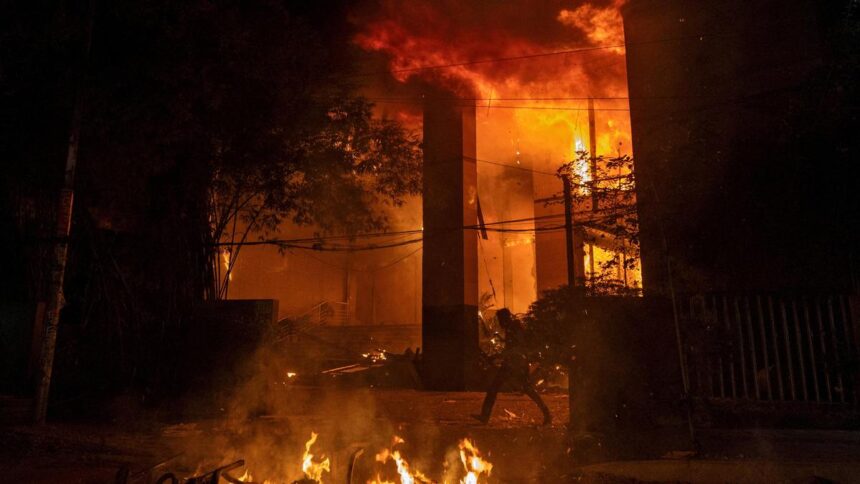
As news of the death broke, thousands of Hadi’s supporters poured into central neighbourhoods of Dhaka, chanting slogans and holding spontaneous gatherings. While many demonstrations remained peaceful, others escalated into confrontations and acts of vandalism. One of the most striking incidents occurred when a group of people set fire to the office building of The Daily Star, one of Bangladesh’s leading English-language newspapers. Images from the scene showed smoke billowing from the building as security forces attempted to restore order, highlighting the volatile mood gripping the capital.
The unrest prompted authorities to increase security deployments across Dhaka and other sensitive areas. Law enforcement agencies were placed on high alert, with additional patrols and checkpoints established to prevent further violence. Officials appealed to citizens to maintain calm and respect the mourning period, warning that those involved in arson or attacks on public and private property would face strict legal action.
Political fallout, accusations and regional implications
Beyond the immediate street unrest, Hadi’s death has triggered sharp political reactions that threaten to strain both domestic stability and regional relations. Mohammed Sarjis Alam of the National Citizen Party, a figure closely aligned with Hadi’s ideological camp, publicly accused India of sheltering those responsible for the killing. He went further to call for the shutdown of the Indian High Commission in Dhaka, a demand that has raised alarm among diplomats and policy analysts.
These accusations, made without publicly presented evidence, have nonetheless resonated with sections of Hadi’s supporters, many of whom already harbour suspicions of foreign interference in Bangladesh’s internal affairs. Political observers note that such rhetoric, if left unchecked, could inflame nationalist sentiments and complicate Bangladesh’s diplomatic engagement with its neighbours at a time when regional cooperation remains critical.
The interim government has so far adopted a cautious approach, neither endorsing the accusations nor dismissing public anger outright. Officials have emphasised that investigations into the shooting are ongoing and that responsibility will be determined through due process. At the same time, the government has reiterated its commitment to maintaining diplomatic norms and safeguarding foreign missions in Dhaka, signalling that calls to target embassies will not be entertained.
Hadi’s rise as a student leader had been marked by strong ideological positions and confrontational politics, earning him both fervent followers and vocal critics. Supporters viewed him as a fearless voice challenging established power structures, while opponents accused him of fuelling radicalism and intolerance. His death has, in effect, transformed him into a martyr-like figure for his base, amplifying his symbolic power even in absence.
Analysts warn that the coming days will be crucial in determining whether the unrest subsides or hardens into a prolonged period of instability. The combination of grief, political mobilisation, and external accusations creates a combustible mix that could influence Bangladesh’s political trajectory in the near term. Much will depend on the interim government’s ability to manage public sentiment, ensure transparent investigation into the killing, and prevent extremist narratives from dominating the discourse.
The situation has also drawn close attention from regional and international observers, who are monitoring developments for signs of escalation. With Bangladesh set to observe a national day of mourning and conduct prayers across the country, authorities hope that collective reflection will ease tensions and allow space for dialogue, even as the political reverberations of Sharif Osman Hadi’s death continue to unfold.