The ninth day of the 2024 Parliament Winter Session witnessed sharp disruptions, heated protests, and repeated adjournments, overshadowing significant legislative business as both Houses struggled to maintain order. While the Rajya Sabha succeeded in passing the Bharatiya Vayuyan Vidheyak, 2024, the Lok Sabha was forced to adjourn for the day amid continuous uproar from the Opposition, halting proceedings just as Railway Minister Ashwini Vaishnaw was preparing to deliver his remarks on the Railways (Amendment) Bill, 2024. Outside Parliament, political tensions intensified with Congress leaders Rahul Gandhi and Priyanka Gandhi Vadra being stopped near the Ghazipur border while attempting to visit violence-hit Sambhal. The day reflected a volatile mix of legislative progress, political confrontation, and procedural deadlock in both Houses.
Opposition Uproar Disrupts Lok Sabha as Railways Amendment Bill Debate Stalled
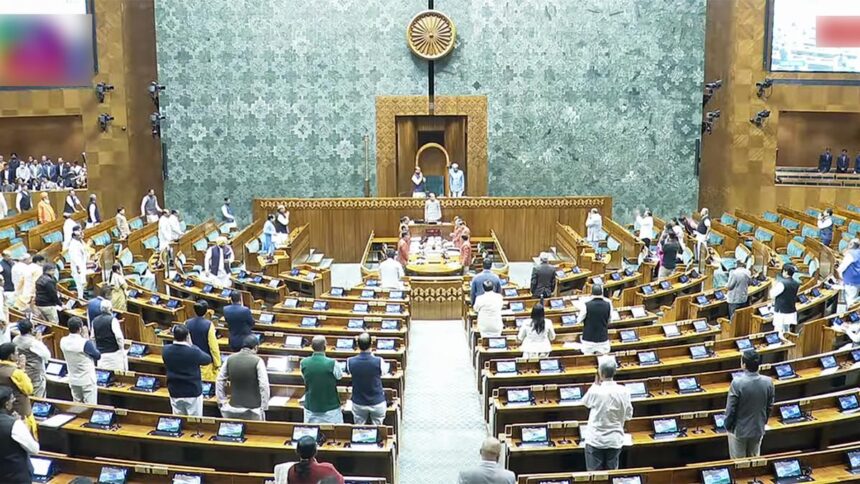
Day 9 of the Winter Session turned tumultuous soon after the Lok Sabha convened, with protests erupting from the Opposition benches in response to what they claimed was “unfair allocation of time” during the ongoing discussions. The House, which had earlier managed to conduct the Question Hour with relative calm, descended into chaos when BJP MP Sudhanshu Trivedi was granted additional time to speak. Opposition parties, already agitated over the handling of debates during the session, expressed strong disapproval, alleging procedural bias and demanding equal opportunity to present their viewpoints.
The uproar intensified when Union Minister for Railways Ashwini Vaishnaw rose to deliver his remarks on the Railways (Amendment) Bill, 2024—a key legislative proposal aimed at reforming operational and safety frameworks in the national railway network. Despite attempts by officiating Speaker Jagadambika Pal to restore order, the repeated disruptions continued. After several unsuccessful appeals urging protesting leaders to allow the minister to speak, Mr. Pal adjourned the Lok Sabha for the day.
The Railways (Amendment) Bill, 2024, which had been taken up earlier for discussion, has been positioned as a crucial reform measure by the Centre, particularly in the backdrop of the government’s broader agenda of modernising the Indian Railways. However, with the debate continuously disrupted, lawmakers were unable to deliberate further on its provisions.
This was not the first adjournment of the day. Earlier, the House had already been suspended temporarily following a brief but intense wave of protests during the post-Question Hour proceedings. The Opposition’s sustained agitation ensured that the Lower House saw little productive business throughout the day.
Outside the Parliament complex, political tensions that had been simmering for days spilled over into the public sphere. A Congress delegation led by Rahul Gandhi and Priyanka Gandhi Vadra attempted to visit Sambhal, the site of violence that broke out on November 24 during a survey of the town’s centuries-old mosque. The Uttar Pradesh administration, citing security concerns and prohibitory orders in force until December 10, intercepted the convoy at the Ghazipur border and prevented their entry. Restrictions on the movement of outsiders have been in place in Sambhal since the violence erupted, and the enforcement of these orders remains a point of contention between the Congress leadership and local authorities.
The incident added another layer to the political drama surrounding the Winter Session, as Congress leaders alleged suppression of democratic rights, while the administration maintained that the restrictions were necessary to prevent further unrest. The standoff at Ghazipur further amplified the political divides that were already reflected in the heated parliamentary proceedings.
In contrast to the Lok Sabha, the Rajya Sabha managed to function with relatively greater discipline and completed important legislative work. The Upper House passed the Bharatiya Vayuyan Vidheyak, 2024—a bill that seeks to strengthen India’s aviation regulatory and administrative framework. The legislation aims to address emerging challenges in the civil aviation sector, including safety norms, operational oversight, and international compliance requirements.
The smooth passage of the bill in the Rajya Sabha stood in stark contrast to the disruptions in the Lok Sabha. While the Opposition did raise concerns and seek clarifications in the Upper House, the debate proceeded substantially without the turbulence experienced in the Lower House. Members of the Treasury Benches welcomed the passage of the aviation bill, arguing that it represents a forward-looking approach to the rapid expansion of air travel in India.
The events of Day 9 also came on the heels of a comparatively more productive Day 8, during which both Houses managed to transact key business following a rare consensus between the Centre and the Opposition. The Lok Sabha had succeeded in passing the Banking Laws (Amendment) Bill, 2024, aimed at reforming regulatory provisions governing the banking sector. Simultaneously, the Rajya Sabha approved the Oilfields (Regulation and Development) Amendment Bill, 2024, which is expected to streamline processes in India’s petroleum exploration sector.
This brief phase of cooperation had raised hopes of smoother proceedings for the remainder of the session. However, the return to disruptions on Day 9 underscored the fragility of parliamentary coordination in the current political climate. Members across party lines expressed concerns that repeated adjournments may compromise the legislative agenda, especially with several critical bills lined up for discussion.
With the Winter Session entering its final stretch, the coming days will determine whether coordination between the government and the Opposition improves or whether legislative progress continues to be overshadowed by procedural deadlock. The contrasting developments—smooth passage in the Rajya Sabha, complete stalling in the Lok Sabha, and rising tensions outside Parliament—capture the complex and often adversarial nature of India’s parliamentary democracy.
As the Centre pushes forward with its legislative priorities and the Opposition intensifies its protests on multiple fronts, the remainder of the Winter Session is likely to witness continued friction unless both sides seek a middle path. The events of December 5 offer a vivid snapshot of the political, procedural, and institutional challenges that define contemporary parliamentary functioning in India.