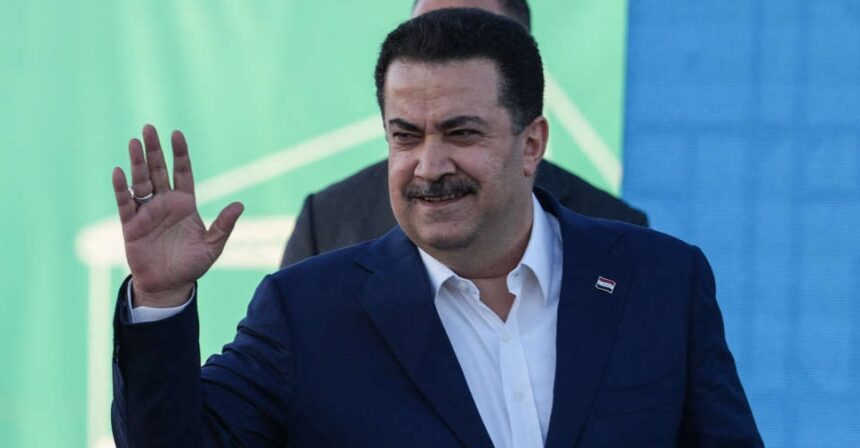
Iraq’s final election results have confirmed that Prime Minister Mohammed Shia al-Sudani’s political coalition has emerged as the single largest bloc in parliament, winning 46 seats in the 329-member legislature. Although this positions Sudani at the forefront of government formation, the complex political landscape of Iraq means that building a viable majority coalition could still take months. With competing domestic factions and the influence of both the United States and Iran shaping the political arena, the next government will face significant challenges as it attempts to navigate an unstable balance of power.
Election Outcome, Major Party Totals and the Fragmented Path Toward a New Government
The Independent High Electoral Commission announced that Sudani’s bloc secured first place with 46 seats, reaffirming the prime minister’s considerable influence within Iraq’s Shia political sphere. This result comes as Sudani seeks a second term in office, hoping to consolidate his authority after a turbulent period marked by security tensions, economic hurdles and public frustration over corruption and slow reforms.
The Taqaddum Party, which draws its strength largely from Iraq’s Sunni-majority western and northern regions, won 27 seats, reflecting its continued regional influence. Former prime minister Nouri al-Maliki’s State of Law coalition secured 29 seats, showing the enduring presence of one of Iraq’s most powerful and controversial political figures. The Kurdistan Democratic Party (KDP), representing Kurdish interests in northern Iraq, obtained 26 seats, confirming its role as a key player in coalition negotiations.
Voter turnout reached 56.11 percent, a figure that election officials highlighted as noteworthy given the political fatigue prevalent among Iraqi citizens. Many young voters in particular viewed the poll as an exercise that would maintain the status quo rather than deliver meaningful change. This sentiment reflects a broader sense of disillusionment among Iraq’s youth, who feel excluded from political decision-making and critical of long-standing systemic corruption.
Following the announcement of results, parties within the Shia ruling alliance issued a joint statement asserting their status as the largest parliamentary bloc. In a meeting attended by Sudani, the alliance declared its intention to move ahead with nominating a prime minister for the next phase, signalling their desire to maintain unity and influence. Within this alliance, internal bargaining will determine which factions receive key ministries, advisory roles and influence over security and economic portfolios.
Iraq’s political system, shaped by sectarian power-sharing after the 2003 US-led invasion, has often made government formation a complicated and lengthy process. The constitution stipulates that the largest bloc in parliament selects the prime minister, but the definition of “largest bloc” has repeatedly led to disputes. In past elections, different parties have claimed this status by forming alliances after results were announced, delaying government formation and deepening political uncertainty.
In this election cycle, similar dynamics appear to be unfolding. Rival blocs, including Sunni, Shia and Kurdish parties, are engaged in negotiations to determine who holds leverage in the formation of Iraq’s next government. For Sudani, the challenge lies not only in securing majority support but also in balancing the interests of powerful paramilitary leaders, tribal authorities and regional partners who will shape the composition of the next cabinet.
The political environment is further shaped by intense public pressure on the government to deliver basic services, economic stability and security. Iraq remains heavily dependent on oil revenues, and many citizens believe the country’s vast wealth has been mismanaged by political elites. Sudani, aware of growing frustration, has attempted to portray himself as a reform-oriented leader. He has argued that he took action against entrenched political forces that initially helped elevate him to power, presenting himself as someone willing to challenge the status quo.
However, critics argue that Sudani remains deeply intertwined with the traditional Shia political establishment that dominates Iraq’s power structure. They contend that his attempts to distance himself from old-guard parties are largely rhetorical, and that real reform remains slow. The election outcome therefore represents both an opportunity and a test for Sudani as he seeks to confirm his political legitimacy.
US–Iran Rivalry, Armed Militia Dynamics and Sudani’s Position in a Deeply Divided Political Landscape
The formation of Iraq’s next government will unfold against the backdrop of intense competition between the United States and Iran for influence over Baghdad’s political and security institutions. This rivalry has shaped Iraqi politics for years, with each power cultivating alliances among political parties, military units and economic actors.
One of the most pressing challenges facing the incoming government is the status of dozens of armed groups that operate across the country. Many of these groups are aligned with Iran and maintain significant autonomy from the state, often answering more to their own commanders than to official institutions. Their presence complicates Iraq’s internal security, its foreign policy and its ability to pursue an independent national agenda.
Washington has increased pressure on Baghdad to curtail these militias, arguing that they undermine state authority, threaten diplomatic missions and destabilise the region. Iranian-aligned factions, however, view themselves as defenders of Iraqi sovereignty against US influence. Managing these conflicting expectations will be one of Sudani’s most difficult tasks.
Sudani’s political survival hinges on navigating this fragile balance. He must maintain support from Shia factions sympathetic to Iran while demonstrating enough independence to satisfy Western partners who provide economic, security and diplomatic backing. Any misstep could alienate one side or the other, potentially triggering political gridlock or even street protests.
The international community has also expressed concern over Iraq’s ability to form a stable government that addresses corruption, unemployment, infrastructure deterioration and economic diversification. These challenges remain unresolved despite years of political turnover. Iraqi citizens repeatedly call for better governance, improved services, transparent spending and mechanisms to hold corrupt officials accountable.
Sudani has attempted to present himself as a unifying figure capable of driving change, arguing that he has sought to challenge the very political forces that once supported him. Yet analysts note that his power is limited by the network of political and militia leaders who dominate Iraq’s security and administrative institutions. To govern effectively, Sudani will need to balance reformist rhetoric with pragmatic compromises.
The Kurdish parties, particularly the KDP, will also play a decisive role in government formation. Kurdish leaders often use their parliamentary weight to secure key ministries, budgetary concessions and regional autonomy guarantees. Their negotiations with the central government regularly involve disputes over oil revenues, territorial claims and security management in disputed areas.
Iraq’s Sunni parties, including the Taqaddum bloc, are similarly essential for creating a functional government. Their concerns focus on reconstruction of areas damaged by past conflicts, curbing militia activity in Sunni regions, and improving representation within national institutions.
Ultimately, the election results underscore the fragmented nature of Iraq’s political system. No single party holds sufficient power to govern alone, and every major faction has leverage. This environment fosters prolonged bargaining, factional rivalries and shifting alliances that can delay crucial decisions and weaken governance.
The broader regional context adds another layer of complexity. As tensions continue between Washington and Tehran, Iraq risks being drawn deeper into proxy dynamics that could limit its sovereignty. For years, Iraqi leaders have struggled to assert independence while accommodating both powers. The next government will need to walk an even finer line as geopolitical tensions surge across the Middle East.
Sudani has promoted the idea of transforming Iraq into a stable, economically thriving state after decades of war, insurgency and political paralysis. Whether he can achieve this vision depends largely on his ability to stabilise the political landscape, assert civilian authority over armed groups and build a coalition capable of governing effectively.
Young Iraqis, who make up a large portion of the population, will be watching closely. Many view the political establishment as self-interested and unresponsive, believing that elections change little in their daily lives. This sense of disillusionment remains one of the biggest obstacles to achieving long-term political legitimacy and stability.
With the final results now confirmed, Iraq enters a new phase defined by negotiation, uncertainty and political contestation. The coming months will determine whether Sudani can maintain his position and whether Iraq’s leadership can chart a path beyond factional interests, external pressure and longstanding institutional weaknesses.