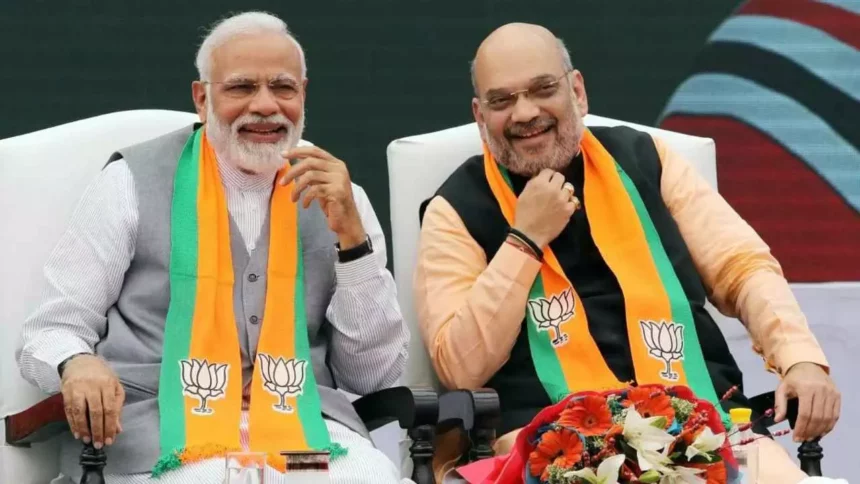
In a significant moment that carried both celebration and political undercurrents, Prime Minister Narendra Modi publicly lauded Union Home Minister Amit Shah for becoming India’s longest-serving Home Minister. His remarks at a National Democratic Alliance (NDA) parliamentary party meeting not only marked an important milestone in Amit Shah’s political journey but also sparked speculation about his future role within the party and the government.
Speaking to NDA lawmakers in Delhi, PM Modi acknowledged that Amit Shah had officially surpassed the tenure of veteran BJP leader LK Advani, who had held the position of Home Minister for 2,256 days between 1998 and 2004. With 2,258 days in office as of this week, Amit Shah now holds the record for the longest continuous tenure in the role. But what caught the attention of political observers was PM Modi’s statement, “This is just the beginning… he has a long way to go,” which many interpreted as more than mere praise.
A Political Signal Beyond Appreciation
Within BJP circles, PM Modi’s comment was seen as a signal that Amit Shah may be in line for an even more prominent role in the future. The endorsement reaffirmed the strong bond between the Prime Minister and Amit Shah, who has been one of PM Modi’s closest political associates since their time together in Gujarat.
A senior BJP leader, speaking on condition of anonymity, suggested that the statement was likely aimed at putting to rest ongoing speculation about internal dynamics and hierarchy within the party. For some, it appeared to re-establish the order of leadership and decision-making, especially at a time when various names have been doing the rounds for key roles in the coming years.
The recognition also aligns with Amit Shah’s impactful performance as a strategist and administrator. From reducing left-wing extremism and cracking down on terror financing to navigating complex legislative changes, Amit Shah has played a pivotal role in shaping the BJP’s national security and ideological agenda. His tenure is especially marked by his successful navigation of the 2019 bill that abrogated Article 370 in Jammu and Kashmir—a move considered one of the most significant political decisions of the decade.
A Decade of Strategy and Growth
Amit Shah’s rise within the BJP has been steep and strategic. He played a key role in the party’s massive 2014 general election victory, particularly in Uttar Pradesh, where the BJP won 71 out of 80 seats. That performance not only boosted the party’s numbers in Parliament but also established Amit Shah as a master of election strategy and social engineering. Shortly afterward, he succeeded Rajnath Singh as BJP national president, setting the stage for the party’s expansion into states previously considered out of reach.
His organizational skills were on full display in 2017 when the BJP returned to power in Uttar Pradesh after 14 years, further solidifying his reputation as a formidable political strategist. He also played an instrumental role in strengthening the party’s presence in the Northeast, including states like Assam, Manipur, and Tripura.
During his time as Home Minister, Amit Shah has been at the forefront of several key initiatives, from pushing for a Uniform Civil Code to enhancing internal security infrastructure across the country. His decisions have often mirrored the ideological stance of the Sangh Parivar, aligning national security policies with broader cultural and nationalistic narratives.
At the NDA meeting, PM Modi also expressed confidence that the country would be free of left-wing extremism by 2026—a timeline that speaks to the administration’s ambitions under Amit Shah’s leadership. With a blend of ideology and pragmatism, Amit Shah has continually reinforced the BJP’s core messaging while adapting to the evolving political landscape.
His long-standing association with PM Modi goes back decades to their political collaboration in Gujarat. The camaraderie, trust, and coordination between the two have often been cited as a key factor behind the BJP’s national dominance over the last decade. Whether in election planning or policy implementation, the PM Modi-Amit Shah duo has worked in lockstep.
The social media response to Amit Shah’s milestone was swift and celebratory. Union Minister Kiren Rijiju and other BJP leaders shared congratulatory messages, praising Amit Shah for his leadership, decisiveness, and commitment to shaping “New India.”
While the future remains uncertain, PM Modi’s public endorsement of Amit Shah’s contributions and his forward-looking comment have stirred political debate about the evolving leadership structure within the BJP and the NDA. For now, the message is clear: Amit Shah’s political journey is far from over, and bigger responsibilities may lie ahead.