Prime Minister Narendra Modi is set to visit Tamil Nadu and Puducherry on March 1, marking a high-profile engagement that blends governance, cultural symbolism, and political messaging. During his time in Tamil Nadu, he will travel to Madurai to offer prayers at the historic Arulmigu Subramanyaswamy temple in Tirupparankundram, a shrine deeply revered in the spiritual landscape of the state. The visit is not merely ceremonial; it arrives against the backdrop of past controversies and ongoing conversations about religious practices, administrative authority, and community harmony. The Prime Minister’s itinerary underscores how faith-based outreach and developmental initiatives often intersect in contemporary Indian politics, especially in culturally significant regions like Tamil Nadu.
Spiritual symbolism and regional outreach in Tamil Nadu
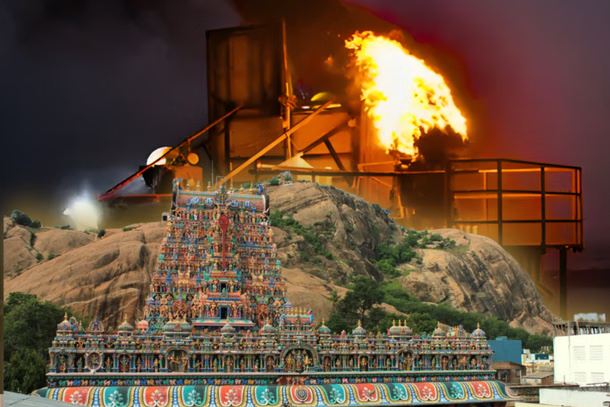
The Arulmigu Subramanyaswamy temple in Tirupparankundram is one of the six abodes of Lord Murugan, known as the Arupadai Veedu, and holds immense religious importance for devotees across Tamil Nadu and beyond. Located in Madurai district, the temple stands atop a hill that has witnessed centuries of worship, cultural evolution, and community interaction. For many devotees, Tirupparankundram is not simply a place of prayer but a symbol of continuity, resilience, and sacred tradition.
The Prime Minister’s decision to offer worship at this temple during his March 1 visit carries symbolic weight. Tamil Nadu’s spiritual heritage is inseparable from its social and political fabric. Visits to iconic temples in the state often resonate far beyond the immediate religious context, reinforcing connections with local identity and cultural pride. By choosing Tirupparankundram, the Prime Minister acknowledges a site that embodies devotion, history, and regional sentiment.
This visit also comes at a time when the intersection of religion and governance continues to attract attention. In the previous year, a controversy emerged during the Karthigai Deepam festival concerning devotees lighting a lamp atop a deepathoon, or stone pillar, situated on the Tirupparankundram hill. Local authorities initially resisted the move, citing concerns about potential tensions between communities. The matter eventually reached the Madras High Court’s Madurai Bench, which permitted Hindus to light the lamp atop the deepathoon and criticized what it described as an exaggerated apprehension of communal conflict.
The episode brought Tirupparankundram into the national spotlight, not only as a religious site but also as a focal point for debates about administrative caution, judicial intervention, and the safeguarding of traditional practices. The Prime Minister’s upcoming visit, therefore, takes place in a setting that has recently symbolized both devotion and dispute. His act of offering prayers may be interpreted by supporters as a gesture affirming cultural rights and religious continuity, while critics may view it through a political lens.
Tamil Nadu occupies a unique position in India’s political map. The state’s Dravidian political legacy, linguistic pride, and strong regional identity often shape national engagements differently than in many other parts of the country. Any high-level visit by a national leader to a religious site in Tamil Nadu carries layered meanings. It speaks to cultural acknowledgment, outreach to local constituencies, and the balancing act between respecting regional distinctiveness and asserting national unity.
In this context, the PM Modi Tamil Nadu visit is not confined to ritual worship. It represents a broader effort to connect with voters, stakeholders, and communities in a state where political narratives are often intensely regional. The Prime Minister’s presence at Tirupparankundram can be read as an attempt to engage directly with Tamil religious sentiment while also reinforcing his administration’s emphasis on heritage preservation and spiritual tourism.
Madurai itself, often referred to as the cultural capital of Tamil Nadu, amplifies the importance of the visit. As one of the oldest continuously inhabited cities in the world, Madurai carries historical and emotional significance. A Prime Ministerial visit to this city invariably draws attention to its legacy and contemporary aspirations. By including Tirupparankundram in his schedule, the Prime Minister situates his engagement within a broader narrative of cultural respect and national integration.
Governance, controversy, and political calculations
Beyond the spiritual dimension, the March 1 visit is expected to include the inauguration and review of various initiatives in Tamil Nadu and Puducherry. The Prime Minister will reportedly arrive in Chennai ahead of his engagements, indicating a tightly packed itinerary that combines administrative responsibilities with ceremonial observances. Such visits typically feature announcements related to infrastructure, connectivity, public welfare, and economic development, aligning with the central government’s broader outreach strategy.
Puducherry, a Union Territory with its own distinctive cultural blend of Tamil and French influences, adds another layer to the visit. Engagements there are likely to highlight developmental initiatives and governance priorities. By pairing temple worship in Madurai with official programs in Tamil Nadu and Puducherry, the visit encapsulates a dual narrative of faith and functionality.
The earlier controversy over the deepathoon lighting during Karthigai Deepam remains a significant backdrop. When local authorities resisted the lighting of the lamp atop the stone pillar, citing fears of communal friction, it triggered strong reactions from sections of society who viewed the move as an unnecessary restriction on religious expression. The Madras High Court’s Madurai Bench intervened, allowing the ritual to proceed and questioning the assumption that conflict was inevitable.
This judicial stance was seen by many as a reaffirmation of constitutional protections for religious practice, while also emphasizing that administrative decisions must be proportionate and evidence-based. The episode underscored the delicate balance authorities must maintain when handling religious events that intersect with sensitive local dynamics.
In that light, the Prime Minister’s act of offering prayers at Tirupparankundram could be perceived as a reaffirmation of confidence in traditional practices at the site. It signals that the temple remains a central, respected institution in the region’s spiritual life, regardless of past disputes. At the same time, the visit must be viewed within the competitive political environment of Tamil Nadu, where alliances, narratives, and cultural messaging play crucial roles.
National leaders visiting temples is not a new phenomenon in Indian politics. However, each visit carries context-specific implications. In Tamil Nadu, where political discourse often emphasizes rationalism and social justice alongside deep-rooted religious traditions, such gestures are interpreted through multiple prisms. The PM Modi Tamil Nadu visit on March 1 arrives at a time when political realignments and electoral calculations remain active considerations.
Observers note that temple visits by prominent leaders can strengthen emotional resonance with local communities. They may also serve to counter perceptions that national politics is disconnected from regional heritage. By appearing at Tirupparankundram, the Prime Minister aligns himself with a site cherished by Murugan devotees, many of whom see the temple as integral to their spiritual identity.
Simultaneously, the governance component of the trip cannot be overlooked. Infrastructure inaugurations and policy announcements often dominate official agendas. The blending of such announcements with religious observances allows leaders to project a holistic image: one that respects tradition while emphasizing progress. In a diverse country like India, this fusion of symbolism and substance is frequently employed to communicate inclusivity and continuity.
Chennai, Madurai, and Puducherry together form a geographic arc that highlights the strategic importance of the southern region. Investments in connectivity, industry, and social welfare programs are typically central themes during such visits. The Prime Minister’s engagements are likely to stress economic growth, job creation, and modernization, reinforcing the narrative of development-driven governance.
At the same time, the symbolic power of Tirupparankundram cannot be divorced from its recent legal and social history. The deepathoon controversy demonstrated how localized disputes can quickly escalate into broader discussions about rights, responsibilities, and communal harmony. The High Court’s decision to permit the ritual signaled a judicial commitment to safeguarding religious customs while expecting authorities to act without undue alarmism.
In visiting the temple after such an episode, the Prime Minister enters a space that has recently been a stage for dialogue between tradition and administration. His presence may be interpreted as a gesture of reassurance to devotees who felt their practices were under scrutiny. It may also be framed as a broader assertion of cultural continuity within a constitutional framework.
The PM Modi Tamil Nadu visit, therefore, unfolds on multiple levels. It is a journey of worship in a sacred city, a tour of development initiatives, and a moment in an ongoing political narrative. Tamil Nadu’s electorate is known for its discernment and strong regional consciousness. Any outreach, whether spiritual or administrative, is weighed against local priorities and historical memory.
As March 1 approaches, attention will remain fixed on Madurai and Tirupparankundram. The Prime Minister’s prayer at the Arulmigu Subramanyaswamy temple will likely generate extensive media coverage and public discussion. For supporters, it may symbolize reverence and unity. For critics, it may represent calculated optics. For many devotees, it will simply be another chapter in the temple’s long and layered history.
The blending of faith and governance is a recurring theme in Indian public life. In Tamil Nadu, where temples stand not only as religious centers but also as repositories of art, music, and social life, such visits carry profound resonance. The Prime Minister’s engagement with Tirupparankundram on March 1 is set to reinforce the enduring interplay between spirituality and statecraft, a dynamic that continues to shape the contours of Indian democracy.