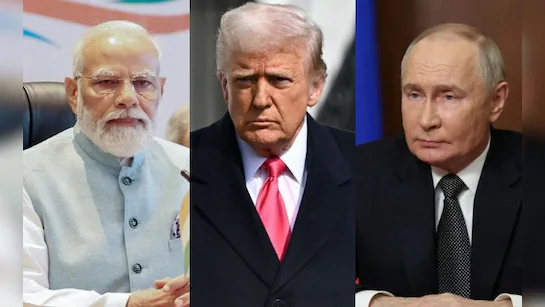
As tensions rise between Washington and New Delhi over trade with Russia, Donald Trump has walked into a diplomatic storm after threatening punitive tariffs on India while appearing unaware that the United States itself continues significant imports from Russia. In a week filled with sharp diplomatic exchanges, contradictions, and clarifications, Donald Trump’s comments and India’s strong pushback have placed the spotlight on the complexities of global trade in a geopolitically divided world.
At the center of the controversy is Donald Trump’s move to impose a 25% tariff on Indian imports, which he announced shortly before a self-imposed August 1 deadline for stricter trade measures against countries continuing business with Moscow. This move came even as negotiations were reportedly still underway for a possible settlement between the U.S. and India. Just days later, Donald Trump hinted at potentially increasing those tariffs, citing India’s continued energy and defense trade with Russia. He labelled India, along with China, as Russia’s biggest energy customers and accused them of indirectly funding Moscow’s military activities.
India Questions U.S. Double Standards
India responded swiftly and firmly to Donald Trump’s criticism, challenging the fairness of his tariff strategy. Government officials in New Delhi highlighted that while Donald Trump points fingers at India, the U.S. has itself continued to purchase Russian commodities such as uranium hexafluoride, fertilizers, palladium, and various chemicals—all critical to key American industries like nuclear energy and electric vehicles.
The Indian Ministry of External Affairs characterized Donald Trump’s targeting of India as “unjustified and unreasonable,” underscoring that New Delhi’s energy trade is based on market availability and national economic needs, not geopolitical alignment. Officials insisted that India would take all necessary steps to protect its economic interests, and reiterated that no external country should dictate the direction of its bilateral relationships.
Adding fuel to the fire, Donald Trump was directly questioned by a journalist about the seeming contradiction in his approach. When asked about U.S. trade with Russia continuing even as he criticizes India, Donald Trump appeared surprised and said, “I don’t know anything about it. I’d have to check, but we’ll get back to you on that.” His response further drew attention to the inconsistencies in Washington’s position and suggested a lack of internal coherence in the U.S. administration’s foreign trade policy.
Donald Trump’s Shifting Rhetoric and Internal GOP Dissent
This isn’t the first time Donald Trump has threatened significant economic measures in relation to the Russia-Ukraine conflict. Nearly a month ago, he floated the idea of imposing 100% tariffs on Russian goods and “secondary tariffs” on countries maintaining trade ties with Moscow, giving a 50-day deadline for a peace deal in Ukraine.
Despite these harsh warnings, Donald Trump later clarified that he never mentioned a specific percentage on the tariffs. When asked about the 100% rate he initially indicated, he responded, “I never said a percentage, but we’ll be doing quite a bit of that. We’ll see what happens over the next fairly short period of time.” This backtracking has added to the confusion surrounding the actual extent and intent of the trade penalties.
Interestingly, while Donald Trump continues to criticize India in public statements, some of his own party members are pushing back. Prominent Indian-American Republican leader Nikki Haley openly voiced support for India and cautioned against alienating a key ally while letting China off the hook. Taking to X (formerly Twitter), Haley argued that China, which remains the top buyer of Russian and Iranian oil, received a 90-day delay on any tariff action. She wrote, “India should not be buying oil from Russia. But China, an adversary and the number one buyer of Russian and Iranian oil, got a 90-day tariff pause. Don’t give China a pass and burn a relationship with a strong ally like India.”
Her statement resonated with a growing segment within Washington who see India as an indispensable partner in the Indo-Pacific strategy and believe that punitive trade measures could jeopardize long-term strategic cooperation between the two democracies.
India Sticks to Its Strategic Autonomy
Despite escalating rhetoric from Donald Trump, there has been no sign of policy change from New Delhi. The Indian government has not issued any directive to reduce trade with Russia, and maintains that its decisions are driven by sovereign interests and grounded in real-time market analysis. Indian officials have repeatedly stressed that the country’s procurement of defense and energy resources is based on its own national security assessments and not influenced by third-party pressures.
At a recent press briefing, a spokesperson reiterated that India evaluates what’s available in the global markets and aligns its purchases with current geopolitical and economic conditions. The country has repeatedly emphasized that it values its bilateral ties with multiple nations and does not see its foreign policy through the lens of rivalries between global powers.
India’s energy diversification became more pronounced after the war in Ukraine triggered sanctions from the U.S. and its allies on Russian oil and gas. This created an opportunity for countries like India to secure energy resources at discounted prices, helping meet domestic demands without placing additional strain on its economy. According to official estimates, in the financial year 2024–25, India imported over $50 billion worth of Russian crude oil, making it one of Moscow’s top customers in the energy sector.
While India has made it clear that its Russian imports are not political in nature, the geopolitical pressure from the West continues to mount. Yet, India’s diplomatic line remains consistent: every country has the right to make decisions in its own interest, and no external actor should define or judge the parameters of its international engagements.
In the midst of this growing friction, Donald Trump’s lack of clarity and shifting stance have raised concerns among trade experts, diplomats, and international observers alike. As India and the U.S. prepare for more rounds of diplomatic and trade negotiations in the coming weeks, much attention will remain focused on whether the Donald Trump administration hardens its stance or chooses a more pragmatic path. For now, New Delhi appears unshaken, determined to protect both its energy security and strategic independence—regardless of who’s calling the shots in Washington.