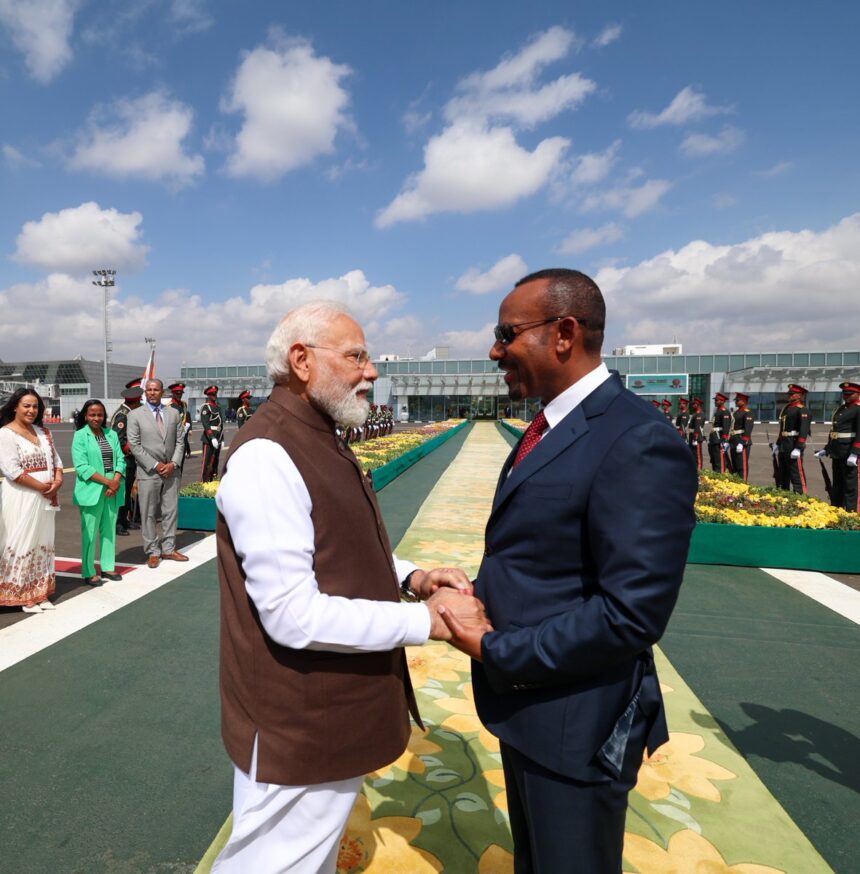
Prime Minister Narendra Modi on Wednesday departed for Oman from Ethiopia, marking the final leg of his four-day, three-nation diplomatic tour, a visit expected to further strengthen India’s strategic, economic and people-to-people ties with the Gulf nation while building on the momentum generated during his landmark engagements in Africa.
Ethiopia Visit Elevates Bilateral Ties to Strategic Partnership
Prime Minister Modi’s visit to Ethiopia, the first by an Indian prime minister in several decades, marked a significant milestone in India’s engagement with Africa. During the visit, India and Ethiopia elevated their long-standing and historically warm relationship to the level of a Strategic Partnership, reflecting growing convergence in political outlook, economic cooperation and shared priorities on global platforms.
Modi held wide-ranging discussions with Ethiopian Prime Minister Abiy Ahmed Ali, covering cooperation across multiple sectors including trade, investment, development partnership, capacity building, education and technology. The talks underscored India’s commitment to deepening its engagement with Africa as a trusted development partner and highlighted Ethiopia’s importance as a key political and economic player on the continent.
Following the bilateral talks, the two leaders witnessed the exchange of several memoranda of understanding aimed at strengthening collaboration in diverse areas. These agreements are expected to expand cooperation in fields such as agriculture, skill development, digital public infrastructure, healthcare and industrial development, reflecting India’s development-oriented approach to international partnerships.
A key highlight of the visit was Prime Minister Modi’s address to a joint session of the Ethiopian Parliament, where he spoke about India’s civilisational links with Africa, shared struggles against colonialism and the importance of South-South cooperation in a rapidly changing global order. He reiterated India’s support for Africa’s aspirations for greater representation in global governance institutions and its commitment to working closely with African nations to address common challenges such as climate change, food security and sustainable development.
In recognition of his efforts to strengthen India-Ethiopia relations and his broader contribution to international diplomacy, Prime Minister Modi was conferred Ethiopia’s highest civilian honour, “The Great Honour Nishan of Ethiopia.” With this, he became the first global head of state to receive the prestigious award, underscoring the deep respect and goodwill India enjoys in the country.
The Ethiopia visit was seen as a reaffirmation of India’s Africa policy, which focuses on partnership, capacity building and mutual growth rather than transactional engagement. It also highlighted New Delhi’s intention to play a more proactive role in Africa’s economic transformation and political stability, while strengthening cooperation with like-minded countries in multilateral forums.
Oman Visit to Focus on Strategic Partnership, Trade and Diaspora Ties
From Addis Ababa, Prime Minister Modi proceeded to Oman on the invitation of Sultan Haitham bin Tarik, beginning his second official visit to the Gulf nation. The visit assumes particular significance as it coincides with the 70th anniversary of the establishment of diplomatic relations between India and Oman, a relationship rooted in centuries-old maritime, cultural and commercial links.
During the visit, Modi is scheduled to hold detailed discussions with Sultan Haitham bin Tarik on strengthening the India-Oman Strategic Partnership, with a focus on enhancing cooperation in trade, investment and economic engagement. The talks are expected to review the full spectrum of bilateral relations, including collaboration in energy, defence, security, technology, agriculture and culture, as well as coordination on regional and global issues of mutual interest.
India and Oman have enjoyed a traditionally close relationship, underpinned by strong political trust and robust economic ties. Oman has been a key partner for India in the Gulf region, providing strategic access to maritime routes and playing an important role in India’s energy security. The two countries have also cooperated closely in defence and security, including through regular naval exercises and institutional dialogue mechanisms.
The visit follows the state visit of Sultan Haitham bin Tarik to India in December 2023, during which both sides agreed to further elevate their partnership and explore new avenues of cooperation. Since then, bilateral engagement has gained momentum, with increased dialogue between government institutions, business communities and defence establishments.
Trade and investment are expected to feature prominently in the discussions, with both sides keen to diversify and expand economic ties beyond traditional sectors. India is one of Oman’s key trading partners, and there is growing interest in enhancing cooperation in areas such as renewable energy, green hydrogen, infrastructure development, logistics and digital technologies. The visit is also likely to provide an opportunity to address issues related to market access, investment facilitation and supply chain resilience.
Energy cooperation remains a cornerstone of the bilateral relationship, with Oman being an important partner in India’s efforts to ensure energy security and transition towards cleaner sources. Discussions are expected to explore collaboration in oil and gas, renewable energy and emerging areas such as green hydrogen, aligning with both countries’ climate and sustainability goals.
Defence and security cooperation is another critical pillar of India-Oman relations. The two countries share a common interest in maintaining peace, stability and freedom of navigation in the Indian Ocean region. Regular exchanges between defence forces and strategic dialogue have strengthened mutual understanding, and the visit is expected to further consolidate this cooperation in the context of evolving regional security dynamics.
Prime Minister Modi is also scheduled to address a gathering of the Indian diaspora in Oman, acknowledging their vital role in strengthening people-to-people ties and contributing to Oman’s economic development. The Indian community in Oman is among the oldest and most well-integrated expatriate communities in the Gulf, and has played a key role in fostering cultural and economic linkages between the two countries.
The Ministry of External Affairs has described the visit as an opportunity for both sides to comprehensively review the bilateral partnership and exchange views on regional and global developments. Against the backdrop of shifting geopolitical alignments and economic uncertainties, the visit underscores India’s commitment to strengthening partnerships in the Gulf region based on mutual respect, shared interests and long-term cooperation.
As Prime Minister Modi concludes his three-nation tour with the Oman visit, the diplomatic engagements across Africa and the Gulf reflect India’s broader foreign policy objective of building strategic partnerships across regions, enhancing its global footprint and promoting stability, development and cooperation in an increasingly interconnected world.