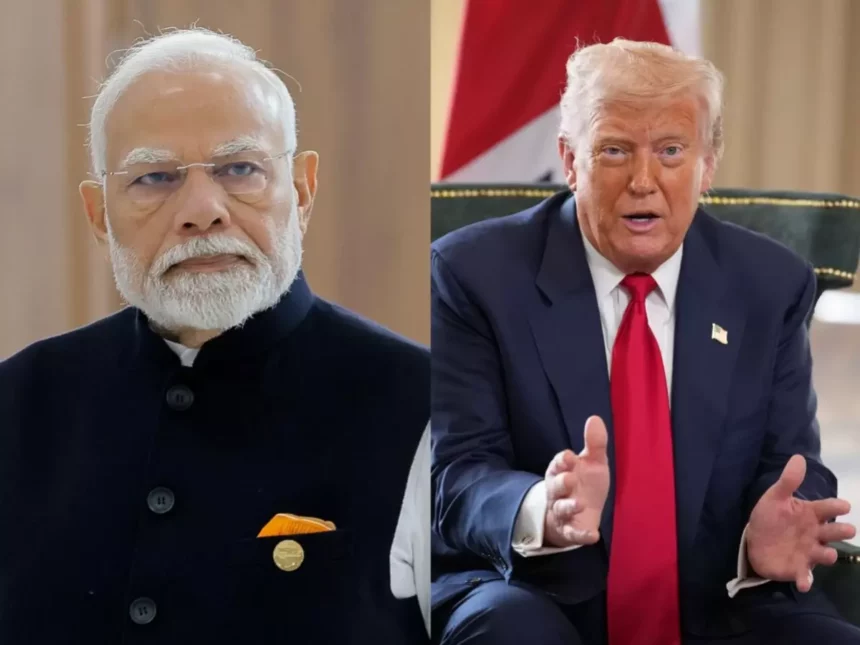
In a fiery outburst that may escalate global diplomatic friction, US President Donald Trump has taken fresh aim at India and Russia, accusing both nations of having “dead economies” and threatening to slap a 25% tariff on Indian imports. Donald Trump, in a strongly worded post on his social media platform Truth Social, claimed he was unconcerned about the growing India-Russia relationship and ridiculed former Russian President Dmitry Medvedev over his recent remarks warning of war. The comments, coupled with Donald Trump’s announced trade penalties, triggered a sharp fall in Indian financial markets and sparked renewed concern over the future of US-India trade relations.
Donald Trump’s latest tirade is particularly significant as it comes just a day after he declared sweeping new tariffs against Indian imports starting August 1, in retaliation for New Delhi’s ongoing trade and defence cooperation with Moscow. He also hinted at broader penalties in the pipeline. “I don’t care what India does with Russia. They can take their dead economies down together, for all I care,” Donald Trump posted. He further complained about India’s tariff policies, calling them some of the highest in the world and citing them as a reason for the historically low volume of US-India trade.
Donald Trump Escalates Criticism Over India’s Ties With Russia
At the heart of Donald Trump’s anger appears to be India’s deepening strategic and commercial relations with Russia, particularly in the defence sector. The former US President, who remains a leading figure in the Republican Party and a key contender for the 2024 presidential race, has repeatedly voiced displeasure over India’s reluctance to align more closely with the United States in isolating Russia diplomatically and economically.
India, which has remained largely neutral in the ongoing Ukraine conflict, continues to import Russian oil and has ongoing arms deals and cooperative defence projects with Moscow. Donald Trump’s disdain for this non-alignment was palpable in his Truth Social post. “We have done very little business with India. Their Tariffs are too high, among the highest in the World,” he said, blaming India’s protectionist policies for limiting bilateral trade.
Although previous US administrations, including Donald Trump’s own, have attempted to push for a free trade agreement with India, talks have remained inconclusive due to disagreements on tariffs, market access, and regulatory barriers. Donald Trump’s renewed threat of a 25% tariff could further stall any prospects of rekindling trade negotiations in the near term.
Dmitry Medvedev’s Warning Sparks Donald Trump’s Fury
Donald Trump’s fury wasn’t just directed at India. A significant portion of his statement took aim at Russia—specifically former President Dmitry Medvedev, who earlier this week criticized Donald Trump’s handling of US-Russia relations and warned that his approach could push the world closer to a war involving the United States.
Dmitry Medvedev, who currently serves as the Deputy Chairman of Russia’s Security Council, had posted on X (formerly Twitter), accusing Donald Trump of playing a dangerous “ultimatum game” with Russia. He claimed that Donald Trump’s aggressive rhetoric and unrealistic deadlines for peace in Ukraine were increasing the chances of a broader conflict, not between Russia and Ukraine, but between Russia and the US itself.
Reacting strongly to Dmitry Medvedev’s remarks, Donald Trump lashed out in his post: “Tell Dmitry Medvedev, the failed former President of Russia, who thinks he’s still President, to watch his words. He’s entering very dangerous territory!”
Donald Trump’s irritation may also stem from Russia’s unwillingness to act swiftly on his proposed peace framework for Ukraine. Just days earlier, he had criticized Russian President Vladimir Putin for not doing enough to end the conflict and said he was reducing the deadline for a peace deal from 50 days to just 10 or 12.
These comments come in the backdrop of Donald Trump positioning himself as a dealmaker who could bring the Russia-Ukraine war to a close if reelected. But his increasingly harsh tone suggests growing frustration with both Moscow’s defiance and New Delhi’s independent approach to its foreign policy.
Indian Markets React Sharply to Tariff Threat
India’s financial markets quickly responded to Donald Trump’s tariff announcement, with key indices registering notable declines during Thursday morning trade. The Nifty 50 index dropped by 0.61% to 24,703.1, while the BSE Sensex fell 0.64% to 80,963.14. The losses were broad-based, as all 16 major sectors reported a decline.
Smaller companies were hit even harder, with mid-cap stocks falling by nearly 0.9% and small-caps sliding about 0.6%. The threat of tariffs disrupted months of careful trade diplomacy between New Delhi and Washington and raised fears of a trade standoff that could impact sectors from textiles to pharmaceuticals and information technology.
The 25% tariff proposed by Donald Trump would be higher than any levies imposed on other major US trading partners, indicating that India is being specifically targeted in this round of trade retaliation. It also comes at a time when India is seeking to expand its manufacturing base and attract more foreign investment under its “Make in India” initiative.
In his post, Donald Trump did leave some room for negotiations, stating that the US is “still negotiating” with India. However, his tone made it clear that patience is wearing thin. His remarks may be aimed at pressuring Indian policymakers to reconsider their stance on Russia, or at least offer trade concessions to avoid further economic consequences.
Rising Political Stakes Ahead of US Elections
The sharp escalation in Donald Trump’s rhetoric against India and Russia may also be viewed through the lens of domestic American politics. With the 2024 US Presidential elections looming, Donald Trump is seeking to consolidate his political base by doubling down on nationalist and protectionist themes. His tough talk on tariffs, trade deficits, and foreign policy aims to present him as a strong leader capable of putting “America First.”
India, once hailed by Donald Trump as a “great friend” during his first term, now appears to be in the crosshairs of his nationalist economic agenda. By highlighting India’s high tariffs and close ties with Russia, Donald Trump is potentially trying to appeal to conservative voters who view global trade partnerships with skepticism and believe American jobs are being lost to foreign economies.
At the same time, Donald Trump’s renewed hostility toward Russia—especially his barbed response to Dmitry Medvedev—signals a shift in tone from the earlier days of his presidency, when he often praised Vladimir Putin. Now, with geopolitical tensions rising and criticism mounting over his foreign policy credentials, Donald Trump seems to be recalibrating his image as a leader who can be tough on both allies and adversaries.
Whether Donald Trump’s remarks will lead to actual policy changes remains to be seen, especially since he is not currently in office. However, his comments carry weight globally due to his significant influence over the Republican base and the possibility of a return to power in 2024.
As India navigates a complex geopolitical environment—with deepening ties to Russia, ongoing trade negotiations with the US, and increasing economic ambitions—it now faces fresh uncertainty about the future of its relationship with Washington. And if Donald Trump does return to power, his comments this week may well be a preview of the hardline stance India could face.