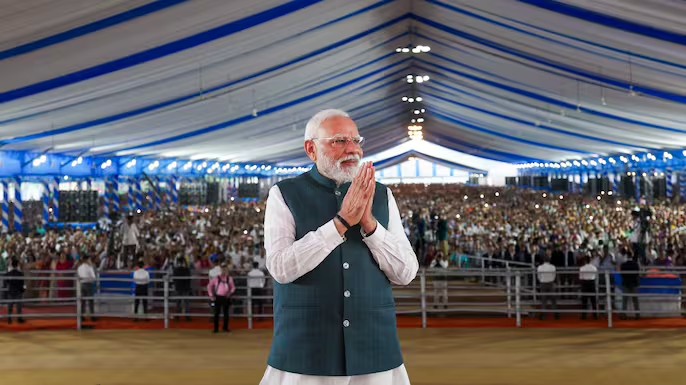
Prime Minister Narendra Modi arrived in Kolkata on Sunday as part of the fourth leg of his five-nation tour, ahead of the 16th Combined Commanders’ Conference at Fort William, the headquarters of the Indian Army’s Eastern Command. This marks his second visit to Kolkata in under a month, demonstrating the strategic importance of West Bengal as India gears up for high-stakes elections next year. During his visit, PM Modi will also inaugurate the new terminal of Purnea Airport in Bihar and launch development projects worth Rs 36,000 crore, reinforcing the government’s commitment to regional infrastructure growth and national defence preparedness. Sharing visuals of his arrival, the Prime Minister waved to a crowd of supporters at Kolkata Airport, highlighting his engagement with the public alongside official duties.
Kolkata Visit and Combined Commanders’ Conference
PM Modi’s Kolkata visit centers on the 16th Combined Commanders’ Conference, scheduled from September 15-17 at Fort William. This biennial conference is a high-level forum that brings together the nation’s top military and civilian leadership to deliberate on strategic priorities, defence reforms, and future preparedness of the armed forces. The theme of this year’s conference, ‘Year of Reforms – Transforming for the Future,’ emphasizes modernizing India’s defence capabilities, strengthening operational readiness, and enhancing strategic frameworks to respond to evolving security challenges.
The Prime Minister will inaugurate the conference at around 9:30 am on Monday, initiating discussions focused on higher defence reforms, modernization of the armed forces, and bolstering India’s position as a self-reliant and secure nation. The forum serves as a critical platform for exchanging views on national security, military infrastructure, and collaborative measures between civilian authorities and defence leadership. Given the strategic context, this conference is expected to review progress on defence projects, operational challenges, and emerging threats, including the integration of advanced technology and defence innovations to ensure India’s preparedness in the rapidly changing geopolitical environment.
The significance of the Combined Commanders’ Conference extends beyond routine military planning. It represents India’s emphasis on strengthening civil-military coordination, strategic foresight, and comprehensive security planning. PM Modi’s presence underlines the government’s commitment to fostering robust defence mechanisms, ensuring that India’s armed forces remain agile, capable, and equipped to address both conventional and unconventional threats. His previous visits to Kolkata, including the August inauguration of Rs 5,200 crore of infrastructure projects, underscore the city’s dual role as a strategic military hub and a centre for administrative planning ahead of elections and national development initiatives.
Bihar Visit and Inauguration of Purnea Airport Terminal
Following his engagements in Kolkata, PM Modi will proceed to Bihar, a poll-bound state where multiple development projects worth Rs 36,000 crore will be inaugurated. Among these is the new terminal building at Purnea Airport, scheduled to be inaugurated at approximately 2:45 pm. The new terminal is designed to enhance passenger handling capacity and improve regional connectivity, reinforcing Bihar’s growing significance in national air transport infrastructure. The Prime Minister will also lay foundation stones for other critical infrastructure projects, including thermal power plants and rail initiatives, reflecting the government’s focus on comprehensive regional development.
Additionally, PM Modi will launch the National Makhana Board in Bihar, promoting the cultivation, marketing, and export potential of this region-specific agricultural commodity. This initiative aligns with broader objectives of economic growth, job creation, and improving livelihoods, particularly in eastern India. By linking infrastructural development with sector-specific initiatives, the government aims to create integrated growth models that strengthen regional economies and enhance public welfare.
The Prime Minister’s Bihar visit also highlights the government’s strategy to integrate transportation, industrial, and agricultural infrastructure to facilitate long-term development. Improved rail connectivity, airport modernization, and industrial expansion are expected to create synergies between urban and rural areas, enhancing overall productivity and accessibility. These projects not only cater to immediate developmental needs but also serve as foundational steps toward creating sustainable economic ecosystems capable of supporting increased domestic and international trade.
Five-Nation Tour and Broader Strategic Objectives
PM Modi’s visit to Kolkata and Bihar forms a crucial leg of his ongoing five-nation tour, which began with Mizoram, where he inaugurated the landmark Bairabi-Sairang rail line at a cost of Rs 8,070 crore. The tour subsequently took him to Manipur, where ethnic violence since 2023 has posed significant challenges. There, PM Modi inaugurated several development projects, signalling the government’s commitment to stabilizing the region and promoting peace through economic and social interventions.
In Assam, PM Modi paid tribute to legendary singer Bhupen Hazarika during his birth centenary celebrations and inaugurated infrastructure and industrial projects valued at over Rs 18,530 crore. Across the tour, the Prime Minister has emphasized balanced development, combining strategic infrastructure, regional growth, and national security priorities. The integrated approach reflects a commitment to strengthening both eastern India and the broader national landscape, ensuring that development and security objectives are pursued in tandem.
The Purnea Airport terminal, combined with the extensive development projects across Bihar, underscores a dual approach to governance: enhancing connectivity while simultaneously promoting industrial and agricultural growth. By launching high-value projects, PM Modi aims to not only strengthen regional economies but also create employment opportunities and stimulate investment, contributing to India’s larger goal of economic self-reliance and modernization.
The Prime Minister’s engagements demonstrate an interconnected vision where defence preparedness, regional development, and socio-economic growth are pursued collectively. By prioritizing infrastructure expansion, security enhancements, and public welfare projects, these initiatives are designed to reinforce India’s long-term stability and ensure that both national and regional objectives are addressed comprehensively. PM Modi’s proactive involvement in inaugurations and strategic meetings reflects a hands-on approach, signaling governmental commitment to monitoring progress and maintaining focus on execution and impact.
The Combined Commanders’ Conference, Purnea Airport inauguration, and the broader Rs 36,000 crore development projects illustrate a multi-dimensional governance strategy. Strengthening defence capabilities alongside infrastructural and industrial development demonstrates a holistic vision of nation-building. Enhancing connectivity, modernizing airports, and supporting industrial growth contribute not only to economic development but also to strategic and social resilience, providing a strong foundation for India’s future growth trajectory.
As India prepares for forthcoming challenges, including security considerations, election preparedness, and economic expansion, the Prime Minister’s visits to Kolkata and Bihar serve as concrete steps in implementing a vision of coordinated governance. By integrating defence discussions with regional infrastructure initiatives, PM Modi underscores the importance of linking strategic security objectives with economic development. This integrated approach ensures that India remains not only secure and well-prepared but also positioned for sustained growth and progress in a rapidly evolving domestic and international context.
Through these engagements, PM Modi reiterates the government’s commitment to transforming India’s infrastructure, security mechanisms, and regional development strategies in ways that are inclusive, sustainable, and future-ready. Investments in air transport, energy, rail, and industrial projects are aimed at creating lasting impacts on the local, regional, and national scale, while the Combined Commanders’ Conference ensures that military preparedness aligns with broader developmental priorities. These strategic and developmental measures collectively advance India’s goal of becoming a resilient, self-reliant, and strategically robust nation capable of addressing emerging challenges while fostering prosperity.
By combining ceremonial inaugurations with high-level strategic conferences, PM Modi’s visit to Kolkata and Bihar highlights a governance model where security, infrastructure, and development are mutually reinforcing. The Prime Minister’s active involvement in both operational and developmental spheres underscores a vision where India strengthens its military preparedness, modernizes infrastructure, and promotes economic growth simultaneously. The holistic focus on connectivity, development, and security reflects a long-term strategy to enhance national resilience, public welfare, and India’s stature as a secure and developed nation on the global stage.