In a key political development, the National Democratic Alliance (NDA) has entrusted Prime Minister Narendra Modi and BJP president JP Nadda with the responsibility of selecting the alliance’s vice-presidential candidate. With the NDA holding a comfortable majority in the Electoral College, the candidate’s election is widely anticipated to be a smooth and uncontested affair. The formal poll process has already begun, with the Election Commission issuing the official notification. The nomination deadline is August 21, and the election, if required, will be conducted on September 9.
Top leadership takes charge of VP nomination
The announcement followed a crucial meeting of NDA constituents held at Parliament House. The meeting, chaired by Defence Minister Rajnath Singh and attended by top leaders including Home Minister Amit Shah, BJP president and Rajya Sabha Leader JP Nadda, and Parliamentary Affairs Minister Kiren Rijiju, marked the formal beginning of the alliance’s preparations to nominate a new Vice-President.
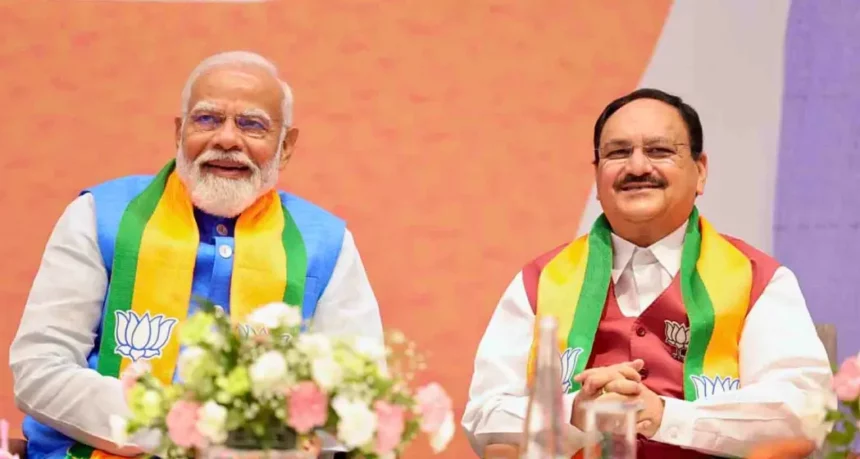
Rijiju confirmed that the NDA had authorised Prime Minister Modi and JP Nadda to make the final call on the vice-presidential nominee. He stated, “NDA parties will support whatever decision is taken under the leadership of Prime Minister Modiji.”
The decision comes in the wake of the sudden resignation of former Vice-President Jagdeep Dhankhar on July 21, nearly two years before the scheduled end of his term in August 2027. The circumstances of the resignation were not elaborated on by the government, but it has triggered a fresh round of political maneuvering as parties prepare for the upcoming vice-presidential election.
Interestingly, no names were floated during the NDA meeting, and there was no formal discussion on potential candidates. This indicates a closed-door decision-making approach within the top echelons of the NDA, likely aimed at maintaining unity and avoiding premature speculation.
NDA’s majority virtually assures easy victory
The NDA’s candidate is widely expected to win the vice-presidential election comfortably. The Electoral College, responsible for electing the Vice-President of India, consists of members from both Houses of Parliament. While the maximum strength of the two Houses is 788, the current effective strength stands at 781 due to one vacant seat in the Lok Sabha and six in the Rajya Sabha. These include a vacancy created by the passing of former Jharkhand Chief Minister Shibu Soren.
Out of these 781 members, the NDA commands a strength of 422, which exceeds the required majority mark of 391 by a comfortable margin of 31 votes. Given this scenario, the election result is considered a foregone conclusion unless the opposition fields a strong and united rival candidate, which, as of now, appears unlikely.
Besides senior BJP leaders, representatives from key NDA allies also participated in the meeting, reflecting the alliance’s collective commitment to the selection process. Attendees included JD(U)’s Lalan Singh, Shiv Sena’s Shrikant Shinde, TDP’s Ram Mohan Naidu and Lavu Sri Krishna Devarayalu, LJP (Ram Vilas) leader Chirag Paswan, Apna Dal (Soneylal) leader Anupriya Patel, Rashtriya Lok Samta Party’s Upendra Kushwaha, and leaders from AIADMK.
Their presence underlines the unity within the alliance and the high level of coordination in ensuring a consensus decision. The gathering of such a wide range of leaders also signals the NDA’s intent to display cohesion at a time when the opposition has been attempting to build a broader anti-BJP front.
Election schedule and next steps
The Election Commission has already issued the notification that formally opens the nomination process. The deadline for filing nominations is set for August 21, while withdrawals can be made until August 25. If an opposing candidate is fielded by the opposition, voting will take place on September 9.
Given the NDA’s commanding numerical position, it is highly probable that their chosen candidate will be elected without much contest. However, the election process will proceed as per constitutional norms, and the possibility of a symbolic challenge from the opposition cannot be entirely ruled out.
The NDA’s approach of consolidating leadership in the hands of PM Modi and JP Nadda also reflects the coalition’s long-standing strategy of centralised decision-making, especially in high-stakes elections. By avoiding public speculation or internal competition, the leadership aims to send a message of unity and preparedness.
This political moment also sets the stage for renewed discussions about the role of the Vice-President in India’s constitutional and legislative framework. As the ex-officio Chairperson of the Rajya Sabha, the Vice-President plays a critical role in steering parliamentary debates and upholding legislative integrity. Hence, the choice of candidate—though electorally predictable—is constitutionally significant.
With the BJP-led NDA opting for a seamless internal selection process and holding a clear numerical advantage, the upcoming vice-presidential election is unlikely to offer any major surprises. The key question now is: who will be the name that PM Modi and JP Nadda choose to fill this important constitutional position? The answer is expected in the coming days, likely closer to the nomination deadline.
Until then, all eyes remain on the BJP’s top brass as they prepare to announce their choice, one that is expected to sail through Parliament and take on the mantle of the country’s next Vice-President.