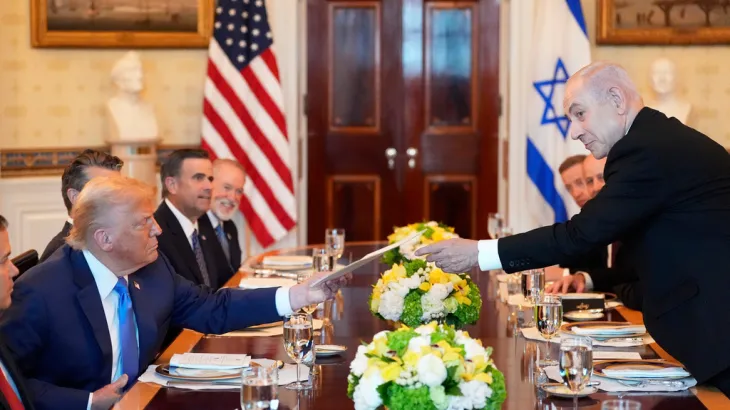
In a high-stakes diplomatic mission, U.S. President Donald Trump’s special envoy Steve Witkoff met Israeli Prime Minister Benjamin Netanyahu on Thursday to address the worsening humanitarian crisis in Gaza and to push for a comprehensive ceasefire deal. As starvation spreads and civilian deaths mount in the conflict-ravaged enclave, international pressure is building on all sides to reach a breakthrough. Witkoff’s visit comes amid heightened tensions, renewed calls for hostages’ release, and continued Israeli military operations, even as the world demands an urgent solution to prevent further catastrophe.
During his meeting with Benjamin Netanyahu, Witkoff emphasized the need to transition from a partial agreement—focused on releasing some of the hostages held by Hamas—to a more comprehensive plan involving the release of all hostages, the disarmament of Hamas, and the full demilitarization of the Gaza Strip. While specific details of this potential plan have not been disclosed, Israeli officials signaled that both nations agree on the necessity of combining humanitarian aid with continued military operations.
Adding to the diplomatic backdrop, President Donald Trump posted on his social media platform Truth Social shortly after Witkoff’s arrival, stating that the fastest way to end the crisis in Gaza is for Hamas to “surrender and release the hostages.” Donald Trump’s post further aligned the envoy’s mission with a hardline stance on Hamas, even as aid groups and international observers raise alarms over famine and human suffering.
U.S. Sanctions and Diplomatic Tensions
Amid these developments, the U.S. State Department announced sanctions on certain officials within the Palestinian Authority (PA) and the Palestine Liberation Organization (PLO), accusing them of undermining peace efforts. Although the specific individuals have not been named, the move marks a clear departure from U.S. allies like France, the U.K., and Canada, which have signaled support for recognizing a Palestinian state in the near future. These nations consider the PA and PLO the legitimate representatives of the Palestinian people—distinct from Hamas, which governs Gaza.
The sanctions’ full implications remain uncertain. The only immediate effect stated by the U.S. government is travel bans on the targeted individuals. A spokesperson for the Palestinian Authority declined to comment, as questions mount over how this latest diplomatic step will influence the fragile peace process and internal Palestinian politics.
Meanwhile, pressure is mounting on Benjamin Netanyahu’s government due to the escalating humanitarian emergency. The United Nations and various aid organizations have warned that food and medical supplies reaching Gaza are vastly insufficient, even after temporary pauses in military activity. Witkoff is scheduled to travel to Gaza on Friday to oversee food aid delivery operations. According to the White House, he and U.S. Ambassador to Israel will brief Donald Trump immediately after the visit to finalize a plan aimed at accelerating humanitarian assistance.
Worsening Conditions on the Ground
Reports from within Gaza paint a bleak picture. Medical officials say at least 23 people were killed by Israeli fire across the territory on Thursday, including 12 civilians attempting to collect aid near the Israeli-controlled Netzarim corridor. The Israeli military claims it fired warning shots to disperse the crowds and did not detect any casualties at the time.
Since the conflict escalated in October 2023, the Gaza Health Ministry has recorded at least 156 deaths due to starvation and malnutrition—most of them children. Israel, under international scrutiny, announced on Sunday that it would temporarily halt military operations for 10 hours a day in select areas to facilitate aid delivery. Still, challenges remain. Civilians report facing violence not only from military forces but also from fellow Palestinians as they struggle to obtain basic food supplies.
One resident from Deir Al-Balah recounted how he was robbed at knifepoint of a sack of flour. Such scenes underscore the chaotic environment in Gaza, where both desperation and lawlessness have taken root.
Mounting Political and International Pressure
Efforts to broker a ceasefire between Israel and Hamas have repeatedly stalled. Talks in Doha ended in a deadlock last week, with both sides blaming the other. Core issues—such as the extent of Israel’s military withdrawal—remain unresolved. In the midst of this diplomatic impasse, Israel responded to Hamas’ latest amendments to a U.S.-backed ceasefire proposal, which envisions a 60-day pause in fighting and an exchange of hostages for Palestinian prisoners.
Adding fuel to the political fire, two senior Israeli cabinet ministers, Defence Minister Israel Katz and Justice Minister Yariv Levin, voiced support for annexing the West Bank. Palestinians widely condemn annexation as the death knell for a two-state solution, fearing it would permanently end any hopes for an independent Palestinian state.
Meanwhile, the families of Israeli hostages still held in Gaza have become increasingly vocal. Outside Benjamin Netanyahu’s office, mothers of the captives staged protests, demanding an end to the war. Hamas is believed to be holding 50 hostages, with approximately 20 thought to be alive. Benjamin Netanyahu, however, remains firm in his stance that the war will not end until Hamas is dismantled and no longer governs Gaza.
The international community continues to offer varying approaches to a resolution. France and Saudi Arabia recently released a joint declaration advocating for a two-state solution and calling for Hamas to relinquish control of Gaza and hand over its weapons to the Palestinian Authority. Qatar and Egypt, key mediators in ceasefire negotiations, have expressed support for this framework. However, Israel has rejected any scenario in which the Palestinian Authority governs Gaza.
In response, Hamas reiterated its commitment to continued resistance, demanding an end to what it calls the “occupation” and the creation of a fully sovereign Palestinian state with Jerusalem as its capital. These conflicting goals leave peace prospects hanging by a thread, even as the humanitarian crisis grows more severe.
In Germany, Foreign Minister Johann Wadephul stressed the importance of initiating negotiations for a two-state solution but reiterated that German recognition of a Palestinian state would come only at the conclusion of such a process. This nuanced stance highlights the increasingly fragmented international consensus on how best to resolve the long-standing Israeli-Palestinian conflict.
As diplomatic talks grind on and conditions in Gaza worsen by the day, the urgency for a comprehensive agreement that addresses both security and humanitarian needs has never been greater. Witkoff’s visit may yet play a crucial role in shaping what comes next—but for now, the people of Gaza continue to suffer as world powers weigh their next moves.