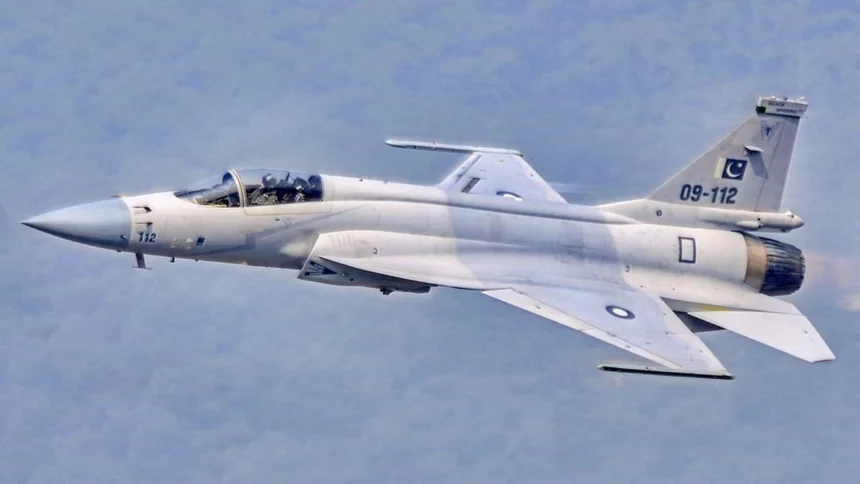
Pakistan’s prime minister Shahbaz Sharif has asserted that global demand for Pakistani-made fighter jets has grown noticeably since the military confrontation with India in May last year, a claim that coincides with reports of Pakistan engaging in negotiations with several countries—particularly Muslim-majority nations—regarding the potential sale of its JF-17 Thunder combat aircraft.
Sharif highlights rising interest in Pakistani jets amid diplomatic and defence negotiations
In remarks delivered in Islamabad, prime minister Shahbaz Sharif stated that interest in Pakistani aerospace products has strengthened following the heightened tensions and aerial engagements with India in 2025. He indicated that several foreign governments were exploring the possibility of acquiring fighter aircraft from Pakistan, although he avoided naming any specific model during his address. His assertion, however, aligns with multiple media reports pointing to the JF-17 Thunder—the lightweight multi-role combat aircraft co-developed by Pakistan and China—as the centrepiece of these discussions.
Sharif’s comments were amplified by state broadcasters, which framed the development as a significant milestone for Pakistan’s defence manufacturing sector. According to reports from Radio Pakistan, foreign delegations have engaged Pakistani authorities to examine potential procurement agreements. While no official list of countries was provided by Sharif, independent reporting across South Asia, the Middle East, and Africa suggests that the JF-17 has become a focal point of Pakistan’s arms diplomacy.
Media outlets widely circulated the names of six Muslim-majority countries—Bangladesh, Sudan, Libya, Saudi Arabia, Iraq, and Indonesia—as potential buyers. These countries, each navigating its own strategic challenges, have shown varying levels of interest in cost-efficient fighter jets that deliver operational utility without the high price tag associated with Western or advanced Russian models.
Indonesia emerged as one of the most prominent potential buyers after its defence minister met Pakistan air chief marshal Zaheer Ahmad Babar Sidhu on 12 January to discuss the acquisition of approximately 40 JF-17 fighter jets. This meeting was reported as part of a broader effort by Indonesia to modernise its air force fleet while balancing cost considerations and geopolitical priorities.
Similarly, Bangladesh has conducted discussions at high-level military channels. A Bangladeshi newspaper revealed that the chiefs of the Pakistan and Bangladesh air forces held talks on the possibility of Dhaka purchasing the aircraft. While Bangladesh has not signed a formal agreement, the existence of these discussions underscores Pakistan’s ambition to expand its defence export footprint in South Asia.
Saudi Arabia has also featured prominently in reported negotiations. According to defence sources, Pakistan explored potential JF-17 sales with Riyadh on 7 January, with reports suggesting that these talks were linked to Saudi Arabia’s $2 billion loan provided to Pakistan. Although the nature of the discussions has not been clearly outlined, such defence conversations usually reflect broader strategic ties between the two nations.
Notably, Pakistan’s military has not issued firm statements confirming deals with Libya or Saudi Arabia, and Bangladesh remains in early-stage discussions. Still, the prospect of these agreements signals Pakistan’s desire to strengthen its defence export portfolio at a time when economic stability is a pressing national priority.
Operational record, foreign interest and technical limitations shape global perception of the JF-17
The JF-17 Thunder is no stranger to foreign markets, having already secured export customers over the past decade. The aircraft currently serves in the air forces of Nigeria, Myanmar, and Azerbaijan, contributing to Pakistan’s growing reputation as an emerging defence supplier. Over time, these sales have helped Islamabad build credibility around the JF-17 platform, presenting it as an affordable yet functional fighter jet for countries seeking a reliable multi-role aircraft.
Interest in the JF-17 received renewed attention after Pakistan reportedly struck a sizeable deal with the Libyan National Army (LNA) in December 2025. According to media reports, the agreement included more than a dozen aircraft at a value of approximately $4 billion, making it the largest arms sale in Pakistan’s history. Although Libya’s political situation complicates international defence transactions, the deal reinforces the aircraft’s appeal among nations with budget constraints or restricted access to Western arms markets.
Pakistan is also reportedly close to finalising a defence deal with Sudan worth around ₹12,500 crore, with JF-17 jets forming part of the expected package. Such agreements, if confirmed, would extend Pakistan’s defence ties into Africa and bolster its geopolitical engagement with nations seeking affordable military hardware.
The JF-17, developed jointly by Pakistan and China in 2007, is a product of the Pakistan Aeronautical Complex and China’s Chengdu Aircraft Corporation. With 58 percent of the aircraft produced in Pakistan and the remaining 42 percent in China, the program strengthens Pakistan’s domestic manufacturing capabilities while leveraging Chinese technology. The jet’s engine—Russia’s Klimov RD-93, and the upgraded RD-93MA for newer variants—is supplied via China, reflecting the collaborative nature of the platform.
Despite its export successes, the JF-17 is not without notable limitations. Analysts frequently point out that the jet’s reliance on a single RD-93 engine constrains its thrust output, particularly when carrying heavy weapons or fuel loads. The aircraft has a limited payload capacity of approximately 3.6 tonnes, forcing pilots to balance between fuel endurance and weapon selection.
The JF-17’s avionics suite has also drawn criticism. Its navigation, communication, and weapons-control systems are often described as outdated compared to modern fighter jets. Additionally, its electronic warfare capabilities are considered average, limiting the aircraft’s ability to detect threats or defend against sophisticated radar and missile systems.
Another major concern lies in maintenance and supply chains. The aircraft depends heavily on Chinese support for spare parts, software upgrades, and system integration. Furthermore, the ongoing Russia-Ukraine war has created uncertainty over the long-term availability of RD-93 engines and spare components.
The JF-17 is not classified as a stealth aircraft, making it more vulnerable to radar detection than newer platforms that incorporate low-observable design features. As global air forces increasingly invest in stealth or semi-stealth fighters, the JF-17 remains positioned as a budget-friendly option rather than a technologically superior one.
Comparisons between the JF-17 and India’s Tejas fighter jet frequently appear in strategic discussions. Tejas is generally considered superior in multiple dimensions, including avionics, cockpit design, sensor fusion, radar technology, and electronic warfare capabilities. Its AESA radar and composite materials contribute to lower radar detectability and improved overall performance.
Nevertheless, the JF-17’s affordability and flexible procurement terms give it an edge in markets where cost is the primary consideration. Many developing nations are unwilling or unable to invest in high-end jets such as the F-16, Rafale, or MiG-29, making the JF-17 a practical alternative that offers acceptable performance at a comparatively low price.
Pakistan has used high-profile military narratives to bolster the aircraft’s image. During an interview with Geo News, foreign minister Khawaja Asif claimed that Pakistan showcased its military capabilities during the May 2025 confrontation with India, implying that Pakistani fighter jets—possibly JF-17s—played an important role.
In August 2025, Pakistan Air Force chief Zaheer Ahmed Babar Sidhu further claimed that the JF-17 was responsible for shooting down Indian aircraft during the conflict. However, Indian air force chief Amar Preet Singh contradicted these claims in October 2025, stating that during Operation Sindoor, Indian jets successfully entered Pakistani airspace, destroyed targets, and downed five Pakistani aircraft, including JF-17s.
The conflicting statements reflect a long-standing pattern in India-Pakistan military narratives, where each side claims operational superiority. Nevertheless, these public assertions have undeniably added to the global visibility of the JF-17, prompting international observers to study the aircraft’s real-world performance.
Shahbaz Sharif’s statement, therefore, arrives at a moment when Pakistan is actively pushing to expand its defence exports while managing economic constraints, geopolitical shifts, and internal military dynamics. Whether the JF-17 program succeeds in converting widespread interest into signed agreements will determine its lasting influence in the global defence market.