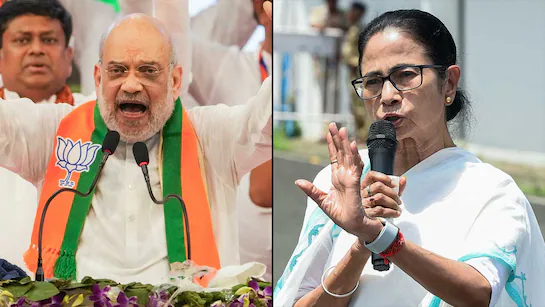
West Bengal chief minister Mamata Banerjee escalated her confrontation with the Union government on Thursday, launching a fierce personal and political attack on Union home minister Amit Shah while warning that the ongoing Special Intensive Revision of voter lists poses a serious threat to the rights of women and marginalised communities. Speaking at a rally in Krishnanagar, she framed the SIR exercise as a politically motivated attempt to influence the 2026 Assembly elections, claiming it was being used to remove legitimate voters from the rolls and intimidate citizens. Her remarks, delivered to an enthusiastic crowd, carried sharp symbolism and invoked mythological imagery to underscore what she described as a battle for the future of Bengal’s democracy and identity.
Political Rhetoric Intensifies as Mamata Warns Women Against Voter List Manipulation
In one of her fiercest critiques yet, Mamata described Amit Shah as “dangerous,” adding that “terror is in his eyes.” Drawing from the Mahabharata, she said, “In one of his eyes you will see Duryodhana, and in the other, Dushasana,” portraying the home minister as embodying tyranny and oppression. The comments marked a significant escalation in Bengal’s political discourse, reflecting deepening distrust between the Trinamool Congress government and the Centre over the handling of the SIR process.
Mamata focused her speech heavily on the role of women, urging them to stay vigilant and resist any attempt by officials to remove their names from the electoral rolls. “In the name of SIR, they will try to snatch away the rights of mothers and sisters,” she said, warning that police forces from Delhi could be deployed during the election period. In a striking appeal, she asked women to defend their voting rights using household tools if necessary. “If your names are cut, use your kitchen utensils and fight. Women will fight from the front, men will stand behind,” she declared. Her rhetoric was designed to mobilise women, who form a crucial voter base for the TMC and have historically responded strongly to her political messaging.
Mamata claimed that the SIR process was being deployed as a political tool to benefit the BJP ahead of the 2026 Assembly polls. She alleged that legitimate Bengali voters were being wrongfully labelled as Bangladeshis and pushed toward detention camps, framing the issue as both an electoral and humanitarian crisis. She also claimed that BJP-backed officers had been sent from Delhi to influence district magistrates and disrupt the impartiality of local administration.
This narrative positions the TMC as the defender of Bengal’s cultural identity and constitutional rights, a strategy Mamata has employed repeatedly during periods of heightened political contestation. Her assertion, “Bengal is different,” sought to reinforce regional pride and collective resistance against what she described as external interference.
Shah Counters Accusations; Communal Flashpoints Add Tension to Bengal’s Political Climate
Amit Shah responded swiftly to Mamata’s accusations. In a post on X, he claimed that her strong opposition to SIR was “an attempt to protect infiltrators.” He argued that the revision exercise was necessary to “save democracy from being polluted,” alleging that certain political parties depended on the votes of illegal entrants and therefore resisted any process aimed at cleaning the electoral rolls. His rebuttal echoed the BJP’s long-standing position that voter list purification is essential to maintaining the integrity of elections.
The debate over SIR, however, is only one part of a broader political climate marked by identity-based tensions and public concern over law and order. Mamata condemned a recent assault on two vendors selling non-vegetarian food at a Gita recitation event in Kolkata’s Brigade Parade Ground. According to police, the victims—one from Topsia and another from Arambagh—were attacked by a group of young men who allegedly threw away their goods and forced them to perform sit-ups. The incident was captured on video, prompting widespread outrage. Three accused individuals, Soumik Goldar, Swarnendu Chakraborty and Tarun Bhattacharya, were arrested based on video evidence.
Mamata warned that such acts of hooliganism would not be tolerated in Bengal. “This is Bengal, not UP. Hooliganism will not be tolerated,” she stated, accusing the BJP of fostering communal division in the state. She reminded the public that “religion is not for dividing but for uniting,” reinforcing her party’s commitment to social harmony and secular governance. Her comments sought to frame Bengal as a state with a long tradition of pluralism, now threatened by extremist influences.
The BJP, meanwhile, maintains that such incidents are isolated and that the TMC’s criticisms are politically motivated. Yet the episode reflects an increasingly charged environment in which cultural events, religious symbolism and political narratives intersect. As Bengal moves closer to a high-stakes election season, both parties are amplifying their messaging, shaping public perception through competing interpretations of security, identity and democratic values.
The SIR debate, while administrative in nature, has evolved into a larger struggle over who defines Bengal’s electorate and whose vision of citizenship prevails. With both sides raising the intensity of their rhetoric, the political landscape is set for deeper confrontation in the months ahead.