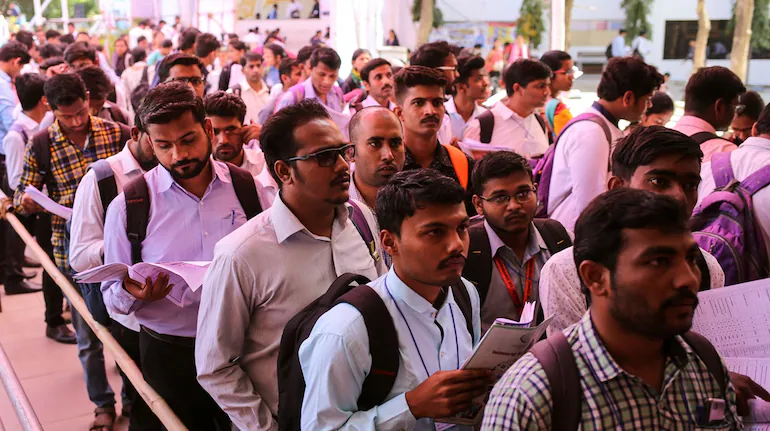
In December 2025, India’s unemployment rate rose slightly to 4.8 percent from 4.7 percent in November, according to recently released monthly labour force data, indicating a modest but notable uptick in joblessness that underscores ongoing challenges in the national labour market, particularly in urban areas where employment has struggled to keep pace with workforce growth.
Marginal rise in national unemployment highlights shifting labour market trends
The latest official figures show that India’s unemployment rate, a measure of the share of people aged 15 and above who are actively seeking work but without a job, increased marginally to 4.8 percent in December 2025, up from 4.7 percent in November as reported by government data released mid-January 2026. This slight rise was anticipated by economists and aligns with projections in several independent polls.
Although the increase appears small at first glance, it reflects underlying dynamics in the labour market that warrant close examination. Urban joblessness in particular has emerged as a key factor driving the overall figure, with urban unemployment rising more noticeably than its rural counterpart. According to detailed breakdowns from labour force surveys, unemployment in cities climbed to approximately 6.7 percent from about 6.5 percent in the previous month, suggesting that urban economies are absorbing new entrants into the workforce more slowly than anticipated and struggling to create jobs at the pace needed to match rising labour supply.
In contrast, rural unemployment remained relatively stable, with figures effectively unchanged month on month. Rural joblessness hovered around 3.9 percent, reflecting a more modest impact of labour market pressures outside urban centres. This divergence between urban and rural employment conditions underscores important structural differences in how jobs are generated across sectors and geographies in India.
Part of the reason for the uptick in the official unemployment rate may be an increase in labour force participation itself, as more people actively look for work. Survey data from December indicates that the labour force participation rate, which measures the share of people either employed or actively seeking employment, crept higher to a level not seen earlier in the year. This suggests that while more individuals are entering or re-entering the workforce with the hope of finding jobs, the pace of job creation has not kept up, at least in the short term, resulting in a modest rise in unemployment.
Such shifts in unemployment are closely watched by policymakers, economists, and business leaders alike, as they offer insight into the health of the economy, the effectiveness of job creation strategies, and the opportunities available to millions of Indians in the workforce. The marginal rise in joblessness also feeds into broader debates about structural reforms, economic growth strategies, and the need to boost employment generation in sectors such as manufacturing, services, and emerging industries.
Youth unemployment — a key concern in a country with a large young population — also edged up slightly in December. In age cohorts typically defined as younger workers, the jobless rate increased modestly, reflecting persistent difficulties in matching skills with available opportunities and the ongoing challenge of creating meaningful work for graduates and early-career professionals.
Another dimension of the changing labour market is variation in jobless rates between male and female workers. While both showed slight increases in unemployment, women continued to experience higher levels of joblessness than men in absolute terms, a pattern that highlights enduring gender disparities in the labour market.
Collectively, these patterns reflect a labour market that is dynamic yet under pressure, with mixed signals of rising participation, stagnating job growth in certain regions, and persistent inequalities in opportunities for different demographic groups.
Underlying forces and implications for India’s employment landscape
To understand what lies behind these headline figures, it is important to look at the broader economic context in which these changes occurred. India’s economy has been navigating multiple forces, including a slowdown in some sectors of growth, shifting patterns of investment, global economic uncertainties, and technological change that affects how companies hire and allocate labour.
Urban areas — which have historically been engines of job creation, especially in services, technology, trade, and manufacturing — are now facing a challenging environment in which new opportunities for employment are not expanding as rapidly as new entrants join the workforce. This phenomenon is partly driven by companies adopting new technologies that automate routine tasks, changing consumption patterns that affect demand for labour, and a cautious business environment amid global economic slowdowns.
Moreover, while the national unemployment rate remains relatively modest by international standards, the slight rise points to a sensitive equilibrium between supply and demand in the labour market. In rural regions, where agricultural and allied activities continue to absorb large segments of the population, the stability of unemployment figures suggests that rural job markets may be functioning differently from their urban counterparts. Continued rural engagement in informal work, seasonal employment, and agricultural labour may help explain why rural unemployment did not rise as sharply.
The increase in labour force participation is an encouraging sign that more Indians are seeking work and willing to engage with the formal economy, but it also places pressure on employers to generate sufficient jobs. If participation continues to rise and work opportunities do not keep pace, the upward pressure on unemployment could persist in future months.
This delicate balance has implications for economic policy and social outcomes. Governments and planners often look at unemployment trends when designing interventions such as skill development programs, incentives for industry growth, and public employment initiatives. Ensuring that growth translates into actual job creation is crucial not just for economic prosperity, but also for social stability and poverty alleviation.
Education and training systems also come under focus as policymakers consider how best to equip young jobseekers with skills that align with evolving industry needs. Efforts to expand vocational training, apprenticeships, and higher education that meets market demands could play a role in improving employability and reducing mismatch in the labour market.
The marginal rise in unemployment may also impact consumption patterns, household incomes, and overall demand in the economy. Households experiencing joblessness or uncertainty may delay expenditures on big-ticket items, affecting sectors such as housing, durable goods, and consumer services.
At the same time, ongoing initiatives to stimulate economic growth — including infrastructure investment, digital economy expansion, and incentives for manufacturing — aim to create a more conducive environment for jobs over the medium term. Whether these efforts translate into sustained employment growth remains a key question for observers of India’s economic trajectory.