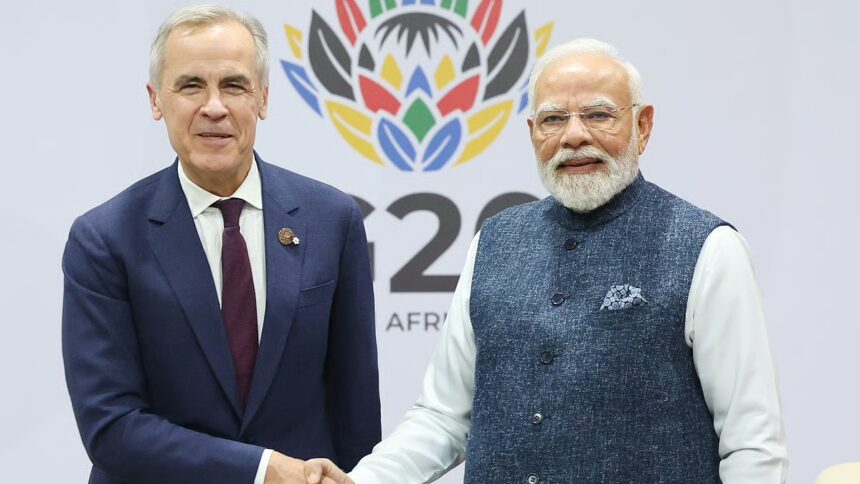
Canadian Prime Minister Mark Carney’s first official visit to India from February 27 to March 2 marks a significant diplomatic moment aimed at revitalizing and deepening the India–Canada strategic partnership. Invited by Prime Minister Narendra Modi, Carney’s trip comes at a crucial juncture when both nations are seeking to stabilise relations, expand economic cooperation, and strengthen engagement across the Indo-Pacific. With meetings scheduled in Mumbai and New Delhi, including delegation-level talks at Hyderabad House and participation in the India–Canada CEOs Forum, the visit reflects a clear intention to reinforce political trust while broadening commercial and strategic collaboration.
Economic diplomacy and strategic partnership at the forefront
The Mark Carney India visit begins in Mumbai, India’s financial capital, underscoring the central role of economic diplomacy in this engagement. By interacting with Indian and Canadian CEOs, industry leaders, financial experts, innovators, educators, and representatives of Canadian pension funds operating in India, Carney signals that trade and investment are key pillars of the renewed bilateral agenda. Such engagements are not merely ceremonial; they serve as practical platforms to identify new opportunities in sectors where both countries possess complementary strengths.
India and Canada share growing economic complementarities. Canada is rich in natural resources, particularly critical minerals that are increasingly vital for clean energy transitions and advanced manufacturing. India, meanwhile, offers a vast market, a dynamic technology sector, and a rapidly expanding industrial base. In recent years, conversations around supply chain resilience, clean energy cooperation, and technology partnerships have gained prominence. The visit is expected to review progress under the India–Canada Strategic Partnership framework and push forward discussions on trade and investment facilitation.
Delegation-level talks between Prime Minister Narendra Modi and Prime Minister Mark Carney, scheduled for March 2 at Hyderabad House in New Delhi, will likely examine both progress and pending challenges in bilateral ties. The India–Canada CEOs Forum, which both leaders will attend, provides a structured channel for business communities to convey policy expectations and explore new avenues of cooperation. Forums of this nature often translate diplomatic goodwill into tangible commercial outcomes.
Key areas identified for discussion include trade and investment, energy collaboration, critical minerals, agriculture, education, research and innovation, and people-to-people ties. Each of these sectors carries strategic significance. Energy cooperation aligns with global climate commitments and the transition toward renewables. Critical minerals partnerships address the growing demand for materials essential to electric vehicles, batteries, and advanced technologies. Agriculture collaboration supports food security and supply chain diversification. Education and research partnerships strengthen long-term institutional bonds and foster innovation ecosystems.
Importantly, the visit also seeks to build upon earlier interactions between the two leaders in Kananaskis in June 2025 and Johannesburg in November 2025. These prior meetings laid the groundwork for a constructive engagement after a period of diplomatic strain. By framing the current visit as a review of progress under the strategic partnership, both governments signal continuity and commitment rather than episodic diplomacy.
The Ministry of External Affairs has described the visit as occurring at an important juncture in the normalisation of India–Canada relations. The emphasis on a constructive and balanced partnership based on mutual respect for each other’s concerns and sensitivities reflects an awareness of past tensions. Diplomatic relationships between large democracies are rarely linear; they evolve through phases of alignment and friction. This visit aims to reaffirm a positive trajectory grounded in shared democratic values, economic interests, and strong people-to-people connections.
Indo-Pacific engagement and diversified global outreach
The Mark Carney India visit is also part of a broader Indo-Pacific tour that includes Australia and Japan, highlighting Canada’s growing strategic interest in the region. The Indo-Pacific has emerged as a central theatre of geopolitical competition and economic dynamism. For Canada, diversifying trade relationships and strengthening security partnerships in this region aligns with its objective of reducing overdependence on traditional markets and enhancing economic resilience.
Following his India engagements, Carney is scheduled to travel to Australia, where he will meet Prime Minister Anthony Albanese. Discussions are expected to focus on defence and maritime security cooperation, critical minerals, trade, and advanced technologies, including artificial intelligence. His planned address to both Houses of the Australian Parliament, the first by a Canadian Prime Minister in nearly two decades, underscores the symbolic importance of this leg of the tour.
The subsequent visit to Japan will involve talks with Prime Minister Sanae Takaichi, with an agenda covering investment ties, clean energy, advanced manufacturing, critical minerals, food security, and security cooperation in support of a free and open Indo-Pacific. By sequencing India, Australia, and Japan in a single tour, Canada demonstrates its commitment to engaging with major Indo-Pacific democracies that play pivotal roles in regional stability and economic integration.
Within this broader framework, India occupies a particularly significant position. As one of the world’s fastest-growing major economies and a key player in regional security architecture, India represents both a strategic partner and an economic powerhouse. The Mark Carney India visit thus functions as both a bilateral reset and a component of Canada’s larger Indo-Pacific strategy.
Carney has stated that Canada is focused on diversifying trade, attracting new international investment, and building resilient partnerships abroad to support economic growth and prosperity at home. This framing reflects a pragmatic approach to foreign policy, where economic objectives are tightly interwoven with diplomatic outreach. India, with its expanding consumer base, technological innovation, and infrastructure ambitions, offers a fertile ground for Canadian investment and collaboration.
People-to-people ties form another enduring pillar of India–Canada relations. A substantial Indian diaspora in Canada has contributed significantly to Canadian society and serves as a bridge between the two nations. Educational exchanges, research collaborations, and cultural linkages reinforce these bonds. Strengthening these connections often helps cushion diplomatic relationships during periods of political tension and provides a foundation for long-term partnership.
Regional and global developments are also likely to feature prominently in discussions. Both India and Canada are members of multilateral forums that address global governance, climate change, economic stability, and security challenges. Coordination on these issues enhances the credibility and effectiveness of their bilateral partnership. As global uncertainties persist, including economic volatility and geopolitical rivalries, countries are increasingly seeking reliable partners with shared democratic values and economic complementarities.
The Mark Carney India visit, therefore, operates on multiple levels. It is a diplomatic effort to consolidate gains under the strategic partnership, an economic mission to expand trade and investment, and a strategic engagement within the evolving Indo-Pacific landscape. By combining high-level political dialogue with business interactions and regional outreach, the visit underscores a comprehensive approach to foreign policy.
As Carney engages with Indian leaders, business communities, and policy stakeholders, the emphasis on mutual respect, balanced engagement, and shared growth will remain central. The reaffirmation of positive momentum in bilateral ties suggests that both governments view this moment as an opportunity to move beyond past frictions and focus on pragmatic cooperation. The outcomes of the meetings in Mumbai and New Delhi may well shape the trajectory of India–Canada relations in the years ahead, embedding economic partnership within a broader strategic vision for the Indo-Pacific.