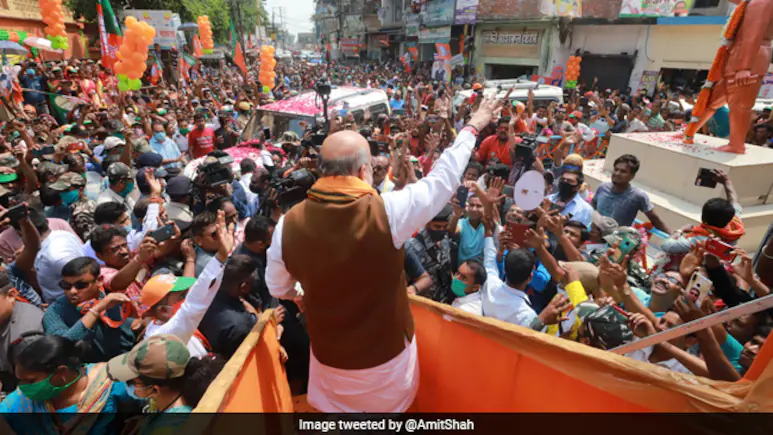
As the West Bengal Assembly elections approach, the Bharatiya Janata Party has unveiled an ambitious statewide campaign strategy centered on nine Parivartan Rath Yatras designed to energise cadres, consolidate support, and project a narrative of political change. The first phase of the yatra will commence on March 1 from multiple constituencies, marking the beginning of a high-intensity outreach effort that echoes the party’s 2021 election playbook. With senior national leaders slated to participate and Prime Minister Narendra Modi expected to address the concluding rally at Kolkata’s Brigade parade ground, the campaign underscores the BJP’s determination to mount a formidable challenge in a state long dominated by the Trinamool Congress.
Organisational momentum and electoral messaging
The BJP Parivartan Rath Yatra West Bengal campaign will unfold in carefully planned phases across diverse regions of the state. The first phase is set to begin from Cooch Behar South, Krishnanagar South, Garhbeta, Raydighi, and Kulti on March 1. The second phase will commence on March 2 from Islampur, Sandeshkhali, Hassan, and Amta. The party has indicated that there will be no yatras on March 3 and 4 due to Holi, with the campaign resuming on March 5.
Between March 5 and March 10, the BJP plans an extensive outreach drive covering over 5,000 kilometres, touching each assembly constituency. The scale of mobilisation is substantial, with around 60 major public meetings and more than 300 smaller gatherings scheduled across the state. Such an expansive travel and meeting schedule reflects a strategy aimed at saturating the political landscape with the party’s message while maintaining sustained visibility in both urban and rural areas.
Senior leaders from the national and state levels are expected to play prominent roles in inaugurating and participating in the yatras. Among those slated to attend are party president JP Nadda, Union Home Minister Amit Shah, Union Defence Minister Rajnath Singh, Union Education Minister Dharmendra Pradhan, Union Minister Nitin Gadkari, Union Minister Shivraj Singh Chouhan, Maharashtra Chief Minister Devendra Fadnavis, and Smriti Irani. Their presence signals the central leadership’s investment in the West Bengal contest and reinforces the perception that the state remains a key electoral battleground.
Prime Minister Narendra Modi’s expected participation in the concluding rally at the iconic Brigade parade ground in Kolkata adds symbolic weight to the campaign. The venue has historically been a stage for major political mobilisations in West Bengal, and the BJP’s choice of location underscores its attempt to project strength and momentum in the heart of the state’s political theatre.
Bengal BJP leader Suvendu Adhikari has emphasised that the initiative is a Parivartan Yatra rather than a traditional Rath Yatra, framing it explicitly as a mission to bring change. According to him, similar strategies have yielded results in other states, and the party now seeks to replicate that success in West Bengal. By branding the campaign around “parivartan,” or change, the BJP aims to tap into anti-incumbency sentiments and position itself as the primary alternative to the ruling establishment.
The organisational focus of the yatra also serves internal objectives. Large-scale campaigns help energise grassroots workers, reinforce booth-level networks, and maintain cohesion among cadres. In a state where political competition is intense and often polarised, visible mobilisation can influence perceptions of viability and strength. The BJP Parivartan Rath Yatra West Bengal effort appears designed to achieve precisely that: to demonstrate organisational muscle while amplifying a consistent political narrative.
Political narrative and confrontation with the ruling establishment
At the heart of the BJP’s campaign is a pointed critique of Chief Minister Mamata Banerjee’s leadership and governance record. West Bengal BJP president Samik Bhattacharya has framed the contest as a battle against what he describes as entrenched corruption. Reflecting on the political shift of 2011, when Mamata Banerjee came to power with the promise of restoring democracy, he argued that one hegemony was replaced by another. He alleged that corruption has become pervasive, claiming that few government offices remain untouched by accusations.
This line of attack is central to the BJP Parivartan Rath Yatra West Bengal narrative. By invoking themes of governance, accountability, and democratic renewal, the party seeks to resonate with voters dissatisfied with the status quo. The repeated emphasis on “change” attempts to transform individual grievances into a broader call for political transformation.
The choice of starting points for the yatras also carries political significance. Constituencies such as Sandeshkhali have recently been in the spotlight, and launching a phase of the campaign from such areas enables the BJP to tie local controversies to its statewide messaging. Similarly, reaching remote and semi-urban constituencies reflects an effort to expand beyond traditional support bases and build cross-regional appeal.
The decision to pause the campaign during Holi reflects sensitivity to cultural and religious observances, while the swift resumption thereafter ensures continuity. The compressed timeline between March 5 and March 10, during which extensive travel and numerous meetings are planned, indicates a high-energy push intended to dominate headlines and public discourse in the run-up to the polls.
West Bengal’s political landscape has historically been shaped by powerful regional forces and ideological currents. For decades, the state was governed by the Left Front before the Trinamool Congress emerged as the dominant force. The BJP’s rise in recent years has altered the competitive equation, transforming what was once a largely bipolar contest into a more complex triangular dynamic in certain constituencies. The Parivartan Rath Yatras represent the party’s attempt to consolidate its gains and convert electoral momentum into a decisive breakthrough.
Mass mobilisation campaigns have long been a feature of Indian electoral politics, serving both symbolic and practical purposes. They create spectacles that draw media attention, foster emotional connections with voters, and offer leaders opportunities to articulate their vision directly to the public. In West Bengal, where political rallies often carry historic resonance, such yatras are also statements of intent.
By deploying nine simultaneous yatras, the BJP signals that it is contesting the election with a full-spectrum strategy rather than a limited or defensive approach. The breadth of participation by senior leaders indicates that the party views West Bengal as a priority state in its broader national calculus. The concluding rally in Kolkata, addressed by the Prime Minister, is likely to be framed as the culmination of a movement rather than a mere campaign event.
The BJP Parivartan Rath Yatra West Bengal initiative thus encapsulates the party’s broader electoral blueprint: a combination of organisational outreach, leadership projection, anti-incumbency messaging, and symbolic mobilisation. As the yatras traverse thousands of kilometres and dozens of constituencies, they will test the party’s ability to convert narrative into numbers and momentum into votes.