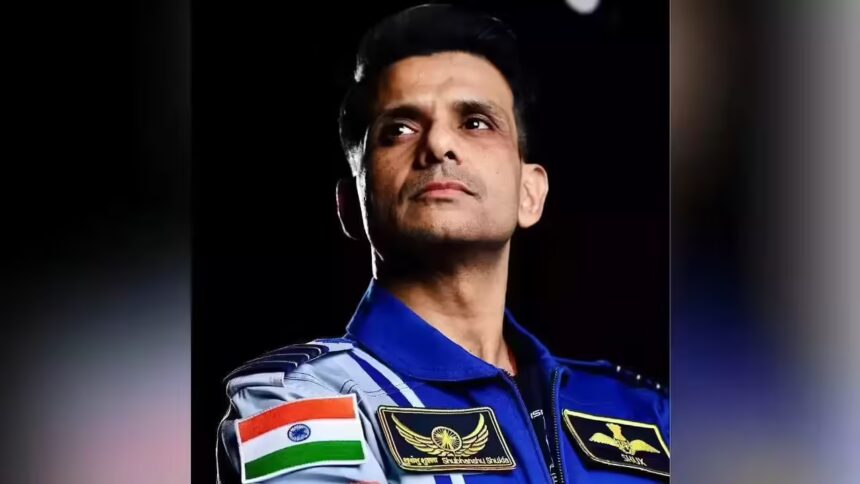
In a landmark moment for India’s journey into space exploration and its vision for a technologically advanced future, the Lok Sabha is set to hold a special discussion honouring astronaut Captain Shubhanshu Shukla. Recently returned from his successful mission to the International Space Station (ISS), Shubhanshu Shukla has captured the imagination of the nation as the first Indian astronaut in over four decades to embark on such a space journey. The session, hailed as a “historic milestone” by Union Parliamentary Affairs Minister Kiren Rijiju, will not only celebrate Shubhanshu Shukla’s achievement but also deliberate upon the crucial role of India’s space programme in shaping the country’s developmental aspirations under the framework of Viksit Bharat by 2047. The honouring of Shubhanshu Shukla in Parliament symbolises India’s renewed commitment to pushing boundaries in science, technology, and space exploration, firmly placing the nation in the global spotlight.
Honouring India’s Astronaut: Symbol of National Pride and Aspirations
Union Minister Kiren Rijiju, while announcing the special session, described the occasion as an extraordinary step in India’s democratic and scientific journey. Writing on X, he called Captain Shubhanshu Shukla “our hero astronaut” and emphasised that Parliament would celebrate his “historic milestone” while also acknowledging India’s growing ambitions in space exploration as an essential component of its vision for a developed nation by the centenary of independence in 2047. Kiren Rijiju’s remarks captured the sentiment that Shubhanshu Shukla’s return to Earth was more than a personal triumph; it was a collective national victory symbolising India’s rising stature in the global scientific and technological community.
Captain Shubhanshu Shukla, who returned on July 15 after participating in NASA’s Axiom-4 (AX-4) mission, has re-ignited widespread excitement about space in India. The last time an Indian astronaut ventured into space was in 1984, when Wing Commander Rakesh Sharma flew aboard the Soviet Soyuz T-11 spacecraft. Shubhanshu Shukla’s successful journey to the ISS therefore represents not only a generational leap but also a reaffirmation of India’s longstanding dream of space exploration. His voyage took off from NASA’s Kennedy Space Centre in Florida on June 25 and concluded with a splashdown off the coast of California on July 15, marking his safe return.
The Lok Sabha Secretariat, in its official agenda, described the special discussion as one dedicated to “India’s first astronaut aboard the International Space Station – the critical role of space programme for Viksit Bharat by 2047.” The framing of the debate underscores the fact that India does not view Shubhanshu Shukla’s achievement in isolation but rather as an integral step in its broader mission of harnessing science and technology to power national development.
Shubhanshu Shukla’s homecoming at Delhi’s Indira Gandhi International Airport was marked by a ceremonious welcome. Among those present were Union Minister Jitendra Singh, Delhi Chief Minister Rekha Gupta, and Shubhanshu Shukla’s family, including his wife and son. The scene at the airport reflected not just pride and relief but also the acknowledgment that his mission has now become part of India’s living history.
For India, Shubhanshu Shukla’s return and subsequent recognition in Parliament constitute both a symbolic and strategic moment. Symbolically, it underscores the idea that Indian scientists, astronauts, and engineers are capable of competing at the highest levels of space exploration. Strategically, it provides momentum to the government’s efforts to build a strong and autonomous space ecosystem, capable of propelling India into a new age of discovery and development.
India’s Space Vision and the Road to Viksit Bharat 2047
The honouring of Captain Shubhanshu Shukla is occurring against the backdrop of India’s long-term vision of becoming a global leader in science and technology. The government’s framing of this event as a milestone for Viksit Bharat by 2047 highlights the broader strategy of linking scientific progress with national development. India, which has already earned global respect for its achievements in space—ranging from the Mars Orbiter Mission to Chandrayaan and Aditya L1—is now aiming to ensure that these milestones contribute directly to economic growth, technological independence, and societal transformation.
Kiren Rijiju noted that the discussion in Parliament would not only focus on honouring Shubhanshu Shukla but also critically assess the role of India’s space programme in achieving developmental targets. The space programme, he said, must be viewed as a foundational pillar of India’s vision of becoming a fully developed nation within the next two decades. His statement captures the essence of India’s developmental model: that space research is not a luxury but a necessity for achieving self-reliance, technological supremacy, and global competitiveness.
The symbolism of Shubhanshu Shukla’s mission resonates particularly strongly because it aligns with India’s new aspirations for space diplomacy and international collaboration. Participation in NASA’s Axiom-4 mission represents not just individual excellence but also institutional cooperation between India and global space agencies. This collaboration highlights India’s intent to be a key stakeholder in global space missions of the future, including long-term habitation projects on the Moon and Mars.
Furthermore, the Lok Sabha’s recognition of Shubhanshu Shukla highlights the democratic and public nature of India’s achievements. By honouring a space explorer within Parliament, the nation underscores that such achievements belong not just to the scientific community but to every citizen. It reflects the understanding that the journey to space is intimately tied to national pride, identity, and progress.
The special discussion comes at a time when India is intensifying its investments in space technology. ISRO is working on a series of ambitious projects, including the Gaganyaan mission that aims to send Indian astronauts into space aboard an indigenous spacecraft. Shubhanshu Shukla’s mission has, in many ways, reinvigorated public enthusiasm for these upcoming ventures, reinforcing the sense that India is on the threshold of a new era in space exploration.
Adding to the significance of the day, two important legislative proposals are also being tabled in Parliament: the Jan Vishwas (Amendment of Provisions) Bill, 2025, introduced by Union Minister Piyush Goyal, and the Indian Institutes of Management (Amendment) Bill, 2025, moved by Union Minister Dharmendra Pradhan. These legislative initiatives, though distinct from the space discussion, together signify a broader governmental effort to strengthen institutional frameworks, both in education and governance, thereby complementing the scientific strides symbolised by Shubhanshu Shukla’s mission.
For the broader public, the story of Captain Shubhanshu Shukla has become a source of immense inspiration. His training, resilience, and successful participation in a high-stakes international mission highlight the strength of Indian human resources in fields that demand not only intellectual brilliance but also immense physical endurance and psychological fortitude. For students and young professionals across the country, his example serves as a reminder that India is no longer a peripheral participant in global science but is steadily moving toward centre stage.
By honouring him in the nation’s highest legislative body, India is effectively placing him alongside the pantheon of individuals whose achievements symbolise the nation’s aspirations. It is not simply an honour for a single astronaut; it is a recognition of the aspirations of millions of Indians who dream of seeing their nation among the leaders of the space age.
The upcoming parliamentary debate is expected to bring together voices from across the political spectrum, all reflecting on the achievements of India’s space programme and the need to further strengthen it. While political contestations dominate much of the parliamentary discourse, the honouring of Shubhanshu Shukla is likely to be an occasion of rare unanimity, with leaders across parties celebrating a moment that belongs to the entire nation.
The space programme, as the Lok Sabha agenda points out, is not only a matter of scientific pride but also a critical instrument for ensuring national development by 2047. This framing connects the extraordinary achievements of individuals like Shubhanshu Shukla with the collective goals of a billion-plus citizens. The discussion will likely emphasise how investments in space exploration can yield benefits for sectors such as agriculture, communication, disaster management, climate monitoring, and national security—fields that directly affect the lives of ordinary Indians.