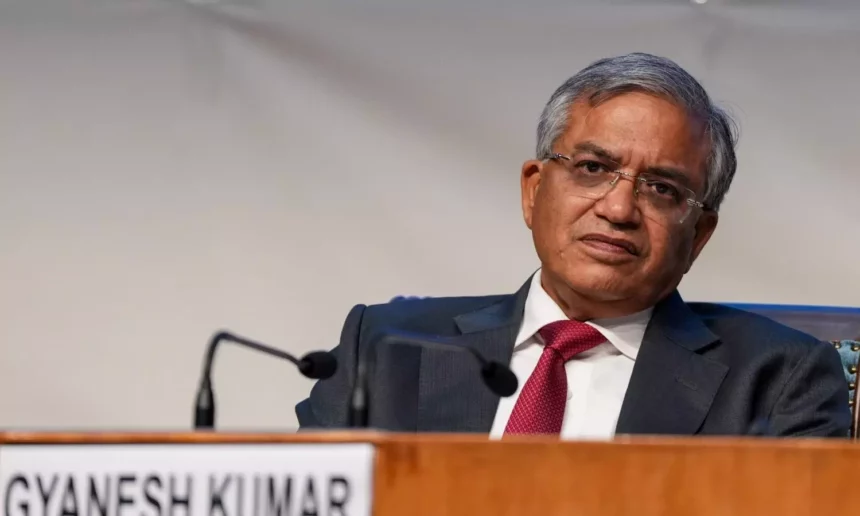
In a dramatic escalation of the political battle over the integrity of India’s electoral system, the Opposition INDIA bloc has announced its intent to bring an impeachment motion against Chief Election Commissioner (CEC) Gyanesh Kumar. The move follows allegations by Congress leader Rahul Gandhi of large-scale voter fraud during the recent Lok Sabha elections, sparking a heated confrontation between the political opposition and the Election Commission of India (ECI). The controversy has now drawn sharp reactions from both sides, raising questions about trust in electoral processes, constitutional accountability, and the balance of power between independent institutions and political leadership.
Opposition Accuses Election Commission of Bias, Moves Towards Impeachment
The genesis of the latest storm lies in Rahul Gandhi’s scathing charge that the ECI facilitated “vote chori” (vote theft) in key states, including Maharashtra, Karnataka, and Haryana. Rahul Gandhi, who now serves as the Leader of Opposition in the Lok Sabha, publicly accused the Commission of manipulating voter rolls and data to secure electoral advantage for the ruling Bharatiya Janata Party (BJP). On August 7, he made a particularly explosive claim: that in the Mahadevapura assembly segment of Bangalore Central, more than one lakh votes were “stolen” to ensure a BJP victory. According to Rahul Gandhi, a detailed analysis carried out by Congress revealed evidence of fraudulent voter registrations, duplicate entries, invalid addresses, and bulk entries such as “80 voters listed under a single address.”
The Congress leader’s allegations have revived an age-old debate about whether the Election Commission remains independent or is susceptible to political influence. Rahul Gandhi framed the matter not merely as electoral malpractice but as institutional collusion, declaring that the ECI was complicit in subverting democracy itself. His remarks, amplified by the INDIA bloc, have pushed the political discourse into uncharted waters.
For the opposition parties, the impeachment notice is both a political statement and a constitutional mechanism. Under Article 324(5) of the Constitution, a Chief Election Commissioner cannot be removed except in the same manner as a Supreme Court judge—by a motion of impeachment passed by Parliament. This is a high bar, requiring a special majority in both Houses, which the Opposition does not possess. Yet, by threatening to invoke such a measure, the INDIA bloc signals both its lack of faith in the institution and its determination to use every possible parliamentary tool to challenge the CEC’s authority.
Congress spokesperson Pawan Khera sharpened the attack by saying that Kumar’s response to Rahul Gandhi’s charges sounded less like that of a constitutional authority and more like that of a BJP spokesperson. “It seemed as though the BJP was speaking through him,” Khera declared, pointing to the Commission’s failure to respond directly to the evidence presented by Rahul Gandhi. RJD leader Manoj Jha also joined the chorus, accusing the Commission of “dodging burning questions.” Meanwhile, JMM MP Mahua Maji demanded that the ECI clarify whether the documents unveiled by Rahul Gandhi—purportedly drawn from official voter lists—were genuine.
The Opposition has framed the issue as not only about electoral irregularities but also about the erosion of institutional credibility. By drawing parallels with past controversies over EVMs, voter rolls, and polling-day irregularities, leaders of the INDIA bloc have argued that a cumulative pattern is emerging: one in which the neutrality of the Election Commission is no longer guaranteed.
Election Commission Pushes Back, Demands Affidavit from Rahul Gandhi
CEC Gyanesh Kumar, visibly agitated by Rahul Gandhi’s charges, convened a press conference in New Delhi where he dismissed the allegations as baseless and damaging to the dignity of the Constitution. Adopting an unusually combative tone, Kumar declared that Rahul Gandhi had only two options: to provide a signed affidavit substantiating his claims or to apologise to the nation. “An affidavit will have to be given or an apology should be made to the country. There is no third option,” Kumar said firmly. He set a deadline of seven days, making it clear that a failure to provide documented evidence would automatically discredit the allegations.
The Commission’s response signaled a strategic shift. Traditionally, the ECI has refrained from engaging in political sparring, choosing instead to issue written clarifications or allow its orders to speak for themselves. Kumar’s combative press conference reflected both the seriousness with which the Commission views the allegations and its intent to push back publicly against attempts to undermine its credibility.
In addressing Rahul Gandhi’s specific claims, Kumar argued that electoral rolls in Maharashtra and Karnataka had been prepared transparently, with ample opportunities for objections during the draft stage. “No objections were raised at the draft roll stage, and even eight months after the election, no substantive proof has been submitted,” he insisted. Dismissing Rahul Gandhi’s repeated charges, Kumar added, “If you keep saying anything ten times or twenty times, it does not become true. The sun rises only in the east; it does not rise in the west just because someone says so.”
On the matter of CCTV and webcasting footage from polling booths, Rahul Gandhi had accused the ECI of destroying potential evidence by limiting storage of recordings to 45 days. Kumar countered this by invoking voter privacy. “Should the Election Commission share CCTV videos of any voter—including their mothers, daughters-in-law, daughters? Would that not be a violation of their right to privacy?” he asked rhetorically. By framing the issue as one of protecting citizens rather than concealing malpractice, Kumar sought to reclaim the moral high ground.
YetRahul Gandhi was quick to hit back, accusing the ECI of double standards. He pointed out that while the Commission was demanding an affidavit from him, it had not sought similar commitments from BJP leaders like Anurag Thakur, who had made comparable allegations in the past. “The Election Commission asks for an affidavit from me. But when Anurag Thakur says the same thing that I am saying, it does not ask for an affidavit from him,” Rahul Gandhi argued, portraying himself as the target of selective scrutiny.
The back-and-forth between the Opposition and the Election Commission underscores the widening trust deficit. At stake is not only the political narrative ahead of upcoming state elections but also the credibility of one of India’s most vital constitutional institutions.
The political reverberations of this confrontation are profound. For the Opposition, the impeachment notice is as much about symbolism as procedure. Even though it is unlikely to secure the parliamentary numbers required to succeed, the very act of moving the motion allows the INDIA bloc to spotlight the erosion of faith in the electoral process. For the ruling party, the controversy provides an opportunity to portray Rahul Gandhi and his allies as habitual critics of institutions whenever electoral outcomes do not favour them.
In the middle of this tug-of-war stands the Election Commission, which is now compelled to defend its authority in the court of public opinion as much as in constitutional law. Kumar’s invocation of the Constitution and his insistence that the ECI “fearlessly stands with all voters without discrimination” are reminders that the credibility of elections is not simply a matter of technical compliance but also of public perception.
As Bihar undergoes a Special Intensive Revision of its electoral rolls, Kumar emphasized that the credibility of “seven crore voters” was being safeguarded through transparent procedures. His remarks, intended to highlight the scale and seriousness of the ECI’s work, also signaled that the Commission is unwilling to allow its legitimacy to be questioned without a fight.
The coming weeks will test whether the Opposition’s impeachment gambit succeeds in keeping the issue alive in Parliament and beyond, or whether the Commission’s forceful counteroffensive blunts the political impact. Either way, the standoff has already set the stage for one of the most contentious debates over India’s democratic institutions in recent memory.