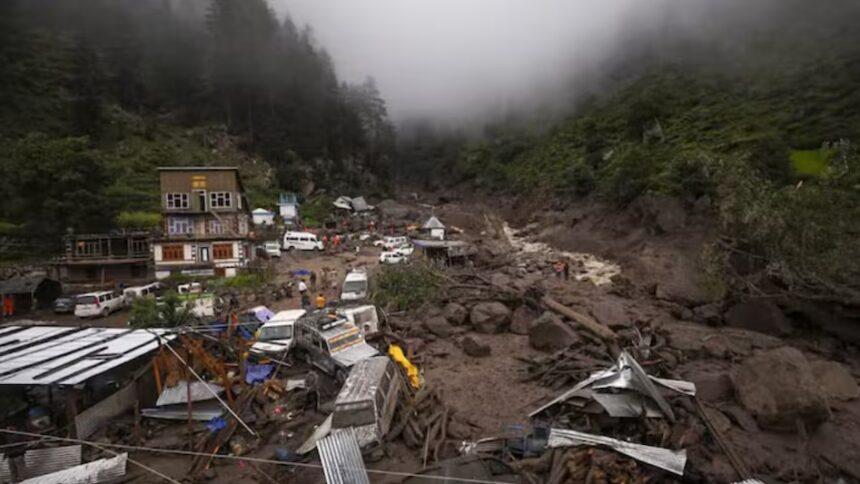
In a catastrophic turn of events, a massive cloudburst struck Chishoti village in Kishtwar district of Jammu and Kashmir, unleashing deadly flash floods that swept through residential areas, religious sites, and key infrastructure. The disaster has left at least 60 people dead, more than 100 injured, and scores missing, with fears that the actual death toll could be significantly higher. Entire houses, makeshift shelters, and vehicles have been reduced to rubble or carried away by raging waters. The incident, which occurred during the Machail Mata Yatra pilgrimage, was captured in multiple videos shared widely on social media, providing a chilling visual record of the sudden destruction and chaos.
The Immediate Impact and Scale of the Destruction
The sheer force of the flash floods following the cloudburst has wreaked havoc across Kishtwar. Initial reports indicate that 16 residential houses and several government buildings have been damaged or destroyed. In addition to the homes, three temples—important religious landmarks for the local community—have been partially or completely swept away. Four traditional water mills, vital for rural livelihoods, were also destroyed, along with a 30-meter-long bridge that served as a crucial transportation link for residents. More than a dozen vehicles, including those of pilgrims attending the Machail Mata Yatra, were overturned or carried off by the surging torrents.
Videos circulating on various platforms reveal the terrifying moments when floodwaters engulfed the area. One clip shows pilgrims and locals screaming, running, and attempting to flee as fast-moving water inundates the streets. Another close-up video captures the unstoppable power of the flood, with trees being uprooted and entire structures collapsing under the water’s impact. The speed of the disaster left little room for escape, and many residents were caught completely off guard.
Tragically, the loss of life includes two personnel from the Central Industrial Security Force (CISF) and a Special Police Officer (SPO) from the local police. Their deaths highlight not only the indiscriminate nature of the calamity but also the dangers faced by those who serve in disaster-prone regions. Families in the area have reported 75 individuals missing, but eyewitness accounts suggest that the number could run into the hundreds. Many victims are feared to have been buried under piles of boulders, logs, and debris carried down by the floodwaters.
Local journalists and agencies have attempted to document the event, with one video from Jammu Links showing an unsteady, chaotic scene—people running in multiple directions, chanting prayers, shouting instructions, and desperately trying to escape the advancing floodwaters. The footage, though not independently verified, adds to the mounting evidence of the overwhelming and sudden nature of the disaster.
Rescue Efforts and Government Response
Rescue operations have been in full swing since the incident, with teams from multiple agencies working tirelessly to locate and assist survivors. Officials from the region have confirmed that as of the latest count, 167 people have been pulled from under debris, with 38 of them in serious condition and requiring urgent medical care. The operation is being hampered by the difficult terrain, the volume of debris, and the continuing threat of additional rain or landslides.
The magnitude of the disaster has prompted a swift response from the highest levels of government. Jammu and Kashmir Chief Minister Omar Abdullah has been in direct communication with Union Home Minister Amit Shah and Prime Minister Narendra Modi. Abdullah shared that the Prime Minister expressed deep grief over the loss of lives and assured that the Centre would provide every possible form of assistance to the state. “The Prime Minister assured that there will be no shortage of support from the Centre for whatever assistance we require,” Abdullah stated, emphasising that the response would be comprehensive and sustained.
In addition to the rescue operations, there are growing concerns about the safety of other villages located along similar flood-prone slopes and river valleys in the region. Experts have pointed out that climate change and increasingly erratic weather patterns may be contributing to the frequency and intensity of such disasters. The cloudburst in Kishtwar follows several similar incidents in Jammu and Kashmir over the past decade, underlining the urgent need for advanced early warning systems and disaster preparedness infrastructure.
The damage to infrastructure is extensive and will require significant resources to repair. The destruction of the bridge in particular has cut off critical access routes, complicating the delivery of aid and the evacuation of affected individuals. Temporary shelters have been established for displaced families, but local authorities warn that the number of those needing shelter, food, and medical assistance is likely to rise as more areas are reached and assessed.
Survivors have described harrowing experiences of clinging to trees, rooftops, or higher ground for hours before rescue teams arrived. In some cases, entire families were separated in the chaos, with relatives still searching desperately for loved ones. The psychological toll on the community is immense, with many having lost not just their homes but also their livelihoods, as agricultural fields and small businesses have been obliterated by the floodwaters.
The incident has also raised questions about the safety measures in place for large public gatherings and religious pilgrimages such as the Machail Mata Yatra. While local authorities have traditionally deployed security and medical teams along the pilgrimage routes, the sheer unpredictability of natural disasters like cloudbursts poses a significant challenge to ensuring the safety of large groups in remote, mountainous regions.
As relief and rescue efforts continue, there is a palpable sense of urgency among both officials and residents to account for the missing and stabilise the situation on the ground. For now, the focus remains on saving lives, clearing debris, and restoring essential services to the devastated areas. The people of Kishtwar are facing a long road to recovery, but the outpouring of support from across the country offers some measure of solace amid the overwhelming tragedy.