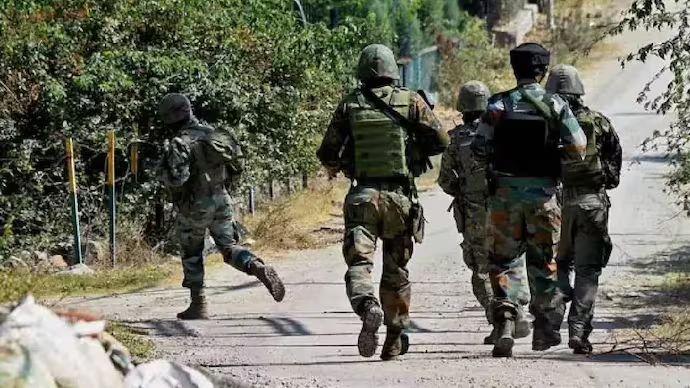
In a sharp escalation of counter-terror operations across Jammu and Kashmir, Indian security forces on Saturday gunned down a terrorist during an intense overnight encounter in Kulgam district. The operation, codenamed ‘Operation Akhal’, marked the third significant counter-insurgency action in just seven days, reflecting the heightened alertness of the forces and the growing frequency of confrontations near the Line of Control (LoC) and deep within Kashmir’s forested interiors.
The Kulgam encounter unfolded as part of a continuing offensive to thwart militant threats in the region. It followed two high-profile operations—‘Operation Shivshakti’ in Poonch and ‘Operation Mahadev’ near Srinagar—that collectively led to the elimination of six terrorists, all reportedly linked to cross-border infiltration and past attacks in Kashmir. With the latest operation, the Indian Army appears to be tightening its grip over insurgent activity, especially from Pakistan-based groups like Lashkar-e-Taiba, which remain active in the valley.
Overnight firefight in Kulgam ends with militant neutralised
The encounter in Kulgam began late Friday evening and continued through the night, with security forces exchanging intermittent but heavy fire with the hidden militant. According to the Indian Army’s Chinar Corps, troops remained in close contact with the terrorist and responded with “calibrated fire”, carefully advancing their position while ensuring minimal collateral damage. By early Saturday, one terrorist had been neutralised. His identity and affiliation are yet to be officially confirmed, but preliminary indications suggest links to one of the Pakistan-backed terror outfits operating in the area.
The army has not yet declared the operation fully concluded, indicating that a combing operation is underway to rule out the presence of more armed militants in the vicinity. The location of the operation—dense, mountainous terrain of Kulgam—has often served as a hideout for militants seeking to evade detection by security forces. Such terrain has historically posed operational challenges, making the success of the current operation even more significant.
This fresh encounter comes at a time when intelligence inputs suggest a spike in infiltration attempts from across the LoC, especially in the wake of increased deployment by the Pakistan Army along forward positions. With the onset of monsoon, thick vegetation provides added cover for terrorist movement, prompting Indian forces to intensify surveillance and field action across sensitive zones.
Pattern of back-to-back operations signals strategic shift
The success of Operation Akhal is the latest in a series of aggressive counter-insurgency actions seen over the past week. On Wednesday, security forces launched ‘Operation Shivshakti’ in Jammu and Kashmir’s Poonch district, along the LoC. That operation began on Tuesday night after Indian troops detected movement along the border in the Kalsian-Gulpur area—an infiltration hotspot.
The terrorists engaged in that encounter reportedly opened fire when challenged, triggering a fierce gun battle that lasted several hours. Two militants were eliminated in the exchange. Army officials indicated that the terrorists were trying to cross into the Indian side and may have had plans to target military or civilian installations.
Just days earlier, another significant encounter had unfolded on July 28 in the forested Lidwas area near Harwan, located on the outskirts of Srinagar. The operation, named ‘Operation Mahadev’, saw the killing of three terrorists, all described as senior operatives of Lashkar-e-Taiba. Among them was a key figure identified as Suleiman, reportedly the mastermind behind the April 22 Pahalgam terror attack, in which several security personnel were injured.
Two other terrorists killed in the same operation—codenamed Afghan and Jibran—were believed to be seasoned militants with training in guerrilla tactics and high-value target execution. The three had been hiding in thick foliage near Harwan, using the forest cover to evade drone surveillance and thermal imaging. Their elimination has been hailed as a major breakthrough in efforts to dismantle Lashkar’s operational backbone in the Valley.
What links these operations is not just their frequency, but their geographic spread and precision. From forest interiors near Srinagar to the rugged LoC terrain in Poonch and the volatile zones of Kulgam, the Indian Army’s response has become more synchronised, swift, and intelligence-driven.
According to officials involved in the planning of these operations, this multi-pronged approach is aimed at preemptively disrupting any terror plots being hatched ahead of India’s upcoming festival and tourist season—a time when militant activity often spikes to undermine public confidence and attract global attention.
While details remain classified, defence sources have hinted at a recent improvement in technical surveillance and cross-agency coordination, enabling faster mobilisation of troops and more accurate real-time tracking of terrorist movement. This explains the reduced reaction time and higher success rate in recent encounters.
With one militant down in Kulgam and area domination operations underway, it’s clear that Operation Akhal is far from an isolated mission. It represents a larger strategic pivot where security forces are taking the fight deep into the suspected safe zones of militants, leaving little room for regrouping or retaliation. The absence of civilian casualties or collateral damage in these recent missions also underlines a more measured, calculated approach, where neutralising threats is balanced with preserving local trust.
The coming days are expected to remain tense across several sectors in Kashmir, with army and paramilitary personnel maintaining high alert and conducting continuous patrols. For now, the message from the ground is clear: any attempt at infiltration or disruption will be met with swift and decisive action.