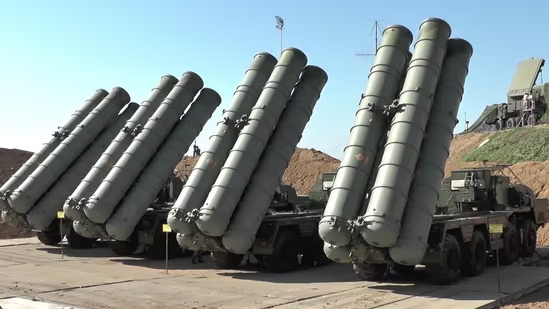
In a significant step towards bolstering national defence against evolving aerial threats, India has unveiled Mission Sudarshan Chakra—a comprehensive, multi-layered security architecture designed to detect, intercept, and neutralise any hostile airborne strike before it can inflict damage. Announced by Prime Minister Narendra Modi during his Independence Day address, this mission represents a fusion of advanced surveillance technologies, long-range interceptor missiles, and real-time intelligence coordination. Its objective is not only to safeguard Indian skies from ballistic missiles, drones, and rockets but also to enable swift retaliatory strikes, taking the fight deep into enemy territory. The system will integrate cutting-edge radar networks, satellite-based inputs, airborne early warning aircraft, and unmanned aerial vehicles (UAVs) into a single, seamless shield that will cover the entire nation by 2035.
Strategic Imperative Behind Mission Sudarshan Chakra
The conceptualisation of Mission Sudarshan Chakra comes at a critical juncture in India’s security landscape. In recent years, the aerial threat spectrum has expanded far beyond conventional ballistic missile attacks to include precision-guided munitions, multiple independently targetable reentry vehicles (MIRVs), kamikaze drones, hypersonic glide vehicles, and advanced cruise missiles. Pakistan’s recent operational advancements have heightened the urgency for a robust, integrated defence system. Most notably, the development of the Ababeel medium-range ballistic missile—with a 2,200-kilometre range and MIRV capability—poses a significant strategic challenge. Such systems can release multiple warheads after re-entry, each capable of striking a separate target, thus overwhelming traditional missile defence measures.
The immediate trigger for accelerating Sudarshan Chakra’s development was the experience during Operation Sindoor, when Pakistan launched nearly 1,000 projectiles at India, including ballistic missiles, Chinese-origin anti-ship missiles, and armed drones. While India’s existing air defence systems, such as surface-to-air missiles and anti-aircraft guns, intercepted many of these threats, some were neutralised through electronic warfare measures like jamming enemy command and control systems. This mixed success underscored the need for a far more sophisticated and layered defence capability—one that can engage incoming threats at multiple stages, from boost phase to terminal descent, ensuring minimal risk to civilian and military assets.
International developments have also influenced India’s strategic thinking. Earlier this year, Israel’s Iron Dome successfully intercepted 498 out of 500 ballistic missiles fired by Iran, demonstrating the effectiveness of an integrated, multi-layered defence network. Indian planners view Sudarshan Chakra as the domestic equivalent of such a system, but with added offensive capabilities to impose costs on the adversary immediately after or even during an attack.
The mission has been shaped through collaboration between top national security planners, the Defence Research and Development Organisation (DRDO), and missile scientists. It aims to create an overarching shield for the country’s vast landmass, its major population centres, and critical infrastructure. Unlike isolated defence systems, Sudarshan Chakra will act as a centralised command-and-control network, integrating real-time data from long-range radars, satellites, UAVs, and airborne early warning platforms. Once a threat is detected, command centres will quickly decide whether to neutralise the projectile with precision interceptors or divert it away from populated areas.
Offensive and Defensive Dimensions of the Mission
While much of the public discourse on Mission Sudarshan Chakra has focused on its defensive aspects, Indian planners have made it clear that this system is equally about deterrence and retaliation. Prime Minister Modi’s statement during his Independence Day address—emphasising that “all public places will be covered by an expanded nationwide security shield by 2035”—signals a determination to make India’s aerial defence both comprehensive and proactive.
On the defensive front, the mission will deploy a range of interceptors with varying ranges and payloads to handle threats across different altitudes and speeds. These will include extended-range systems being developed under DRDO’s Project Kusha for deployment by the Indian Air Force and Navy by 2030. By combining short-, medium-, and long-range interceptor missiles with advanced radar coverage, the network will be capable of engaging multiple incoming threats simultaneously.
Crucially, Sudarshan Chakra will incorporate the ability to intercept MIRV-equipped missiles before the warheads separate, significantly reducing the risk of multiple simultaneous impacts on different targets. This capability requires not just advanced missile technology but also a highly responsive sensor network capable of tracking fast-moving targets in real time.
On the offensive side, India is already working on an array of precision strike weapons that complement the defensive shield. Missiles such as the Pralay (short-range ballistic missile) and Nirbhay (long-range cruise missile) are being developed to penetrate enemy defences and strike high-value targets. The Indian Navy, in particular, is expected to benefit from long-range missile systems capable of hitting enemy vessels and land-based installations from standoff distances.
During Operation Sindoor, Pakistani forces deployed a variety of weapon systems, including Chinese CM-400 AKG anti-ship missiles launched from JF-17 fighters and Turkish-made Yiha drones with multi-role payloads. India’s ability to neutralise these threats demonstrated the efficacy of its existing air defence network, but Sudarshan Chakra aims to elevate this capability to a level where interception rates approach near-total success while enabling immediate counterstrikes.
National security planners stress that this dual capability—defence and offence—is critical for credible deterrence. The knowledge that any hostile act will trigger not only the failure of the attack but also a devastating counterstrike serves as a powerful disincentive for adversaries. This strategic posture aligns with India’s broader doctrine of maintaining escalation dominance, ensuring that it can control the tempo and intensity of any conflict scenario.
Another key element of Sudarshan Chakra is its adaptability to technological advancements. As adversaries develop hypersonic weapons and stealthier drones, the system will be designed for rapid upgrades in both sensor and interceptor technology. Artificial intelligence and machine learning will play a significant role in threat assessment, target prioritisation, and engagement decisions, reducing human reaction time and improving overall system efficiency.
From a geopolitical perspective, Mission Sudarshan Chakra also signals India’s intent to achieve greater strategic autonomy. While the country may collaborate with international partners for specific technologies, the core architecture will be indigenously developed, ensuring that operational control remains entirely in Indian hands. This independence is vital in a security environment where external suppliers may impose restrictions during times of crisis.
Mission Sudarshan Chakra represents a transformative step in India’s defence posture. By combining cutting-edge defensive measures with potent offensive capabilities, it seeks not only to shield the nation from aerial attacks but also to deter adversaries through the promise of swift and overwhelming retaliation. The integration of satellite intelligence, long-range radars, airborne early warning systems, and multi-range interceptor missiles into a unified, AI-enhanced network will mark a new era in Indian strategic defence. With full nationwide deployment targeted for 2035, Sudarshan Chakra is poised to become the backbone of India’s aerial security in an increasingly contested geopolitical landscape.